Collision theory
Definition
Collision theory
The theory that reactant particles must collide with energy equal to or greater than the activation energy for a reaction to take place.
Definition
Successful collision
A collision between reactant particles with energy equal to or greater than the activation energy, so that the particles react.
Definition
Activation energy
The minimum energy that colliding particles must have to react, given the symbol EaE_aEa.
- For a reaction to happen, the reactant particles must first collide with each other.
- Most collisions do not lead to a reaction, because the particles do not have enough energy and simply bounce apart.
- A collision only leads to a reaction if the colliding particles have kinetic energy equal to or greater than the activation energy, EaE_aEa.
- The rate of reaction depends on the number of successful collisions per unit time.
- Four ideas are used to explain changes in rate:
- The number of particles per unit volume, which describes how crowded the reacting particles are.
- The frequency of collisions, which is the number of collisions between particles per unit time.
- The kinetic energy of the particles, which increases as they move faster.
- The activation energy, which is the energy barrier that colliding particles must overcome.
Concentration and pressure
- Increasing the concentration of a solution increases the number of particles per unit volume.
- The particles are closer together, so they collide more frequently.
- More frequent collisions mean more successful collisions per unit time, so the rate increases.
- Increasing the pressure of a gas squeezes the same number of particles into a smaller volume, which also increases the number of particles per unit volume.
- The gas particles therefore collide more frequently, so the rate increases in the same way as for concentration.
- Neither change gives the particles more energy, so the proportion of collisions that are successful stays the same.
Surface area
- Only the particles on the surface of a solid can collide with particles of the other reactant.
- Cutting a solid into smaller pieces exposes more of its particles at the surface.
- More particles are available to collide, so there are more frequent collisions and the rate increases.
- The energy of the particles does not change, so it is the frequency of collisions, not the proportion that succeed, that increases.
Temperature
- Increasing the temperature gives the particles more kinetic energy, so they move faster.
- Faster particles collide more frequently.
- A greater proportion of the particles also have energy equal to or greater than the activation energy.
- A greater proportion of collisions are therefore successful, so there are many more successful collisions per unit time.
- The increase in the proportion of successful collisions is the bigger effect, which is why a small rise in temperature can make a large difference to the rate.
Example
Explaining a faster rate at a higher temperature
- Marble chips react with hydrochloric acid more quickly at 40 ∘C40\ ^\circ\text{C}40 ∘C than at 20 ∘C20\ ^\circ\text{C}20 ∘C.
- At 40 ∘C40\ ^\circ\text{C}40 ∘C, the acid particles have more kinetic energy and move faster.
- They collide with the surface of the marble more frequently.
- A greater proportion of these collisions have energy equal to or greater than the activation energy.
- There are more successful collisions per unit time, so carbon dioxide is given off more quickly.
Catalysts and activation energy
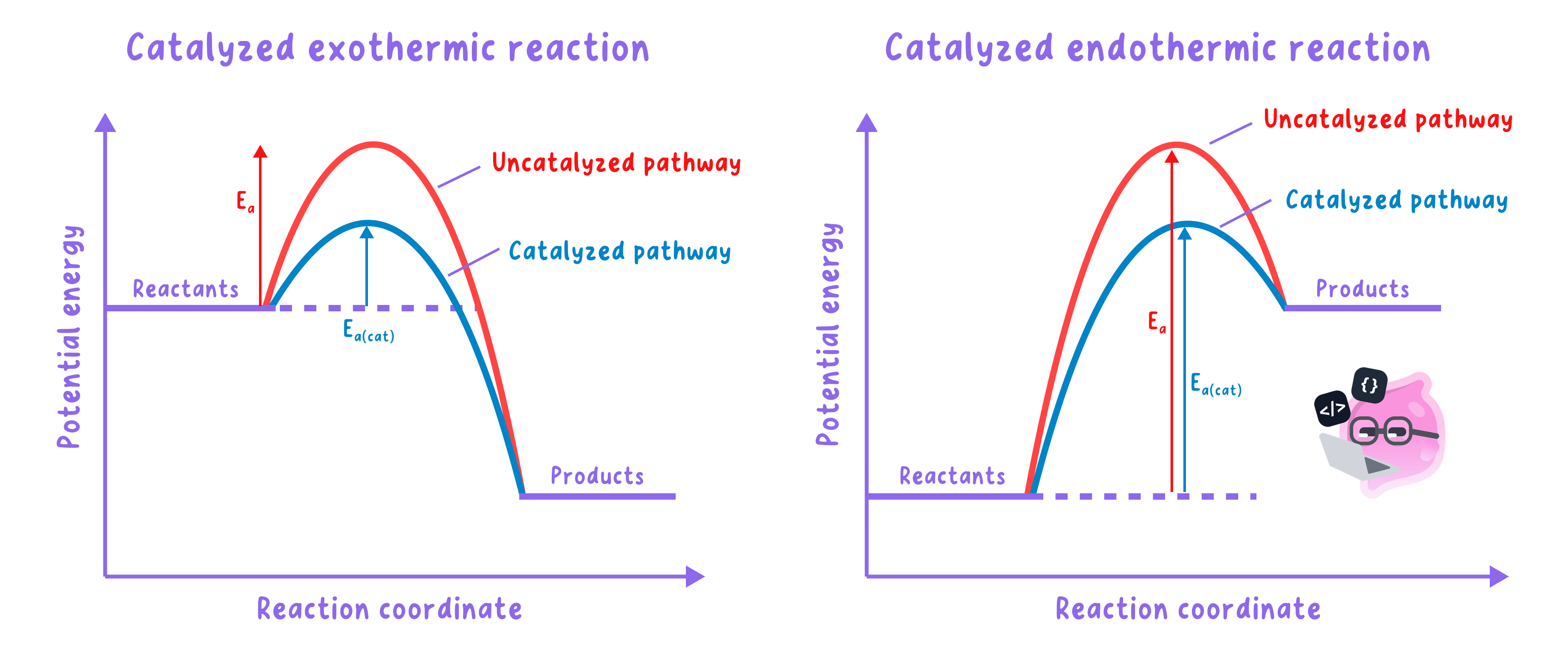
- A catalyst provides an alternative reaction pathway with a lower activation energy.
- The energy of the particles is unchanged, but a greater proportion of collisions now have energy equal to or greater than the lower activation energy.
- There are more successful collisions per unit time, so the rate increases.
- On a reaction pathway diagram, the catalysed pathway has a lower peak, while the energies of the reactants and products stay the same.
- The overall energy change of the reaction, ΔH\Delta HΔH, is therefore the same with or without the catalyst.
- Enzymes work in the same way, lowering the activation energy of reactions in living cells so that they are fast at body temperature.
- At high temperatures an enzyme's structure changes, so it can no longer provide the lower-energy pathway.
- Removing a catalyst means the reaction must again follow the pathway with the higher activation energy, so the rate falls.
Evaluating methods for measuring rate
- Gas syringe: this measures the volume of gas directly, usually to the nearest 1 cm31\ \text{cm}^31 cm3, and works for any gas.
- Some gas escapes in the moment between adding the reactant and fitting the bung, so the first readings are slightly low.
- A syringe can stick, and it cannot hold more than its maximum volume, often 100 cm3100\ \text{cm}^3100 cm3.
- Upturned measuring cylinder or burette over water: this is cheap and simple to set up.
- It is unsuitable for gases that dissolve in water, such as carbon dioxide or ammonia, because some of the gas dissolves instead of being collected.
- Loss in mass on a balance: this is quick to read and can record many readings, especially with a balance linked to a computer.
- It works well for carbon dioxide, which has Mr=44M_r = 44Mr=44, because the mass lost is large enough to measure.
- It works poorly for hydrogen, which has Mr=2M_r = 2Mr=2, because the mass lost is too small to measure accurately.
- A cotton wool plug is needed so that acid spray does not escape and add to the loss in mass.
- Disappearing cross: this needs very little apparatus.
- Deciding when the cross disappears is a judgement, so the timings vary between observers.
- It gives only one time for each experiment, rather than a full curve showing how the rate changes.
- Ways to improve any of these methods include:
- Repeating each experiment and calculating a mean, so that unusual results can be spotted and ignored.
- Using a water bath so that the temperature stays constant.
- Using a light sensor and data logger in place of the eye for the disappearing cross.
- Hanging the solid on a thread or placing it in a small tube inside the flask, so that the bung is already in place when the reaction starts.
Example
Choosing a method for a small amount of hydrogen
- 0.13 g0.13\ \text{g}0.13 g of zinc reacts with excess dilute sulfuric acid.
- The amount of zinc is found from its mass and ArA_rAr.
- One mole of zinc gives one mole of hydrogen, so 0.0020 mol0.0020\ \text{mol}0.0020 mol of hydrogen forms.
- A volume of 48 cm348\ \text{cm}^348 cm3 fits easily in a 100 cm3100\ \text{cm}^3100 cm3 gas syringe, but a mass change of 0.0040 g0.0040\ \text{g}0.0040 g is too small to detect on a balance reading to 0.01 g0.01\ \text{g}0.01 g, so the gas syringe is the better method.
Exam technique
Writing collision theory explanations
- Mark schemes give separate marks for each link in the explanation, so write out every step.
- For concentration or pressure, write that there are more particles per unit volume, so there are more frequent collisions.
- For temperature, write that particles have more kinetic energy, collide more frequently, and that a greater proportion of collisions have energy greater than or equal to the activation energy.
- For a catalyst, write that it lowers the activation energy by providing an alternative pathway, so a greater proportion of collisions are successful.
- Write “more frequent collisions” or “more collisions per unit time”, because “more collisions” on its own is often not enough.
- When you evaluate a method, give a reason linked to the actual reaction, such as “carbon dioxide dissolves in water”.
Common Mistake
- Do not write that a catalyst gives the particles more energy.
- Do not write that raising the temperature lowers the activation energy, because the activation energy does not change.
- Do not write that particles collide harder at a higher concentration, because concentration changes how often particles collide, not their energy.
Self review
- What two conditions must be met for a collision to be successful?
- Why does increasing the pressure of a gas increase the rate of reaction?
- Give the two reasons why increasing temperature increases the rate of reaction.
- How does a catalyst increase the rate of a reaction?
- Why is measuring loss in mass a poor method for a reaction that gives off hydrogen?
