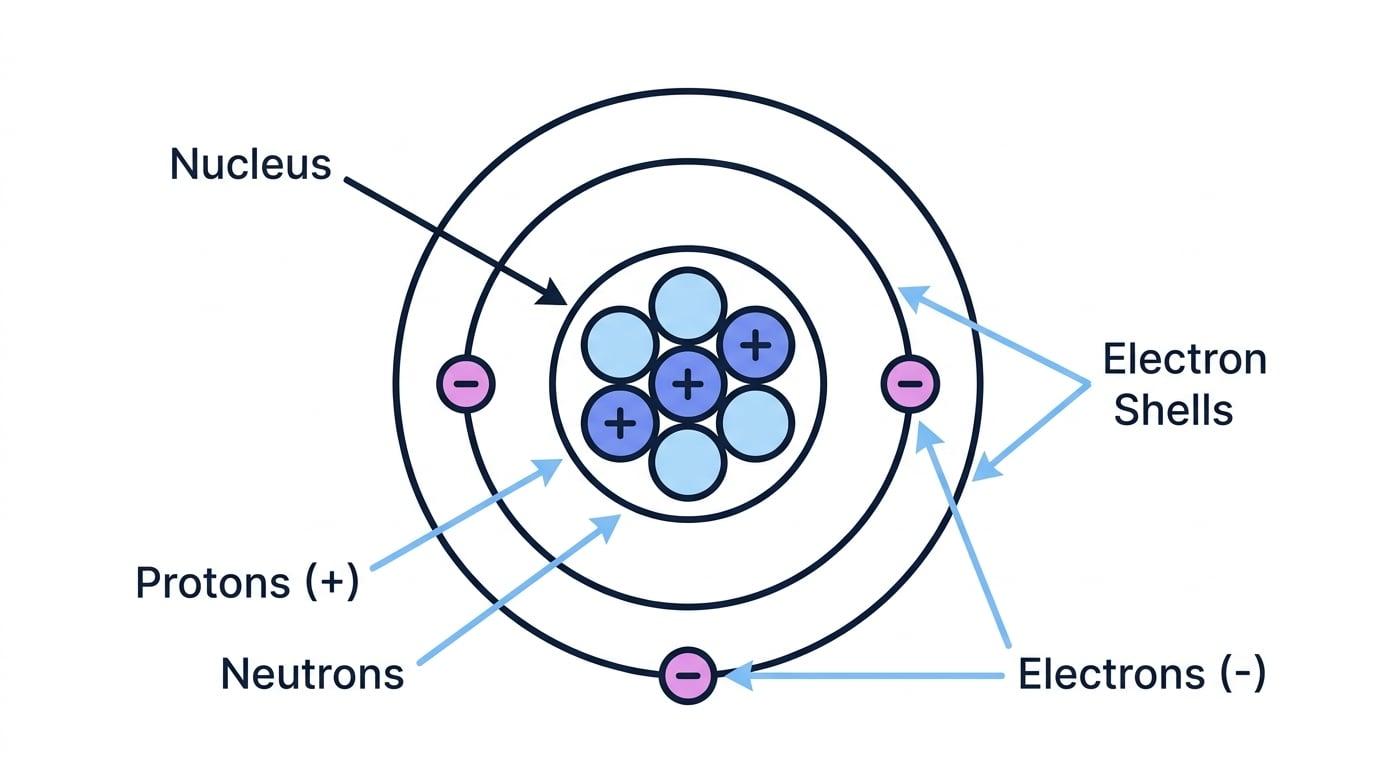
2.2.1 Atomic structure
The structure of an atom
Nucleus
The very small, dense centre of an atom, which contains the protons and neutrons.
Electron shell
A region around the nucleus of an atom in which electrons are found, with each shell able to hold only a limited number of electrons.
- Every atom has a tiny central nucleus with electrons moving around it.
- The nucleus contains two kinds of particle, protons and neutrons.
- The electrons are arranged in electron shells, which surround the nucleus at increasing distances from it.
- The nucleus is extremely small compared with the whole atom, so most of the volume of an atom is empty space through which the electrons move.
- If an atom were enlarged to the size of a football stadium, its nucleus would be about the size of a pea on the centre spot.
- Almost all the mass of an atom is concentrated in its nucleus, because protons and neutrons are far heavier than electrons.
- The positively charged nucleus attracts the negatively charged electrons, and this attraction holds the electrons in the atom.
Protons, neutrons and electrons
Proton
A positively charged particle in the nucleus of an atom, with a relative mass of 111 and a relative charge of +1+1+1.
Neutron
An uncharged particle in the nucleus of an atom, with a relative mass of 111 and a relative charge of 000.
Electron
A negatively charged particle found in the shells around the nucleus, with a relative mass of 11840\frac{1}{1840}18401 and a relative charge of −1-1−1.
- The real masses and charges of these particles are extremely small, so chemists compare them using relative mass and relative charge.
- Relative values compare each particle with a proton, which is given a relative mass of 111 and a relative charge of +1+1+1.
- A proton is found in the nucleus and has a relative mass of 111 and a relative charge of +1+1+1.
- A neutron is found in the nucleus and has a relative mass of 111 and a relative charge of 000, so it is neutral.
- An electron is found in the shells and has a relative mass of 11840\frac{1}{1840}18401 and a relative charge of −1-1−1.
- The mass of an electron is so small that it is often described as negligible, meaning it is almost nothing compared with the mass of a proton or a neutron.
- The charge on an electron is the same size as the charge on a proton but opposite in sign, so one electron exactly cancels the charge of one proton.
- An atom has no overall charge, because it contains equal numbers of protons and electrons.
- A carbon atom has 6 protons with a total charge of +6+6+6 and 6 electrons with a total charge of −6-6−6, giving an overall charge of 000.
Proton number and mass number
Proton number
The number of protons in the nucleus of an atom, also known as the atomic number.
Mass number
The total number of protons and neutrons in the nucleus of an atom, also known as the nucleon number.
- The proton number is the number of protons in the nucleus of an atom, and it is also called the atomic number.
- The proton number identifies the element, so every atom with 6 protons is a carbon atom and every atom with 11 protons is a sodium atom.
- The Periodic Table lists the elements in order of increasing proton number, starting with hydrogen, which has a proton number of 111.
- Protons and neutrons are together called nucleons, because they are the particles found in the nucleus.
- The mass number is the total number of protons and neutrons in the nucleus of an atom, and it is also called the nucleon number.
- Electrons are not counted in the mass number, because their mass is negligible.
- In a neutral atom, the number of electrons is equal to the proton number.
- The number of neutrons in an atom is found by subtracting the proton number from the mass number, number of neutrons=mass number−proton number\text{number of neutrons}=\text{mass number}-\text{proton number}number of neutrons=mass number−proton number.
Counting the particles in an atom
- An atom of sodium has a proton number of 11 and a mass number of 23.
- The proton number gives the number of protons, so the atom contains 11 protons.
- The atom is neutral, so it also contains 11 electrons.
- The neutrons are the nucleons that are not protons.
- An atom of argon has a proton number of 18 and a mass number of 40, so it contains 18 protons and 18 electrons.
- Do not give an electron a relative mass of 000, because its relative mass is 11840\frac{1}{1840}18401, which is very small but not zero.
- Do not include electrons in the mass number, because the mass number counts only the protons and neutrons in the nucleus.
- Do not say that the number of neutrons identifies an element, because only the proton number does this.
Writing the definitions
- Learn the definitions of proton number and mass number word for word, because each one is usually worth a mark on its own.
- Always include the words nucleus and atom, because an answer such as the number of protons on its own is incomplete.
- When you give a relative charge, include the sign as well as the number, such as +1+1+1 for a proton and −1-1−1 for an electron.
- When completing a table of particles, check that the number of protons plus the number of neutrons equals the mass number.
- Where in an atom are protons, neutrons and electrons found?
- State the relative mass and relative charge of an electron.
- Define mass number.
- Why does an atom have no overall charge?
- How many neutrons are in an atom with a proton number of 13 and a mass number of 27?
2.2.2 Electronic configuration and the Periodic Table
Electronic configuration
Electronic configuration
The arrangement of electrons in the shells of an atom or ion, written as the number of electrons in each shell starting from the shell nearest the nucleus.
- The electrons in an atom occupy electron shells around the nucleus, and each shell can hold only a limited number of electrons.
- Electrons fill the shell closest to the nucleus first, and a new shell only starts once the shell inside it is full.
- For the elements with proton numbers 1 to 20, the shells fill in a fixed pattern.
- The first shell holds a maximum of 2 electrons.
- The second shell holds a maximum of 8 electrons.
- The third shell holds 8 electrons before any electrons go into the fourth shell.
- The electronic configuration is written as the number of electrons in each shell, starting with the shell nearest the nucleus and separating the numbers with commas.
- Aluminium, with 13 electrons, has the configuration 2,8,32,8,32,8,3.
- In a neutral atom the number of electrons equals the proton number, so the numbers in the configuration must add up to the proton number.
- Potassium, with 19 electrons, is 2,8,8,12,8,8,12,8,8,1 and calcium, with 20 electrons, is 2,8,8,22,8,8,22,8,8,2, because the third shell takes 8 electrons before the fourth shell begins.
- In a shell diagram, the nucleus is drawn at the centre, each shell is drawn as a circle around it, and the electrons are drawn as dots or crosses on the circles.
Building electronic configurations
- Carbon has a proton number of 6, so its 6 electrons go 2 into the first shell and 4 into the second shell.
- Chlorine has a proton number of 17, so 2 electrons fill the first shell, 8 fill the second shell and the remaining 7 go into the third shell.
- Potassium has a proton number of 19, so after the first three shells take 2, 8 and 8 electrons, the last electron starts the fourth shell.
Electronic configuration of ions
Ion
An atom or group of atoms that carries an electrical charge because it has lost or gained one or more electrons.
- An ion forms when an atom loses or gains electrons, while the protons and neutrons in its nucleus stay exactly the same.
- A positive ion has fewer electrons than protons, so for each positive charge you subtract one electron from the proton number.
- A negative ion has more electrons than protons, so for each negative charge you add one electron to the proton number.
- Once you know how many electrons the ion has, place them into shells in the same order as for an atom.
- The ions of the first 20 elements usually have the same configuration as a noble gas, with a full outer shell.
- The sodium ion, Na+\text{Na}^{+}Na+, has the configuration 2,82,82,8, which is the same as a neon atom.
- The chloride ion, Cl−\text{Cl}^{-}Cl−, has the configuration 2,8,82,8,82,8,8, which is the same as an argon atom.
Configurations of common ions
- The magnesium ion, Mg2+\text{Mg}^{2+}Mg2+, comes from an atom with 12 protons that has lost two electrons.
- The oxide ion, O2−\text{O}^{2-}O2−, comes from an atom with 8 protons that has gained two electrons.
- The calcium ion, Ca2+\text{Ca}^{2+}Ca2+, comes from an atom with 20 protons that has lost two electrons.
Groups and outer-shell electrons
Group
A vertical column of elements in the Periodic Table whose atoms have the same number of outer-shell electrons.
Noble gas
An element in Group VIII of the Periodic Table, whose atoms have a full outer electron shell.
- The Periodic Table arranges the elements in order of proton number, in vertical columns called groups and horizontal rows called periods.
- The outer shell is the occupied shell furthest from the nucleus, and the electrons in it are called outer-shell electrons.
- For Groups I to VII, the number of outer-shell electrons in an atom is equal to its group number.
- Lithium, 2,12,12,1, and sodium, 2,8,12,8,12,8,1, each have one outer-shell electron, so both are in Group I.
- Nitrogen, 2,52,52,5, has five outer-shell electrons, so it is in Group V.
- Chlorine, 2,8,72,8,72,8,7, has seven outer-shell electrons, so it is in Group VII.
- The noble gases in Group VIII all have a full outer shell.
- Helium, 222, has a full first shell even though it has only two electrons.
- Neon, 2,82,82,8, and argon, 2,8,82,8,82,8,8, each have eight electrons in a full outer shell.
- Elements in the same group have the same number of outer-shell electrons, which is why the Periodic Table places them in the same column.
Periods and occupied shells
Period
A horizontal row of elements in the Periodic Table whose atoms have the same number of occupied electron shells.
- A shell is occupied if it contains at least one electron.
- The period number of an element is equal to the number of occupied shells in its atom.
- Lithium, 2,12,12,1, has two occupied shells, so it is in Period 2.
- Sodium, 2,8,12,8,12,8,1, has three occupied shells, so it is in Period 3.
- Potassium, 2,8,8,12,8,8,12,8,8,1, has four occupied shells, so it is in Period 4.
- Moving one place to the right along a period adds one electron to the outer shell, while moving down one place in a group adds one more occupied shell.
- The electronic configuration therefore tells you exactly where an element sits in the Periodic Table.
Locating an element from its configuration
- An element has the configuration 2,8,62,8,62,8,6.
- It has three occupied shells, so it is in Period 3.
- It has six outer-shell electrons, so it is in Group VI.
- The element in Period 3 and Group VI has a proton number of 2+8+6=162+8+6=162+8+6=16, which is sulfur.
- Always use the configuration of the neutral atom to find the group and period, because the Na+\text{Na}^{+}Na+ ion is 2,82,82,8 like neon but sodium is still in Group I and Period 3.
- Do not place helium in Group II because it has two outer-shell electrons, because its outer shell is full and it is a Group VIII noble gas.
- Never put more than 2 electrons in the first shell or more than 8 in the second shell.
Writing configurations
- Write configurations as numbers separated by commas, such as 2,8,12,8,12,8,1, so that each shell can be read clearly.
- Check that the numbers add up to the proton number for an atom, or to the corrected number of electrons for an ion.
- When you are given a shell diagram, count the electrons on each circle, then read the group from the outer shell and the period from the number of circles.
- What is the electronic configuration of a magnesium atom, which has a proton number of 12?
- What is the electronic configuration of a chloride ion, Cl−\text{Cl}^{-}Cl−?
- How is the group number linked to the number of outer-shell electrons in Groups I to VII?
- What does the number of occupied shells tell you about an element?
- Which group contains elements with a full outer shell?