8.1.1 Arrangement of the Periodic Table and periodic trends
How the Periodic Table is arranged
Periodic Table
An arrangement of all the known elements in order of increasing proton number, set out in periods and groups.
Proton number
The number of protons in the nucleus of an atom, also known as the atomic number.
Period
A horizontal row of elements in the Periodic Table whose atoms have the same number of occupied electron shells.
Group
A vertical column of elements in the Periodic Table whose atoms have the same number of outer-shell electrons.
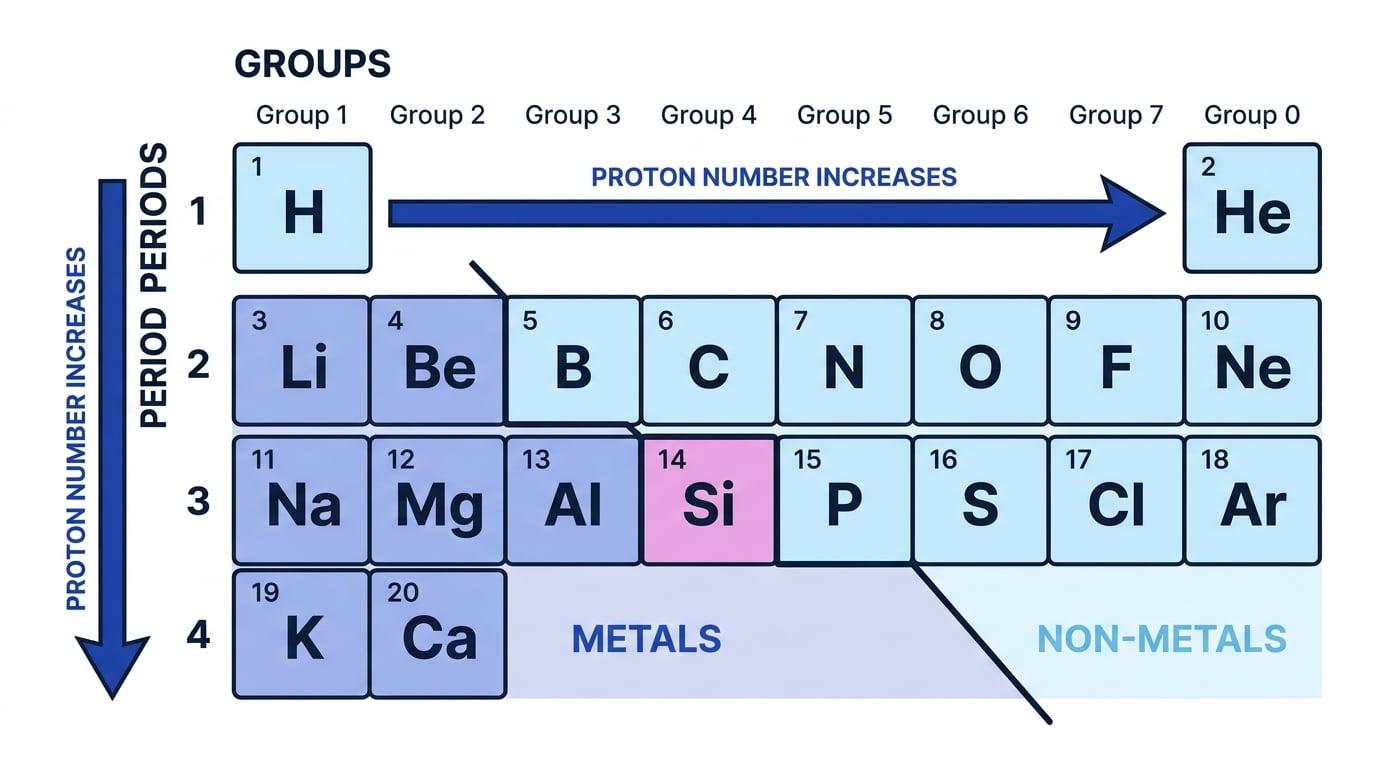
- The Periodic Table places every known element in order of increasing proton number, which is also called the atomic number.
- Hydrogen, with one proton in each nucleus, comes first, helium with two protons comes second, and each element after that has one more proton than the element before it.
- Every element has its own proton number, so every element has exactly one position in the table.
- The horizontal rows are called periods, and they are numbered from Period 1 at the top to Period 7 at the bottom.
- The vertical columns are called groups, and the main groups are numbered with Roman numerals from Group I on the far left to Group VIII on the far right.
- The block of metals between Group II and Group III contains the transition elements, which are not given a group number in this numbering.
- Each box in the table shows the element's symbol, its name, its proton number and its relative atomic mass.
- Elements in the same period have the same number of occupied electron shells.
- Elements in the same group have the same number of outer-shell electrons.
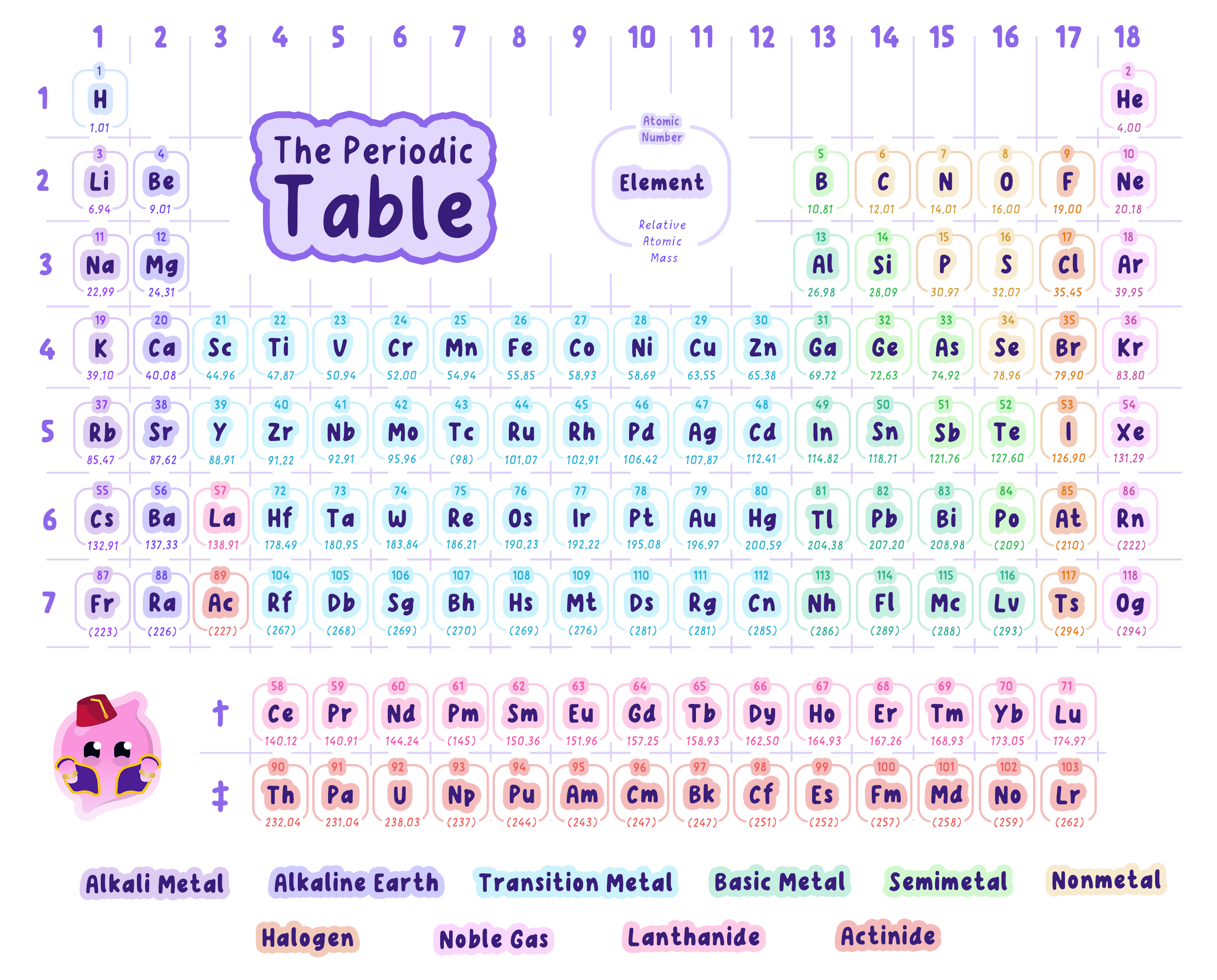
Locating sulfur in the Periodic Table
- Sulfur has a proton number of 161616, so each sulfur atom contains 161616 protons and 161616 electrons.
- The electrons fill the shells as 2,8,62,8,62,8,6.
- Sulfur atoms have three occupied shells, so sulfur is in Period 3.
- Sulfur atoms have six outer-shell electrons, so sulfur is in Group VI.
- Phosphorus, with a proton number of 151515, sits immediately to the left of sulfur, and chlorine, with a proton number of 171717, sits immediately to its right.
Metals to non-metals across a period
Metallic character
The extent to which an element behaves as a metal, shown mainly by how readily its atoms lose electrons to form positive ions.
- Moving from left to right across a period, the elements change from metals to non-metals.
- In Period 3, sodium, magnesium and aluminium are metals, silicon has properties between those of metals and non-metals, and phosphorus, sulfur, chlorine and argon are non-metals.
- Atoms on the left of a period have only one, two or three outer-shell electrons, and they lose these electrons in reactions to form positive ions.
- Losing electrons to form positive ions is typical metallic behaviour.
- Atoms on the right of a period have nearly full outer shells, so they tend to gain or share electrons instead.
- Gaining or sharing electrons is typical non-metallic behaviour.
- Metallic character therefore decreases across a period, while non-metallic character increases.
- The physical properties follow the same pattern, so the shiny solids that conduct electricity on the left give way to dull solids and gases that do not conduct on the right.
- The metals of a period sit to the left of a stepped line that runs down the right-hand side of the table, and the non-metals sit to the right of this line.
- Do not write that metallic character increases across a period, because it decreases from left to right while non-metallic character increases.
- Do not use this pattern to describe a change down a group, because it describes a change along a horizontal row.
Group number and the charge on ions
- Atoms form ions by losing or gaining electrons until their outer shell is full, giving them the same electronic configuration as a noble gas.
- For Groups I to VII, the group number equals the number of outer-shell electrons, so it tells you how many electrons each atom must lose or gain.
- Groups I, II and III: atoms lose their outer-shell electrons and form positive ions.
- Group I atoms lose one electron and form ions with a charge of +1+1+1, such as Na+\text{Na}^{+}Na+.
- Group II atoms lose two electrons and form ions with a charge of +2+2+2, such as Mg2+\text{Mg}^{2+}Mg2+.
- Group III atoms lose three electrons and form ions with a charge of +3+3+3, such as Al3+\text{Al}^{3+}Al3+.
- Groups V, VI and VII: atoms gain electrons to fill their outer shell and form negative ions.
- Group V atoms gain three electrons and form ions with a charge of −3-3−3, such as N3−\text{N}^{3-}N3−.
- Group VI atoms gain two electrons and form ions with a charge of −2-2−2, such as O2−\text{O}^{2-}O2−.
- Group VII atoms gain one electron and form ions with a charge of −1-1−1, such as Cl−\text{Cl}^{-}Cl−.
- For Groups I to III, the size of the positive charge equals the group number.
- For Groups V to VII, the size of the negative charge equals eight minus the group number.
- Group IV atoms such as carbon and silicon would have to lose or gain four electrons, so they usually share electrons in covalent bonds and do not form simple ions.
- Group VIII atoms already have a full outer shell, so they do not form ions at all.
Predicting the ions of calcium and sulfur
- Calcium is in Group II, so each calcium atom loses its two outer-shell electrons.
Ca→Ca2++2e−\text{Ca} \rightarrow \text{Ca}^{2+} + 2e^{-}Ca→Ca2++2e−
- The calcium ion has the electronic configuration 2,8,82,8,82,8,8, which is the same as argon.
- Sulfur is in Group VI, so each sulfur atom gains two electrons to fill its outer shell.
S+2e−→S2−\text{S} + 2e^{-} \rightarrow \text{S}^{2-}S+2e−→S2−
- The sulfide ion also has the electronic configuration 2,8,82,8,82,8,8.
- Calcium sulfide therefore has the formula CaS\text{CaS}CaS, because one Ca2+\text{Ca}^{2+}Ca2+ ion balances the charge of one S2−\text{S}^{2-}S2− ion.
Similar properties within a group
Electronic configuration
The arrangement of electrons in the shells of an atom or ion, written as the number of electrons in each shell starting from the shell nearest the nucleus.
- Elements in the same group have the same number of electrons in their outer shell.
- Lithium (2,12,12,1), sodium (2,8,12,8,12,8,1) and potassium (2,8,8,12,8,8,12,8,8,1) each have one outer-shell electron.
- Fluorine (2,72,72,7) and chlorine (2,8,72,8,72,8,7) each have seven outer-shell electrons.
- In a chemical reaction, it is the outer-shell electrons that are lost, gained or shared.
- Atoms with the same number of outer-shell electrons therefore react in the same way, so elements in the same group have similar chemical properties.
- They form ions with the same charge, so sodium and potassium both form +1+1+1 ions.
- They also form compounds with the same type of formula, so sodium chloride is NaCl\text{NaCl}NaCl and potassium chloride is KCl\text{KCl}KCl.
- The properties are similar rather than identical, because each element further down a group has one more occupied shell than the element above it.
- This extra shell produces gradual changes in properties down a group, such as a steady change in reactivity.
Explaining similar chemical properties
- Give the reason as the same number of outer-shell electrons or the same number of electrons in the outer shell.
- Writing "the same number of electrons" or "the same number of shells" does not earn the mark, because elements in a group have different total numbers of electrons and different numbers of shells.
- Add that reactions involve the outer-shell electrons, so atoms with the same outer shell react in the same way.
Predicting properties from position
- Period number: this tells you the number of occupied electron shells in an atom of the element.
- Group number: this tells you the number of outer-shell electrons for Groups I to VII.
- From the outer-shell electrons you can predict the charge on the ion the element forms.
- You can also predict that the element reacts in a similar way to the other members of its group.
- Position across the period: this tells you whether the element is likely to be a metal or a non-metal.
- An element towards the left of a period is likely to be a metal that forms positive ions.
- An element towards the right of a period is likely to be a non-metal that forms negative ions or shares electrons.
- Known members of the same group: an unfamiliar element is expected to behave like the elements above and below it, with its properties continuing the pattern down the group.
Predicting the properties of strontium
- Strontium is in Period 5 and Group II.
- Being in Period 5, a strontium atom has five occupied electron shells.
- Being in Group II, a strontium atom has two outer-shell electrons.
- Strontium is on the left of its period, so it is a metal.
- Each strontium atom loses two electrons to form an Sr2+\text{Sr}^{2+}Sr2+ ion.
- Strontium reacts in a similar way to magnesium and calcium, which are also in Group II.
- Strontium chloride has the formula SrCl2\text{SrCl}_2SrCl2, matching magnesium chloride, MgCl2\text{MgCl}_2MgCl2.
- In what order are the elements arranged in the Periodic Table?
- What is the difference between a period and a group?
- How does metallic character change from left to right across a period?
- What charge is on the ions formed by elements in Group II, Group III and Group VI?
- Why do elements in the same group have similar chemical properties?
8.1.2 Identifying trends in groups
Trends in a group
Trend
A gradual change in a property, in one overall direction, from one element to the next down or up a group.
- A trend is a gradual change in a property, in one overall direction, as you move from element to element down or up a group.
- Elements in a group have the same number of outer-shell electrons, but each element has one more occupied shell than the element above it.
- Because the change from one element to the next is always the same kind of change, properties tend to change steadily down a group rather than randomly.
- Properties that often show a trend include melting point, boiling point, density, atomic radius and reactivity.
- A property may increase down a group, decrease down a group, or show no clear trend.
- A property that increases down a group must decrease up the same group, so the direction you read in always matters.
- Questions often give you data for a group you have not studied, such as Group II or Group VI, and expect you to find the trend from that information alone.
Reading trends from data
- Put the elements in order: list them from the top of the group to the bottom, which is the order of increasing proton number.
- Read one property at a time: follow the values for a single property in that order.
- Compare the ends: compare the value for the first element with the value for the last element to find the overall direction.
- Check the middle: confirm that the values in between move in the same direction.
- Treat each property separately: one property can increase down a group while another property decreases down the same group.
- Use descriptions as well as numbers: words such as "reacts slowly", "reacts quickly" and "reacts violently" form an ordered scale, so they show a trend in reactivity just as numbers do.
- Read charts in the same way: in a bar chart, the elements are usually placed along the horizontal axis in group order, so you read the heights of the bars from left to right.
A numerical trend in Group VI
- The melting points of four Group VI elements, from the top of the group, are oxygen −218 ∘C-218\ ^\circ\text{C}−218 ∘C, sulfur 115 ∘C115\ ^\circ\text{C}115 ∘C, selenium 221 ∘C221\ ^\circ\text{C}221 ∘C and tellurium 450 ∘C450\ ^\circ\text{C}450 ∘C.
- The first value is the lowest and the last value is the highest.
- Every value in between is higher than the one before it.
- The trend is that melting point increases down Group VI.
A descriptive trend in Group II
- Four Group II metals are added to dilute hydrochloric acid of the same concentration.
- Magnesium fizzes steadily, calcium fizzes rapidly, strontium fizzes very rapidly and barium reacts violently.
- The descriptions become more vigorous from magnesium to barium.
- The trend is that reactivity increases down Group II.
Writing a complete trend statement
- A complete statement names the property, the direction of change and the direction in the group.
- "The melting point increases down the group" is complete, because it gives all three parts.
- "It increases" is incomplete, because it does not say which property changes or in which direction you are reading.
- Use down the group when reading from top to bottom and up the group when reading from bottom to top.
- When a question asks you to use the data, quote values with their units as evidence, such as "from 115 ∘C115\ ^\circ\text{C}115 ∘C for sulfur to 450 ∘C450\ ^\circ\text{C}450 ∘C for tellurium".
- Comparative words such as higher, lower, denser and more reactive are the clearest way to compare two elements in the same group.
- A change along a period is not a group trend, so only describe the elements in the column you have been given.
Anomalies and unclear patterns
Anomalous value
A value that does not fit the pattern shown by the rest of the data.
- An anomalous value is a value that does not fit the pattern shown by the rest of the data.
- If one value breaks an otherwise steady trend, describe the overall trend and name the element whose value does not fit.
- Do not ignore an anomalous value, and do not let one odd value hide the trend shown by all the others.
- If the values rise and fall with no overall direction, state that the property shows no clear trend.
- A trend does not need equal steps between neighbouring elements, so values of 555, 999, 202020 and 222222 still show a steady increase.
A trend with an anomaly in Group II
- The melting points of the Group II metals, from the top of the group, are beryllium 1287 ∘C1287\ ^\circ\text{C}1287 ∘C, magnesium 650 ∘C650\ ^\circ\text{C}650 ∘C, calcium 842 ∘C842\ ^\circ\text{C}842 ∘C, strontium 777 ∘C777\ ^\circ\text{C}777 ∘C and barium 727 ∘C727\ ^\circ\text{C}727 ∘C.
- Beryllium has the highest value and barium has one of the lowest, so the overall direction is downwards.
- Calcium, strontium and barium each have a lower melting point than the element above them.
- Magnesium does not fit, because its melting point is lower than that of calcium, the element below it.
- The trend is that melting point generally decreases down Group II, with magnesium as the anomalous value.
Estimating a missing value
- When a trend is steady, a missing value lies between the values of the elements directly above and below it.
- For an element at the bottom of the group, continue the pattern in the same direction.
- Keep the size of an estimated step similar to the steps already shown in the data.
- An estimate does not need to match the real value exactly, as long as it fits the trend shown by the data.
Estimating the boiling point of krypton
- The boiling points of four noble gases are helium −269 ∘C-269\ ^\circ\text{C}−269 ∘C, neon −246 ∘C-246\ ^\circ\text{C}−246 ∘C, argon −186 ∘C-186\ ^\circ\text{C}−186 ∘C and xenon −108 ∘C-108\ ^\circ\text{C}−108 ∘C.
- Each value is higher than the one above it, so boiling point increases down the group.
- Krypton sits between argon and xenon, so its boiling point must lie between −186 ∘C-186\ ^\circ\text{C}−186 ∘C and −108 ∘C-108\ ^\circ\text{C}−108 ∘C.
- A sensible estimate is about −150 ∘C-150\ ^\circ\text{C}−150 ∘C, and the measured value is −153 ∘C-153\ ^\circ\text{C}−153 ∘C.
Answering trend questions
- Check whether the question asks about the change down or up the group before you write the direction.
- When a question says "use the information", base your answer only on the data given, even if the group is one you have not met before.
- When several properties are listed, write a separate trend statement for each one and name the property every time.
- What is meant by a trend in a group?
- In what order should you list the elements before reading a trend from a table?
- What three parts does a complete trend statement contain?
- What should you write if one value does not fit the pattern shown by the others?
- How would you estimate a missing value for an element in the middle of a group?