11.5.1 Alkenes, cracking and the test for unsaturation
Alkenes
Alkene
An unsaturated hydrocarbon that contains a carbon-carbon double covalent bond.
-
Alkenes are a family of hydrocarbons whose molecules contain a double carbon-carbon covalent bond, written C=C\text{C}=\text{C}C=C.
-
A double covalent bond is made of two shared pairs of electrons between the same two carbon atoms.
-
Alkenes are unsaturated hydrocarbons, because they contain a C=C\text{C}=\text{C}C=C double bond.
- Unsaturated means that more atoms can be added to the molecule when the double bond opens up.
-
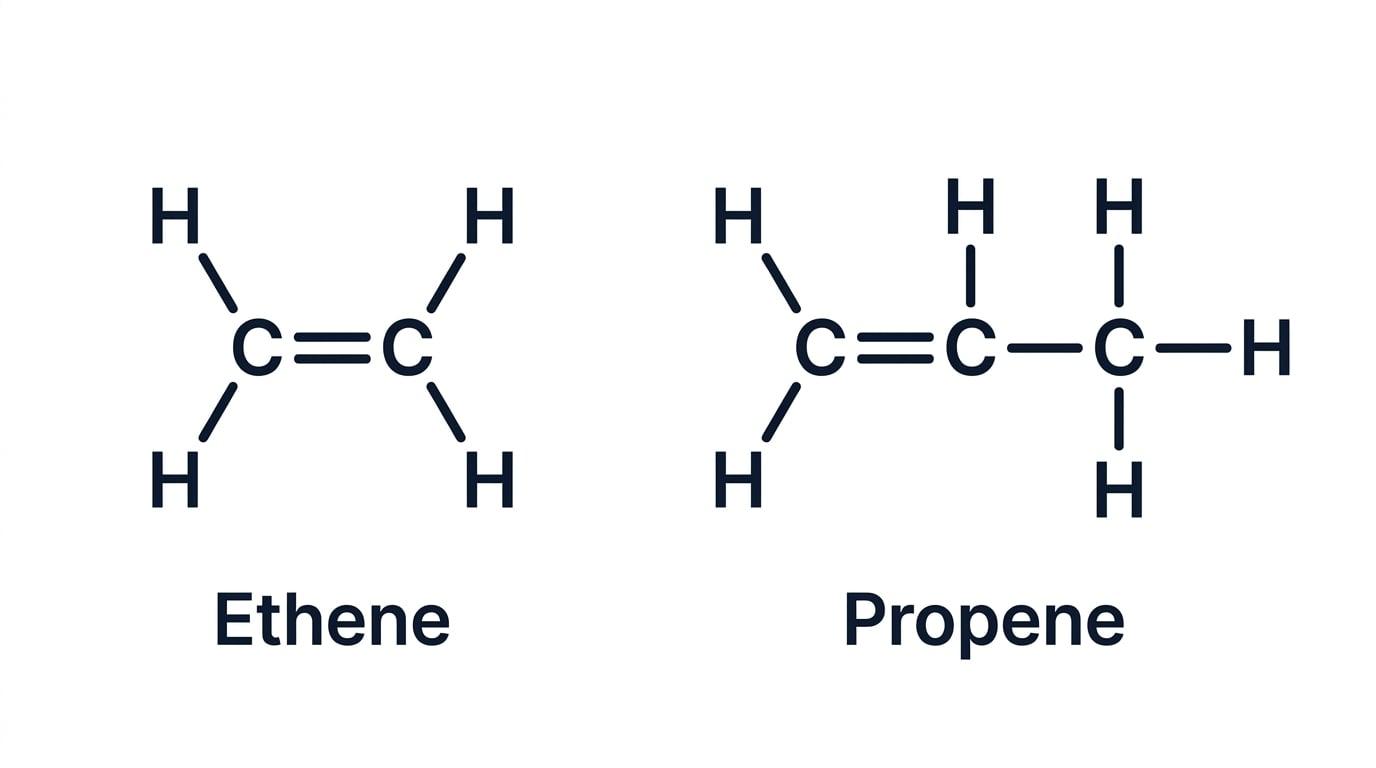
The names of alkenes end in -ene, such as ethene and propene.
-
Ethene, C2H4\text{C}_2\text{H}_4C2H4, is the simplest alkene, with the structural formula CH2=CH2\text{CH}_2=\text{CH}_2CH2=CH2.
HH∣∣C=C∣∣HH \begin{array}{ccc} \text{H} & & \text{H} \\ | & & | \\ \text{C} & = & \text{C} \\ | & & | \\ \text{H} & & \text{H} \end{array} H∣C∣H=H∣C∣H- Each carbon atom in ethene still forms four bonds, counting the double bond as two.
-
Propene, C3H6\text{C}_3\text{H}_6C3H6, has the structural formula CH2=CHCH3\text{CH}_2=\text{CHCH}_3CH2=CHCH3.
HHH∣∣∣C=C−C−H∣∣HH \begin{array}{ccccccc} \text{H} & & \text{H} & & \text{H} & & \\ | & & | & & | & & \\ \text{C} & = & \text{C} & - & \text{C} & - & \text{H} \\ | & & & & | & & \\ \text{H} & & & & \text{H} & & \end{array} H∣C∣H=H∣C−H∣C∣H−H -
Alkenes are more reactive than alkanes, because the double bond is a reactive site where other atoms can join.
Cracking
Cracking
The breaking down of large alkane molecules into smaller alkanes and alkenes, and sometimes hydrogen, using a high temperature and a catalyst.
Catalyst
A substance that increases the rate of a reaction and is chemically unchanged at the end of the reaction.
-
Cracking breaks large alkane molecules into smaller, more useful molecules.
-
The large alkanes come from the heavier fractions of petroleum, such as kerosene and diesel oil.
-
Cracking needs two conditions.
- A high temperature, of about 500 ∘C500\ ^\circ\text{C}500 ∘C, so that the alkane turns into a vapour and its bonds can break.
- A catalyst, such as aluminium oxide or silica, which speeds up the breakdown without being used up.
-
The hot alkane vapour is passed over the heated catalyst, and some of its C−C\text{C}-\text{C}C−C bonds break.
-
The products of cracking are a smaller alkane and an alkene, and sometimes hydrogen.
- There are not enough hydrogen atoms in the large molecule for every product to be an alkane, so at least one product must be an alkene.
-
Cracking is a type of thermal decomposition, because heat breaks one substance down into several simpler ones.
-
Decane can be cracked into octane and ethene.
C10H22→C8H18+C2H4 \text{C}_{10}\text{H}_{22} \rightarrow \text{C}_8\text{H}_{18} + \text{C}_2\text{H}_4 C10H22→C8H18+C2H4 -
Ethane can be cracked to form ethene and hydrogen.
C2H6→C2H4+H2 \text{C}_2\text{H}_6 \rightarrow \text{C}_2\text{H}_4 + \text{H}_2 C2H6→C2H4+H2
Balancing a cracking equation
- Tetradecane, C14H30\text{C}_{14}\text{H}_{30}C14H30, is cracked into decane, C10H22\text{C}_{10}\text{H}_{22}C10H22, and ethene, C2H4\text{C}_2\text{H}_4C2H4.
- Decane uses 101010 of the 141414 carbon atoms, so 444 carbon atoms are left for ethene.
- Each ethene molecule has 222 carbon atoms, so two ethene molecules form.
- Hydrogen checks out too, because 22+(2×4)=3022 + (2 \times 4) = 3022+(2×4)=30.
- To find a missing product, subtract the atoms you know, so cracking C12H26\text{C}_{12}\text{H}_{26}C12H26 into C8H18\text{C}_8\text{H}_{18}C8H18 leaves C4H8\text{C}_4\text{H}_8C4H8.
- C4H8\text{C}_4\text{H}_8C4H8 fits the pattern CnH2n\text{C}_n\text{H}_{2n}CnH2n, so it is an alkene, while C8H18\text{C}_8\text{H}_{18}C8H18 fits CnH2n+2\text{C}_n\text{H}_{2n+2}CnH2n+2, so it is an alkane.
Reasons for cracking
- Fractional distillation of petroleum gives more long-chain hydrocarbons than are needed.
- It gives too little of the short-chain fractions such as petrol, which are in high demand as fuels.
- The demand for petrol is greater than the supply from fractional distillation alone.
- Cracking converts the surplus long-chain alkanes into shorter-chain alkanes that are useful as fuels, such as petrol.
- Cracking produces alkenes, which are needed as starting materials for making polymers such as poly(ethene) and other chemicals such as ethanol.
- Cracking can also produce hydrogen, which is used as a fuel and to make other chemicals such as ammonia.
- Long-chain alkanes are less useful as they are, because they are viscous, hard to ignite and burn with a smoky flame.
Testing for unsaturation
- Aqueous bromine, also called bromine water, is used to tell a saturated hydrocarbon from an unsaturated one.
- Add a few drops of orange aqueous bromine to the hydrocarbon and shake the mixture.
- With an alkene, the aqueous bromine changes from orange to colourless, which is described as decolourised.
- The colour disappears because the bromine reacts with the C=C\text{C}=\text{C}C=C double bond and is used up.
- With an alkane, the aqueous bromine stays orange, because an alkane has no double bond for the bromine to react with.
- The test works for any unsaturated hydrocarbon, so a colour change shows that the molecule contains a C=C\text{C}=\text{C}C=C double bond.
Cracking liquid paraffin
- Aim: to crack a long-chain alkane and show that the gas produced is unsaturated.
- Apparatus: hard-glass boiling tube, ceramic wool, liquid paraffin, small lumps of aluminium oxide or broken porous pot, bung fitted with a delivery tube, trough of water, four test tubes with bungs, Bunsen burner, clamp stand, dropping pipette, aqueous bromine and eye protection.
- Method:
- Push some ceramic wool to the bottom of the boiling tube and soak it with about 2 cm32\ \text{cm}^32 cm3 of liquid paraffin.
- Place a layer of aluminium oxide lumps in the middle of the tube, then clamp the tube horizontally and fit the bung and delivery tube.
- Fill the test tubes with water and stand them upside down in the trough, ready to collect gas.
- Heat the aluminium oxide strongly, flicking the flame onto the ceramic wool now and then so that the paraffin turns into vapour that passes over the hot catalyst.
- Throw away the first tube of gas, because it is mostly air pushed out of the apparatus.
- Collect three tubes of gas and seal each one with a bung.
- Add about 1 cm31\ \text{cm}^31 cm3 of aqueous bromine to one tube of gas and shake, then repeat with a few drops of liquid paraffin in a clean tube for comparison.
- Results:
- A colourless gas bubbles into the test tubes.
- The gas turns aqueous bromine from orange to colourless.
- The liquid paraffin leaves the aqueous bromine orange.
- Conclusion: cracking turned the saturated liquid paraffin into smaller molecules that include an unsaturated alkene.
- Safety: wear eye protection, lift the delivery tube out of the water before you stop heating so that cold water is not sucked back into the hot tube, keep the gas away from flames because it is flammable, and handle aqueous bromine with gloves in a well-ventilated room.
- Do not describe the colour change as "clear", because clear is not a colour and the correct word is colourless.
- Do not forget the catalyst when you give the conditions for cracking, because "high temperature" alone does not earn full credit.
- Do not say that cracking forms only alkenes, because a smaller alkane forms as well.
Answering on cracking and the bromine test
- Give the conditions for cracking as a high temperature and a catalyst, and name the catalyst if you can.
- For the reasons for cracking, link the reason to the product, such as "to make more petrol because demand is greater than supply" or "to make alkenes for making polymers".
- For the bromine test, state the colour before and after, writing "orange to colourless" for an alkene and "stays orange" for an alkane.
- Check a cracking equation by counting carbon and hydrogen atoms on both sides, and make sure at least one product is an alkene.
- What type of bond makes an alkene unsaturated?
- State the two conditions needed for cracking.
- Give two reasons why large alkane molecules are cracked.
- Complete the equation C10H22→C8H18+?\text{C}_{10}\text{H}_{22} \rightarrow \text{C}_8\text{H}_{18} + {?}C10H22→C8H18+?
- What colour change is seen when an alkene is shaken with aqueous bromine?
11.5.2 Addition reactions of alkenes
Addition reactions
Addition reaction
A reaction in which atoms join across a carbon-carbon double bond so that the reactants form only one product.
- In an addition reaction, two molecules join together to form only one product.
- Alkenes take part in addition reactions because of their C=C\text{C}=\text{C}C=C double bond.
- One of the two bonds in the double bond breaks, leaving a C−C\text{C}-\text{C}C−C single bond.
- Each of the two carbon atoms then forms a new bond to one of the added atoms.
- The product is saturated, because the double bond has gone.
- No atoms are lost, so the product contains every atom from both reactants.
- Alkenes react with three substances in this way.
- Bromine, or aqueous bromine, with no catalyst.
- Hydrogen, with a nickel catalyst.
- Steam, with an acid catalyst.
Adding bromine
-
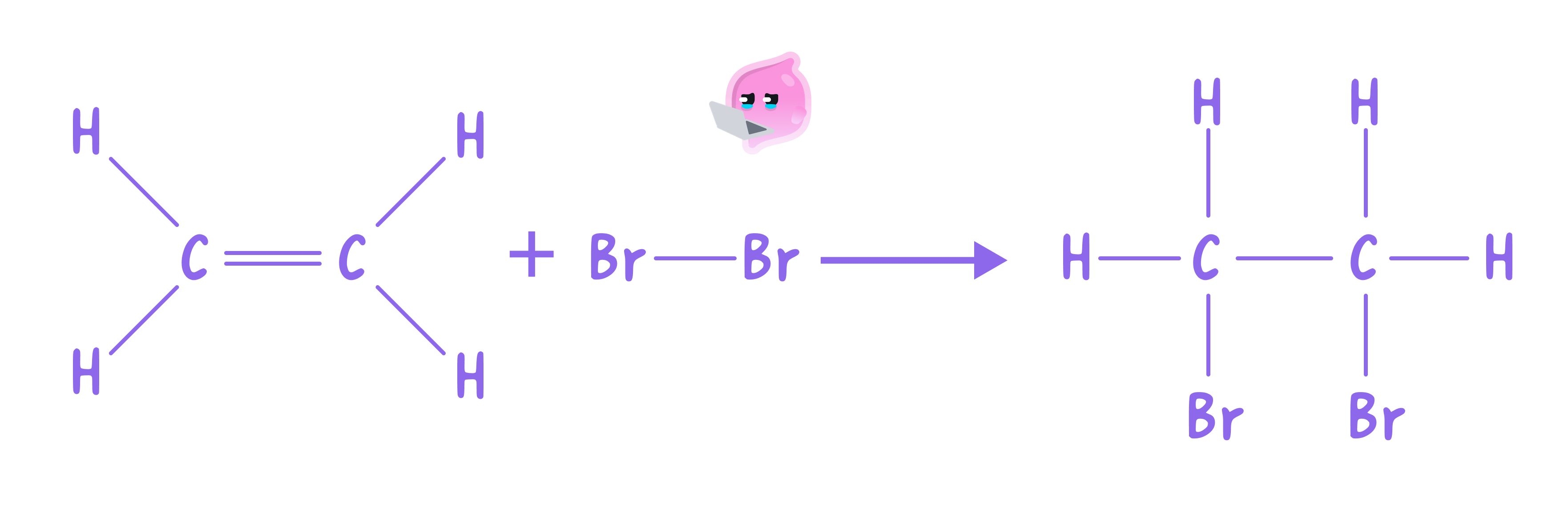
Ethene reacts with bromine at room temperature to form 1,2-dibromoethane.
CH2=CH2+Br2→CH2BrCH2Br \text{CH}_2=\text{CH}_2 + \text{Br}_2 \rightarrow \text{CH}_2\text{BrCH}_2\text{Br} CH2=CH2+Br2→CH2BrCH2Br -
One bromine atom joins each carbon atom that was part of the double bond, which is why the name contains the numbers 1,2.
-
The displayed formula of 1,2-dibromoethane shows two bromine atoms on neighbouring carbon atoms joined by a single bond.
HH∣∣Br−C−C−Br∣∣HH \begin{array}{ccccccc} & & \text{H} & & \text{H} & & \\ & & | & & | & & \\ \text{Br} & - & \text{C} & - & \text{C} & - & \text{Br} \\ & & | & & | & & \\ & & \text{H} & & \text{H} & & \end{array} Br−H∣C∣H−H∣C∣H−Br -
With aqueous bromine, the orange colour turns colourless because the bromine is used up as it adds to the alkene.
- This colour change is the reason aqueous bromine is used to test for a C=C\text{C}=\text{C}C=C double bond.
Adding hydrogen
Hydrogenation
The addition of hydrogen across a carbon-carbon double bond, using a nickel catalyst, which converts an alkene into an alkane.
-
An alkene reacts with hydrogen in the presence of a nickel catalyst to form an alkane.
- The mixture is heated to about 150 ∘C150\ ^\circ\text{C}150 ∘C as the gases pass over the nickel.
-
Ethene reacts with hydrogen to form ethane.
CH2=CH2+H2→NiCH3CH3 \text{CH}_2=\text{CH}_2 + \text{H}_2 \xrightarrow{\text{Ni}} \text{CH}_3\text{CH}_3 CH2=CH2+H2NiCH3CH3 -
One hydrogen atom joins each carbon atom, so the product has six C−H\text{C}-\text{H}C−H bonds and one C−C\text{C}-\text{C}C−C bond.
-
The nickel is written above the arrow, because it is a catalyst and is not used up.
-
The same reaction is used to turn liquid vegetable oils, which contain C=C\text{C}=\text{C}C=C bonds, into solid spreads such as margarine.

Adding steam
-
An alkene reacts with steam in the presence of an acid catalyst to form an alcohol.
- Steam is water in the gas state, so the molecule added is H2O\text{H}_2\text{O}H2O.
-
Ethene reacts with steam to form ethanol.
CH2=CH2+H2O→acid catalystCH3CH2OH \text{CH}_2=\text{CH}_2 + \text{H}_2\text{O} \xrightarrow{\text{acid catalyst}} \text{CH}_3\text{CH}_2\text{OH} CH2=CH2+H2Oacid catalystCH3CH2OH -
The water molecule splits so that an H\text{H}H atom joins one carbon atom and an OH\text{OH}OH group joins the other carbon atom.
-
The displayed formula of ethanol shows the O−H\text{O}-\text{H}O−H group bonded to one carbon atom.
HH∣∣H−C−C−O−H∣∣HH \begin{array}{ccccccccc} & & \text{H} & & \text{H} & & & & \\ & & | & & | & & & & \\ \text{H} & - & \text{C} & - & \text{C} & - & \text{O} & - & \text{H} \\ & & | & & | & & & & \\ & & \text{H} & & \text{H} & & & & \end{array} H−H∣C∣H−H∣C∣H−O−H- This reaction is one of the main ways of manufacturing ethanol, and you will meet its industrial conditions with ethanol manufacture.
Drawing the products
- Copy the carbon chain of the alkene and change the C=C\text{C}=\text{C}C=C double bond into a C−C\text{C}-\text{C}C−C single bond.
- Add one new atom or group to each of the two carbon atoms that were joined by the double bond.
- For bromine, add Br\text{Br}Br to both carbons.
- For hydrogen, add H\text{H}H to both carbons.
- For steam, add H\text{H}H to one carbon and OH\text{OH}OH to the other.
- Leave every other atom exactly where it was, and check that each carbon has four bonds.
Addition reactions of propene
- Propene, CH2=CHCH3\text{CH}_2=\text{CHCH}_3CH2=CHCH3, has its double bond between the first and second carbon atoms, so the new atoms join those two carbons.
- With bromine, the product is 1,2-dibromopropane.
- With hydrogen and a nickel catalyst, the product is propane.
- With steam and an acid catalyst, the OH\text{OH}OH group can join either carbon of the double bond, so each propene molecule forms one of two possible alcohols.
- In every case the third carbon atom, the CH3\text{CH}_3CH3 group, is unchanged.
- Do not leave the double bond in the product, because it becomes a single bond during addition.
- Do not put both bromine atoms on the same carbon atom, because one bromine atom adds to each carbon of the double bond.
- Do not write a second product such as HBr\text{HBr}HBr or H2O\text{H}_2\text{O}H2O, because an addition reaction forms only one product.
- Do not swap the catalysts, because hydrogen needs nickel and steam needs an acid.
Writing about addition reactions
- Define an addition reaction by saying that only one product forms, because that is the point that earns the mark.
- Name the catalyst for each reaction, writing nickel for hydrogen and acid catalyst for steam, while bromine needs none.
- In a displayed formula, show every bond, including the O−H\text{O}-\text{H}O−H bond in an alcohol, and count four bonds around each carbon.
- Write structural formulae in full, such as CH2BrCH2Br\text{CH}_2\text{BrCH}_2\text{Br}CH2BrCH2Br and CH3CH2OH\text{CH}_3\text{CH}_2\text{OH}CH3CH2OH, rather than molecular formulae that do not show the arrangement.
- How many products form in an addition reaction?
- Name the product when ethene reacts with bromine, and give its structural formula.
- Which catalyst is needed when an alkene reacts with hydrogen?
- What type of compound forms when an alkene reacts with steam?
- Draw the displayed formula of ethanol.