Addition reactions
Addition reaction
A reaction in which atoms join across a carbon-carbon double bond so that the reactants form only one product.
- In an addition reaction, two molecules join together to form only one product.
- Alkenes take part in addition reactions because of their C=C\text{C}=\text{C}C=C double bond.
- One of the two bonds in the double bond breaks, leaving a C−C\text{C}-\text{C}C−C single bond.
- Each of the two carbon atoms then forms a new bond to one of the added atoms.
- The product is saturated, because the double bond has gone.
- No atoms are lost, so the product contains every atom from both reactants.
- Alkenes react with three substances in this way.
- Bromine, or aqueous bromine, with no catalyst.
- Hydrogen, with a nickel catalyst.
- Steam, with an acid catalyst.
Adding bromine
-
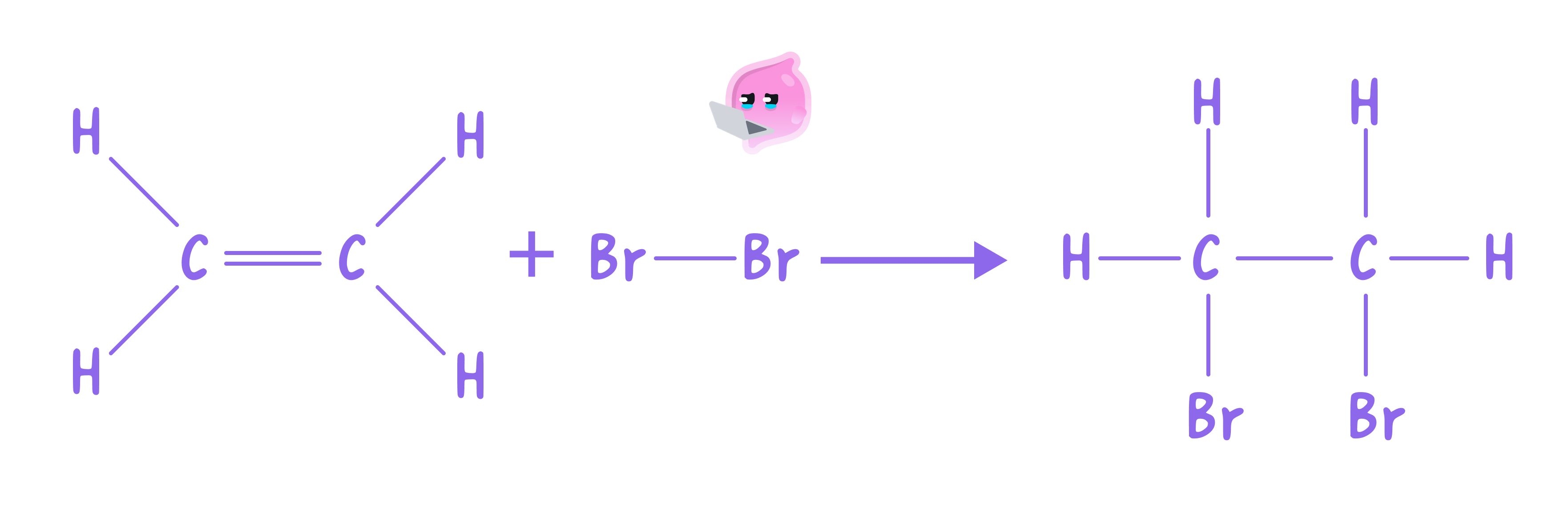
Ethene reacts with bromine at room temperature to form 1,2-dibromoethane.
CH2=CH2+Br2→CH2BrCH2Br \text{CH}_2=\text{CH}_2 + \text{Br}_2 \rightarrow \text{CH}_2\text{BrCH}_2\text{Br} CH2=CH2+Br2→CH2BrCH2Br -
One bromine atom joins each carbon atom that was part of the double bond, which is why the name contains the numbers 1,2.
-
The displayed formula of 1,2-dibromoethane shows two bromine atoms on neighbouring carbon atoms joined by a single bond.
HH∣∣Br−C−C−Br∣∣HH \begin{array}{ccccccc} & & \text{H} & & \text{H} & & \\ & & | & & | & & \\ \text{Br} & - & \text{C} & - & \text{C} & - & \text{Br} \\ & & | & & | & & \\ & & \text{H} & & \text{H} & & \end{array} Br−H∣C∣H−H∣C∣H−Br -
With aqueous bromine, the orange colour turns colourless because the bromine is used up as it adds to the alkene.
- This colour change is the reason aqueous bromine is used to test for a C=C\text{C}=\text{C}C=C double bond.
Adding hydrogen
Hydrogenation
The addition of hydrogen across a carbon-carbon double bond, using a nickel catalyst, which converts an alkene into an alkane.
-
An alkene reacts with hydrogen in the presence of a nickel catalyst to form an alkane.
- The mixture is heated to about 150 ∘C150\ ^\circ\text{C}150 ∘C as the gases pass over the nickel.
-
Ethene reacts with hydrogen to form ethane.
CH2=CH2+H2→NiCH3CH3 \text{CH}_2=\text{CH}_2 + \text{H}_2 \xrightarrow{\text{Ni}} \text{CH}_3\text{CH}_3 CH2=CH2+H2NiCH3CH3 -
One hydrogen atom joins each carbon atom, so the product has six C−H\text{C}-\text{H}C−H bonds and one C−C\text{C}-\text{C}C−C bond.
-
The nickel is written above the arrow, because it is a catalyst and is not used up.
-
The same reaction is used to turn liquid vegetable oils, which contain C=C\text{C}=\text{C}C=C bonds, into solid spreads such as margarine.

Adding steam
-
An alkene reacts with steam in the presence of an acid catalyst to form an alcohol.
- Steam is water in the gas state, so the molecule added is H2O\text{H}_2\text{O}H2O.
-
Ethene reacts with steam to form ethanol.
CH2=CH2+H2O→acid catalystCH3CH2OH \text{CH}_2=\text{CH}_2 + \text{H}_2\text{O} \xrightarrow{\text{acid catalyst}} \text{CH}_3\text{CH}_2\text{OH} CH2=CH2+H2Oacid catalystCH3CH2OH -
The water molecule splits so that an H\text{H}H atom joins one carbon atom and an OH\text{OH}OH group joins the other carbon atom.
-
The displayed formula of ethanol shows the O−H\text{O}-\text{H}O−H group bonded to one carbon atom.
HH∣∣H−C−C−O−H∣∣HH \begin{array}{ccccccccc} & & \text{H} & & \text{H} & & & & \\ & & | & & | & & & & \\ \text{H} & - & \text{C} & - & \text{C} & - & \text{O} & - & \text{H} \\ & & | & & | & & & & \\ & & \text{H} & & \text{H} & & & & \end{array} H−H∣C∣H−H∣C∣H−O−H- This reaction is one of the main ways of manufacturing ethanol, and you will meet its industrial conditions with ethanol manufacture.
Drawing the products
- Copy the carbon chain of the alkene and change the C=C\text{C}=\text{C}C=C double bond into a C−C\text{C}-\text{C}C−C single bond.
- Add one new atom or group to each of the two carbon atoms that were joined by the double bond.
- For bromine, add Br\text{Br}Br to both carbons.
- For hydrogen, add H\text{H}H to both carbons.
- For steam, add H\text{H}H to one carbon and OH\text{OH}OH to the other.
- Leave every other atom exactly where it was, and check that each carbon has four bonds.
Addition reactions of propene
- Propene, CH2=CHCH3\text{CH}_2=\text{CHCH}_3CH2=CHCH3, has its double bond between the first and second carbon atoms, so the new atoms join those two carbons.
- With bromine, the product is 1,2-dibromopropane.
- With hydrogen and a nickel catalyst, the product is propane.
- With steam and an acid catalyst, the OH\text{OH}OH group can join either carbon of the double bond, so each propene molecule forms one of two possible alcohols.
- In every case the third carbon atom, the CH3\text{CH}_3CH3 group, is unchanged.
- Do not leave the double bond in the product, because it becomes a single bond during addition.
- Do not put both bromine atoms on the same carbon atom, because one bromine atom adds to each carbon of the double bond.
- Do not write a second product such as HBr\text{HBr}HBr or H2O\text{H}_2\text{O}H2O, because an addition reaction forms only one product.
- Do not swap the catalysts, because hydrogen needs nickel and steam needs an acid.
Writing about addition reactions
- Define an addition reaction by saying that only one product forms, because that is the point that earns the mark.
- Name the catalyst for each reaction, writing nickel for hydrogen and acid catalyst for steam, while bromine needs none.
- In a displayed formula, show every bond, including the O−H\text{O}-\text{H}O−H bond in an alcohol, and count four bonds around each carbon.
- Write structural formulae in full, such as CH2BrCH2Br\text{CH}_2\text{BrCH}_2\text{Br}CH2BrCH2Br and CH3CH2OH\text{CH}_3\text{CH}_2\text{OH}CH3CH2OH, rather than molecular formulae that do not show the arrangement.
- How many products form in an addition reaction?
- Name the product when ethene reacts with bromine, and give its structural formula.
- Which catalyst is needed when an alkene reacts with hydrogen?
- What type of compound forms when an alkene reacts with steam?
- Draw the displayed formula of ethanol.
