1.8.1a Financial and market measures
Business success can be measured using revenue, market share, customer satisfaction and profit
- No single measure gives a complete picture. Revenue, market share, customer satisfaction and profit each show a different part of performance, so they are most useful when considered together and over time.
- A shop whose revenue rises can still be performing poorly if its costs rise even faster and its profit falls.
- One positive figure does not automatically mean the whole business is successful.
Revenue shows sales income, not whether the business is profitable
- Revenue is the income received from sales: rising revenue may indicate that the business is selling more units, charging higher prices or both.
- Revenue alone does not show whether the business is making money because it does not take costs into account.
Profit shows the financial return after costs
- Profit is the amount left after total costs are subtracted from revenue: increasing profit suggests that the business is generating a larger financial return after paying its costs.
- A business can increase revenue but reduce profit if the extra sales require even larger increases in wages, materials, promotion or other costs.
Do not confuse revenue with profit: revenue is sales income, while profit is what remains after costs.
Market share compares the business with total market sales
- Market share measures the firm's sales as a percentage of total market sales: a rising market share shows that the business is strengthening its position relative to competitors.
- Sales can rise while market share falls: if the whole market grows faster than the business, the firm can sell more than before but represent a smaller percentage of total market sales.
- A drinks business has sales of £2.4 million in a market with total sales of £30 million.
Do not treat higher sales as proof of higher market share: market share depends on how the business's sales change relative to the whole market.
Customer satisfaction can indicate whether success is likely to continue
- Customer satisfaction shows how pleased customers are with the product and service: it can be judged through surveys, reviews, complaints, repeat purchases and other customer feedback.
- High customer satisfaction can support future revenue and profit because satisfied customers are more likely to buy again and recommend the business to others.
The measures are strongest when used together and compared over time
- The measures can move in different directions. Cutting prices may increase sales and market share while reducing profit per unit. Cutting costs may improve profit in the short term but damage customer satisfaction if service or quality falls.
- Comparison improves the judgement. A figure is more meaningful when compared with previous years, competitors or the objective the business originally set.
- What is revenue and why can it give an incomplete picture of success?
- What is profit?
- How is market share calculated?
- Give three ways customer satisfaction can be judged.
- How can one measure of success improve while another gets worse?
1.8.1b Growth and satisfaction measures
Business success can also be measured by growth and the satisfaction of owners, shareholders and employees
- These measures add information that revenue, profit and market share cannot show on their own. They help judge whether the business is getting bigger and whether important people connected to it are satisfied with its performance.
A restaurant chain may grow from one site to ten, but if employees are leaving because workloads have become unmanageable, the growth may be difficult to sustain.
Growth can indicate success but can also create pressure
- Growth means an increase in the size of the business: it can be shown by measures such as higher revenue, more employees, more outlets or a larger scale of operations.
- Growth can indicate success because the business is expanding its activities and may be attracting more customers or entering more markets.
- Growth can also create pressure: rapid expansion may require more finance, managers and employees, and can make quality or control harder to maintain.
Owners and shareholders judge success against the outcomes they want
- Owners judge success against what they wanted from the business: this may include financial returns, growth or non-financial aims such as independence and control.
- A sole trader who values independence may be satisfied with a smaller business that provides a reliable income and leaves full control with the owner.
- Shareholders usually focus strongly on financial returns: dividends and changes in the value of their investment can influence whether they are satisfied with company performance.
Employee satisfaction can support the performance of the business
- Employee satisfaction reflects how employees feel about working for the business: pay, working conditions, workload, job security, relationships and opportunities can all influence satisfaction.
- Businesses can use indicators such as labour turnover, absence and staff feedback: high turnover or absence can suggest problems, while positive staff surveys and strong employee retention may indicate higher satisfaction.
- Employee satisfaction can support performance: satisfied employees may be more willing to stay, provide good customer service and maintain productivity, reducing recruitment and training disruption.
- Do not treat owner or shareholder satisfaction as the same thing as employee satisfaction.
- The same decision can improve one group's satisfaction while reducing another's.
Different measures of success can point in different directions
- Fast growth may satisfy owners who want expansion while reducing employee satisfaction if workloads rise too quickly. Higher pay may improve employee satisfaction while reducing the profit available to owners in the short term.
- The most useful judgement therefore depends on the objectives of the business and on whose satisfaction is being considered.
- Give three ways the growth of a business can be measured.
- Why is growth often treated as a sign of success?
- How can owners and shareholders judge whether they are satisfied with a business?
- Give three indicators that can help judge employee satisfaction.
- How can growth improve one measure of success while weakening another?
1.8.2 Reasons for business failure
Business failure can result from finance problems, weak competitiveness or failure to adapt
Business failure: when a business is forced to stop trading because it can no longer continue operating, for example because it cannot meet its financial obligations or generate enough demand and cash to survive.
- The causes of failure often interact. A business that loses customers because it is uncompetitive can experience falling revenue, which then creates cash-flow problems and makes it harder to raise additional finance.
A business can have valuable assets and customer orders but still fail if it does not have enough cash available when wages, rent or supplier payments are due.
Cash-flow problems can leave a business unable to pay its bills
- Cash-flow problems: a business fails if it cannot obtain enough cash to meet payments when they are due, even if it appears profitable overall.
- A firm may have made a profitable sale but still face a cash shortage if the customer will not pay for several weeks while wages and suppliers must be paid now.
- Lack of finance: a business may be unable to raise the money needed to survive a difficult period, replace essential assets or finance changes needed to remain competitive.
- A new business with little trading history may find lenders unwilling to provide more finance after an unexpected fall in sales.
Do not use cash-flow problems and lack of finance as the same cause: cash flow is about having cash available at the right time, while lack of finance is about being unable to obtain enough funding.
Weak competitiveness can drive customers towards rival businesses
- Customers switch to stronger competitors: a business can lose demand if competitors offer lower prices, better quality, stronger customer service or products that customers prefer.
- If sales fall far enough, revenue may no longer cover the business's costs and the firm may be unable to continue.
- High costs can also weaken competitiveness: a business with higher costs than its rivals may have to charge higher prices or accept a lower profit margin, leaving it less able to respond to competition.
Failure to adapt can leave a business selling what the market no longer wants
- Customer tastes can move away from the firm's products: if the business continues offering products that customers no longer want, demand and revenue can decline.
- Technological change can make an existing product or business model less attractive: firms that fail to adopt new ways of producing, selling or delivering value may lose customers to businesses that do adapt.
- A video-rental business that continues relying on physical rentals while customers move to streaming can see its market disappear.
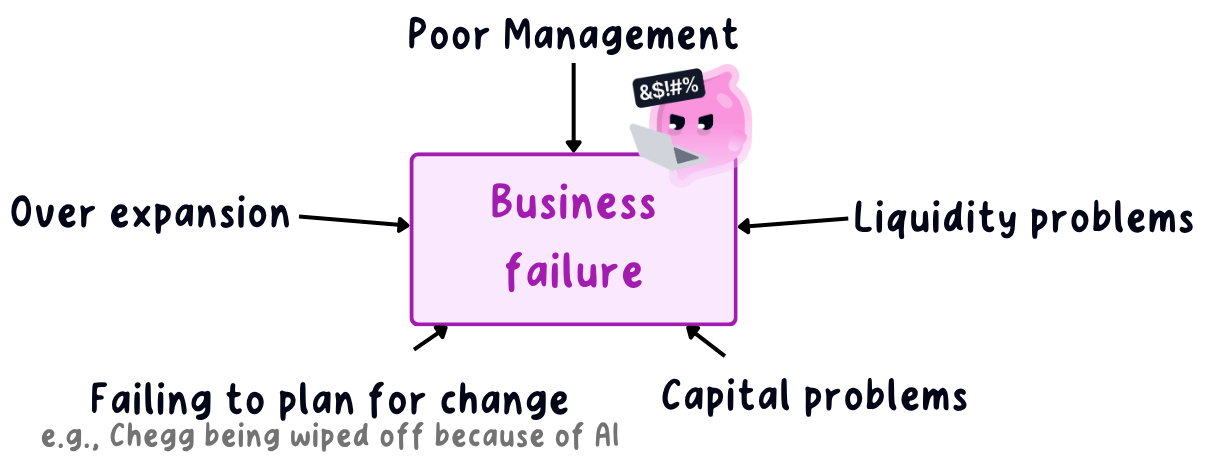
The causes of failure can reinforce one another
- Failure is often the end of a chain rather than one isolated event. A firm that fails to adapt may lose competitiveness, which reduces sales, creates cash-flow problems and makes lenders less willing to provide finance.
- Which cause is most serious depends on the business. A new firm with very little cash may be most vulnerable to finance problems, while an established business in a fast-changing market may be more threatened by failing to adapt.
- How can cash-flow problems cause a profitable business to fail?
- What is the difference between a cash-flow problem and a lack of finance?
- Why can weak competitiveness lead to business failure?
- How can failure to adapt to changing tastes or technology lead to failure?
- How can one cause of failure lead to another?