Research replaces guesswork before the money is spent
Definition
Market research: the process of gathering and analysing information about customers, competitors and the market to support business decisions.
- A business may spend heavily on designing, making, stocking and promoting a product before it earns anything back, so finding out what customers want first reduces the risk of committing money to the wrong idea.
- Research can also give lenders or investors evidence that demand exists, although it cannot guarantee that customers will buy when the product launches.
Research identifies who the customers are and what they value
- Research can identify customer characteristics such as age, income, location and lifestyle, helping the business focus on the people most likely to buy rather than treating everyone as one market.
- It can then investigate the features, quality, buying habits and price range those customers prefer. This information can shape what the business offers and how it positions the product.
Example
A café researching a new menu may discover that regular customers want more vegan options and will pay slightly more for them, giving the owner evidence for both the product range and the price.
A gap in the market is an unmet customer need
Definition
Gap in the market: a customer need or group of customers that existing businesses are not serving well.
- Research can reveal repeated complaints about existing products, groups of customers that rivals overlook, or locations where a service is not available. Filling such a gap can give a business less direct competition and a clearer reason for customers to choose it.
- A gap is only attractive if enough customers want the solution and are willing to pay enough for it. A need may be genuinely unmet because serving it would cost more than customers are prepared to pay.
Example
- Suppose local commuters repeatedly complain that no café near a station opens before 7 am.
- That may reveal a gap, but the owner still needs to estimate whether enough early customers would buy to cover the extra staffing and opening costs.
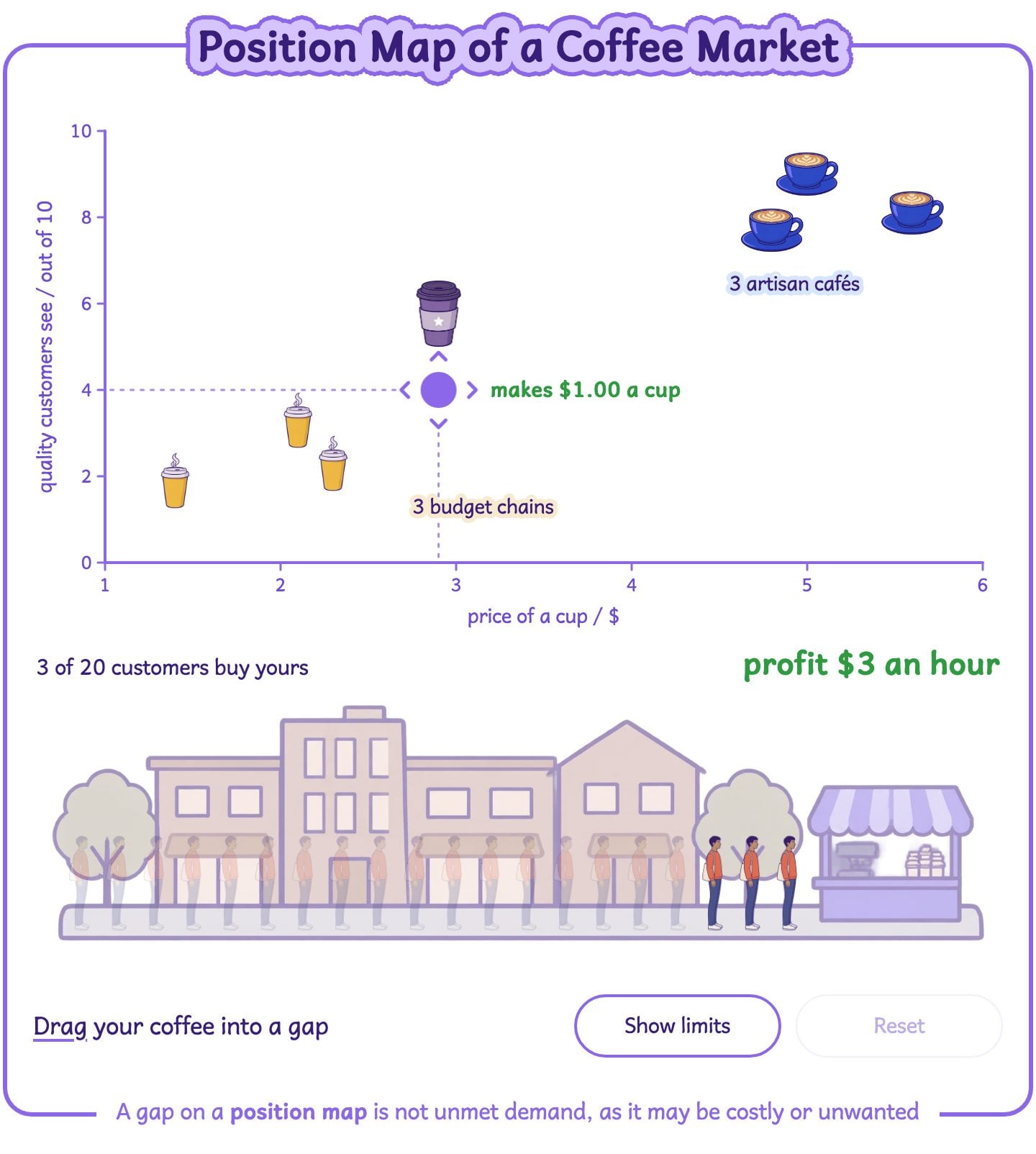
Look at the position map and notice that a gap does not always mean real, profitable demand.
Customer research feeds directly into the marketing mix
- What customers value affects the product; what they are willing to pay influences price; where they shop influences place; and the media they use influences promotion.
- The research therefore becomes useful only when the business turns the finding into a decision, rather than collecting information without changing what it does.
Exam technique
- Identify the customer need or gap shown by the information.
- Link the finding to a specific business decision, such as product design, price, place or promotion.
- For a market gap, explain why enough demand and willingness to pay still have to be checked.
Self review
- What is market research?
- Give three things research can reveal about customers.
- What is a gap in the market?
- Why might an apparent gap still not be commercially worthwhile?
- How can market research influence the marketing mix?