Different types of training serve different purposes
- Businesses use induction, on-the-job and off-the-job training for different reasons, depending on whether the employee needs to settle into the organisation, learn the actual job or develop knowledge and skills away from normal work.
Example
A new supermarket employee may receive induction when joining, learn the till through on-the-job training, and later attend an off-the-job course for a specialist skill.
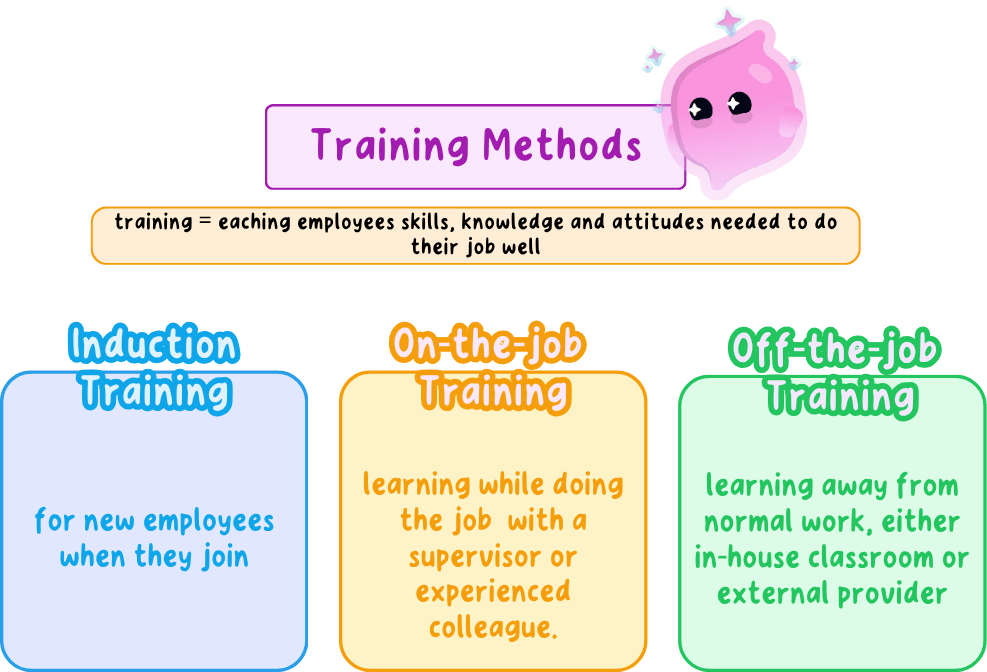
Induction training helps new employees settle in
Definition
Induction training: training given when an employee first joins a business to introduce the workplace, the organisation and the job.
- Induction introduces colleagues, procedures, expectations and practical information, helping reduce early confusion and allowing the new employee to become confident and productive more quickly.
On-the-job training is practical and closely matched to the workplace
Definition
On-the-job training: learning while carrying out the job in the workplace, often with guidance from an experienced employee.
- Advantages: the training is directly related to the firm's actual tasks, equipment and working methods, can have a lower direct cost than an external course and may allow the employee to contribute to work while learning.
- Disadvantages: the experienced employee providing the training has less time for their own work, and poor methods or habits can be passed on if the trainer is not effective.
Off-the-job training gives structured or specialist learning away from normal work
Definition
Off-the-job training: training carried out away from the employee's normal workplace or normal job duties, such as a course, workshop or college programme.
- Advantages: the employee can learn from specialist trainers, follow a structured programme and concentrate on knowledge or skills that may not be available inside the business.
- Disadvantages: the business may pay course fees and lose the employee's working time, and the training may be less closely matched to the firm's exact equipment or procedures.
Businesses often use a mixture of training types
- Induction suits a new starter, on-the-job training suits practical skills that need to be learned in the real workplace, and off-the-job training can suit specialist or structured learning.
- The business should also consider cost, time away from work, how closely the training must match its own systems and whether suitable expertise already exists inside the organisation.
Exam technique
- Identify the purpose first: settling in, learning the real workplace task or gaining specialist structured knowledge.
- Match that purpose to induction, on-the-job or off-the-job training.
- Then use cost, relevance and time away from work to justify why that method suits the business.
Self review
- What is the main purpose of induction training?
- What is the difference between on-the-job and off-the-job training?
- Give one advantage and one disadvantage of on-the-job training.
- Give one advantage and one disadvantage of off-the-job training.
- Why might one employee receive more than one type of training over time?