1.2.1a Sole trader and partnerships
Sole traders and partnerships: ownership changes who controls the business and shares the profit
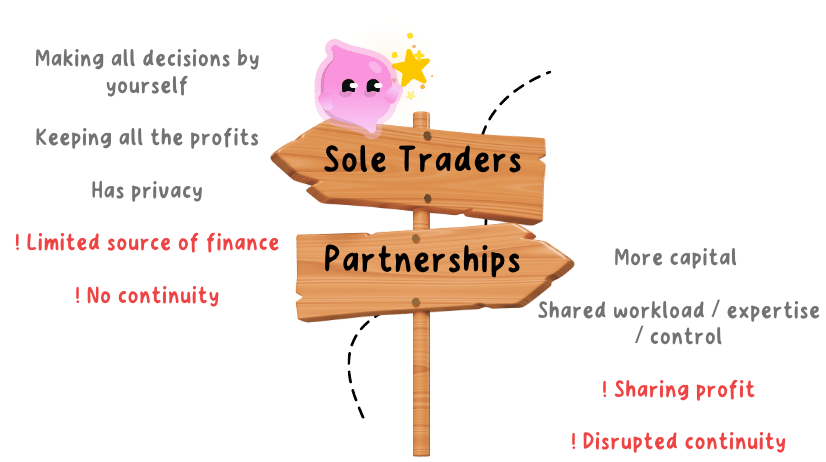
- Both sole traders and partnerships are unincorporated, meaning the business and its owner or owners are not separate legal bodies.
- These forms are common among smaller businesses because the owners can stay closely involved in day-to-day decisions.
Sole traders: one owner keeps direct control
Sole trader: a business owned by one person, who controls the business and receives its profit.
- One owner can respond without waiting for agreement from another owner, which can make decisions quicker.
- The owner receives the business profit rather than dividing it with partners or shareholders.
- The same owner also carries the decision-making pressure and workload, which can become harder to manage as the business grows.
- A self-employed plumber may value choosing which jobs to accept and keeping the profit, but illness can disrupt the business because there is no second owner to share responsibility.
- Do not read sole trader as meaning one worker.
- It means one owner, and the business can still employ other people.
Partnerships: more owners bring more resources but shared control
Partnership: a business owned by two or more people who share responsibility for running it and share the profit.
- Partners share ownership and contribute to decisions, which brings more viewpoints but can make agreement slower.
- Partners can combine money, experience and specialist skills that one owner may not have alone.
- The partners divide the business profit according to the arrangement they have agreed.
- Three dentists may form a partnership so they can combine different clinical skills and share the workload.
- They also have to share important decisions and the profit the practice makes.
The better form depends on how much control and support the owner wants
- A sole trader can suit a small owner-managed business where direct control and keeping the profit matter strongly.
- A partnership can suit a business that benefits from more owners, skills and resources and can accept shared decisions and profit.
- What is a sole trader?
- Can a sole trader employ staff?
- What is a partnership?
- How does control differ between a sole trader and a partnership?
- Why might an owner choose to take on a partner?
1.2.1b Limited companies and public corporations
Limited companies and public corporations have different forms of ownership
Private limited company (Ltd): a company whose shares are privately owned and cannot be offered for sale to the general public.
Public limited company (plc): a company whose shares can be offered for sale to the general public, usually through a stock exchange.
Public corporation: an organisation owned by the government and established to provide goods or services.
- Private and public limited companies are incorporated businesses. The company has a legal identity separate from its shareholders and can own assets, enter contracts and owe debts in its own name.
- This separate legal identity is why shareholders normally have limited liability: they risk the money invested in their shares rather than being personally responsible for all company debts.
Private limited companies
- Shares are kept private: ownership can be shared between family members, friends or selected investors without offering shares to the general public.
- The business can raise share capital: selling shares to selected investors can provide more finance than one owner could contribute alone.
- Control can remain concentrated: because shares are privately held, the original owners can choose who is allowed to become a shareholder and may find it easier to retain control.
- There are greater legal and reporting requirements: forming and running a company involves more administration than an unincorporated business, and some financial information is made public.
- A growing family business may choose Ltd status to gain limited liability and raise finance while keeping ownership within a small group.
Public limited companies
- Shares can be sold to the public: this can allow a plc to raise very large amounts of share capital to finance expansion, acquisitions or major investment.
- Ownership can become widely spread: many outside investors may own shares, so the founders can have less control than in a private limited company.
- The company faces greater scrutiny: a plc is subject to detailed reporting requirements and shareholders can closely examine its performance and decisions.
- A successful national business may become a plc because selling shares to the public can provide the finance needed for rapid expansion.
- The trade-off is that the original owners no longer control who can buy those shares.
Public corporations
- A public corporation is owned by the government rather than by private shareholders. It is therefore fundamentally different from a public limited company.
- Its purpose may include providing an important service to the public, including services that the government wants available even where maximising profit would not provide the same outcome.
- Government ownership can influence objectives and decisions because public service considerations may be weighed alongside financial performance.
- The word public causes a common confusion. A plc is privately owned by shareholders even though its shares are available to the public; a public corporation is owned by the government.
Do not confuse a plc with a public corporation: in a plc, public describes who can buy the shares, while a public corporation is owned by the government.
The key ownership differences
- An Ltd and a plc are both companies owned by shareholders. The main difference is who can buy their shares.
- A public corporation is not a type of limited company because its ownership rests with the government rather than shareholders.
- What is a private limited company?
- What is the difference between an Ltd and a plc?
- Why can a plc usually raise more share capital than an Ltd?
- What is a public corporation?
- Why is a public limited company not the same as a public corporation?
1.2.2a Risk, ownership and limited liability
Risk, ownership and liability determine how much an owner can lose
- The form of ownership affects the financial risk faced by the owner. The possible loss from failure is very different for an unincorporated owner and a shareholder in a limited company.
Unlimited liability
Unlimited liability: the owner is personally responsible for the business's debts, so personal savings and possessions may be at risk if the business cannot pay what it owes.
- There is no separate legal identity: sole traders and partnerships are unincorporated, so business debts are also the responsibility of the owner or partners.
- Personal wealth can be at risk: if the business cannot pay what it owes, the owner may have to use personal savings or other possessions to meet the debts.
- If a sole trader closes with £30,000 of unpaid business debts, the owner's responsibility does not stop at the money originally invested in the business.
- Risk can influence decisions: an owner with unlimited liability may be more cautious about borrowing heavily or making an expansion that could create large debts.
Limited liability
Limited liability: shareholders are normally responsible for company debts only up to the amount they have invested, so their personal assets are protected if the company fails.
- The company is legally separate: an incorporated company owes its own debts, so shareholders are not normally personally responsible for the full amount the company owes.
- The possible loss is capped: a shareholder may lose the value of the investment in the company, but personal assets are normally protected from company debts.
- A shareholder who invests £5,000 in a company that later fails may lose the £5,000 investment, but is not personally required to repay all of the company's remaining debts.
- Limited liability can encourage investment: people may be more willing to buy shares when they know the amount they can lose is limited.
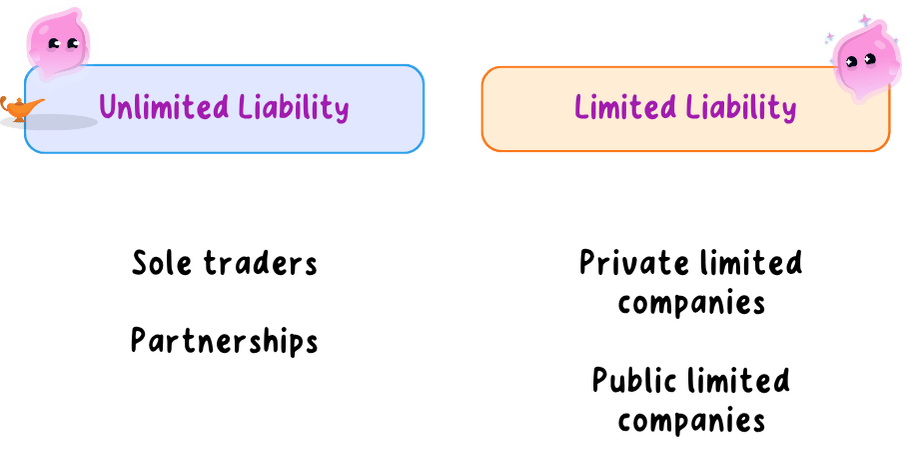
Do not read limited liability as a limit on the size or ambition of the business; it limits the owners' personal financial exposure if the company fails.
Public ownership can protect services but may weaken efficiency pressures
- Reason for public ownership: the government can ensure that an important service is provided even where serving every area or customer is not highly profitable.
- Public ownership can allow decisions to focus on service availability and wider public needs rather than only on returns to private shareholders.
- Reason against public ownership: without the same pressure from private owners and competitors, there may be less incentive to control costs or improve efficiency.
- If a publicly owned organisation makes persistent losses, government funds may be needed to support it, creating an opportunity cost for other public spending.
Ownership and liability change together as a business incorporates
- A business that grows from a small owner-managed operation into a company changes not only who can own it but also how financial risk is divided between the organisation and its owners.
- This can make incorporation attractive when potential debts become much larger, because the protection of limited liability becomes more valuable as the financial commitments of the business increase.
- What is the difference between limited and unlimited liability?
- Why can unlimited liability affect an owner's willingness to borrow or expand?
- Why can limited liability encourage investment in a company?
- Give one reason for public ownership.
- Give one reason against public ownership.
1.2.2b Ownership, control and appropriateness
Ownership affects control, finance, profits and the groups a business answers to
- Changing the form of ownership can change who makes decisions, what sources of finance are available and how the profit is divided. The choice therefore affects much more than the legal name of the business.
A founder who sells shares to raise money may gain the finance needed for expansion, but new shareholders also gain ownership rights and can influence decisions.
How ownership affects the business
- Ownership and control: a sole trader owns and controls the business alone, partners share ownership and control, and shareholders own companies while directors are responsible for managing them.
- Sources of finance: the ownership form affects which finance is available. Companies can raise share capital, while sole traders and partnerships cannot issue shares.
- Use of profits: a sole trader receives the business profit, partners divide it, and a company can retain part of its profit and distribute part to shareholders as dividends.
Shareholder: a person or organisation that owns shares in a company and therefore owns part of it.
Stakeholder: a person or group with an interest in, or affected by, the activities of a business.
- Stakeholders and shareholders: shareholders are owners of a company, while stakeholders include employees, customers, suppliers, the government and local communities that are affected by business decisions.
- Their interests can conflict. Shareholders may want higher dividends, employees may want higher pay and customers may want lower prices, even though all three demands use the same business resources.
Do not use shareholder and stakeholder as synonyms: every shareholder is a stakeholder, but many stakeholders do not own shares.
More finance can mean less control
- Taking on more owners can increase the finance available, but it also spreads ownership. A founder may therefore have to choose between keeping tight control and gaining the capital needed to grow faster.
- An owner who converts a business into a company and sells a large proportion of the shares may gain enough finance for new premises while losing the ability to make every major decision alone.
The appropriate form of ownership depends on the needs of the business
- The appropriate form depends on the amount of finance required, the degree of control the owners want, the financial risk involved, the skills and number of owners, and how the profit is expected to be used.
- A small owner-managed service may suit sole-trader ownership when control matters and finance needs are limited. A business needing shared expertise or more owner finance may suit a partnership.
- A growing business may choose a private limited company when limited liability and share capital become important but the owners still want to restrict who can buy shares.
- A large business that needs substantial share finance may choose public limited company status, accepting wider ownership and a greater possibility that the original owners lose control.
- When judging which ownership form is appropriate, use the business's need for finance and the owner's willingness to share control rather than listing generic advantages.
- A large finance requirement points towards a company, while a strong desire for personal control can point towards a sole trader or tightly held private company.
- What is the difference between a shareholder and a stakeholder?
- How can the form of ownership affect control?
- How can ownership affect the sources of finance available?
- How can the use of profit differ between a sole trader, partnership and company?
- What factors can make one form of ownership more appropriate than another?
1.2.3 Other forms of business organisation
Franchises, social enterprises and multinationals are organised in different ways
- These forms describe different ways a business can organise its activities. A franchise uses an established business system, a social enterprise puts a social purpose at the centre of trading, and a multinational operates across national borders.
Franchises use an established brand and business system
Franchise: an arrangement where a franchisee pays for the right to use the name, products and business methods of an established franchisor.
- The franchisor provides the established brand and business system: this may include products, operating methods, training, marketing and support that have already been tested elsewhere.
- The franchisee owns and operates the individual business: the franchisee usually pays an initial fee and ongoing charges in return for using the franchisor's name and system.
- A well-known brand can attract customers from the start and reduce the uncertainty of building a completely new business concept.
- The trade-off is reduced independence: the franchisee must follow the franchisor's rules and pay agreed fees, so they do not have the same freedom as the owner of a fully independent business.
A fast-food franchisee may benefit from an established menu, national advertising and staff training, but must operate the outlet according to the franchisor's standards.
Do not confuse franchisor and franchisee: the franchisor owns the established brand and system, while the franchisee pays for the right to operate using them.
Social enterprises trade to support a social or environmental purpose
Social enterprise: a business that trades to achieve a social or environmental purpose and uses its profit to support that purpose.
- A social purpose is central to the organisation: the business may aim to improve employment opportunities, support a community or reduce environmental harm while still trading and earning revenue.
- Profit supports the purpose: instead of treating the largest possible payout to owners as the main goal, the business uses profit to continue or expand its social or environmental work.
- A café could employ and train people who face barriers to work, using the income from normal trading to support the programme.
- Commercial pressures still matter: a social enterprise must still attract customers and cover its costs, so it has to balance its mission with the need to remain financially sustainable.
Multinationals have operations in more than one country
Multinational: a business that owns or controls business operations in more than one country, such as factories, offices or stores. Merely exporting to customers abroad does not by itself make a business multinational.
- Operations abroad can include factories, offices, stores or other business activities located in another country.
- The defining feature is having business operations abroad, not simply making sales to overseas customers from the home country.
- Operating internationally can increase the scale and complexity of the business: managers may need to coordinate employees, suppliers and customers across different countries, laws, cultures and currencies.
The detailed benefits of becoming a multinational and the effects on the host country belong to the later multinational articles, so this article stops at what a multinational is and how the organisation operates.
The three forms serve different purposes
- A franchise can suit an owner who wants to operate under an established brand and system. A social enterprise suits a business whose purpose includes creating social or environmental value. A multinational is an organisation that has developed operations across national borders.
- What is a franchise?
- What is the difference between a franchisor and a franchisee?
- What is a social enterprise?
- How does a social enterprise use its profit?
- What feature makes a business a multinational?