2.3.1a Types of training
Different types of training serve different purposes
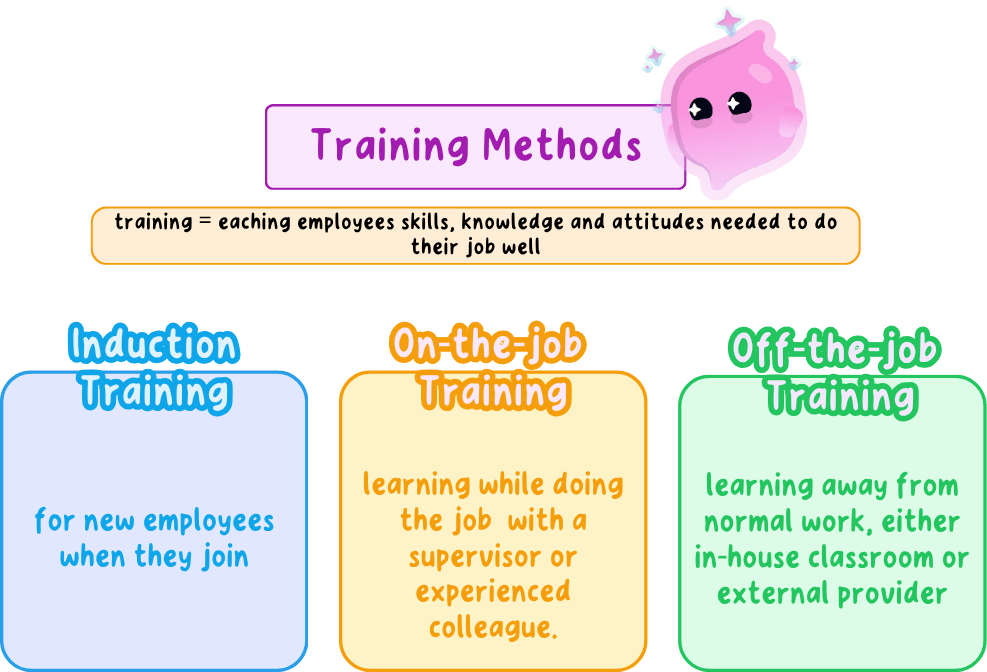
- Businesses use induction, on-the-job and off-the-job training for different reasons, depending on whether the employee needs to settle into the organisation, learn the actual job or develop knowledge and skills away from normal work.
A new supermarket employee may receive induction when joining, learn the till through on-the-job training, and later attend an off-the-job course for a specialist skill.
Induction training helps new employees settle in
Induction training: training given when an employee first joins a business to introduce the workplace, the organisation and the job.
- Induction introduces colleagues, procedures, expectations and practical information, helping reduce early confusion and allowing the new employee to become confident and productive more quickly.
On-the-job training is practical and closely matched to the workplace
On-the-job training: learning while carrying out the job in the workplace, often with guidance from an experienced employee.
- Advantages: the training is directly related to the firm's actual tasks, equipment and working methods, can have a lower direct cost than an external course and may allow the employee to contribute to work while learning.
- Disadvantages: the experienced employee providing the training has less time for their own work, and poor methods or habits can be passed on if the trainer is not effective.
Off-the-job training gives structured or specialist learning away from normal work
Off-the-job training: training carried out away from the employee's normal workplace or normal job duties, such as a course, workshop or college programme.
- Advantages: the employee can learn from specialist trainers, follow a structured programme and concentrate on knowledge or skills that may not be available inside the business.
- Disadvantages: the business may pay course fees and lose the employee's working time, and the training may be less closely matched to the firm's exact equipment or procedures.
Businesses often use a mixture of training types
- Induction suits a new starter, on-the-job training suits practical skills that need to be learned in the real workplace, and off-the-job training can suit specialist or structured learning.
- The business should also consider cost, time away from work, how closely the training must match its own systems and whether suitable expertise already exists inside the organisation.
- Identify the purpose first: settling in, learning the real workplace task or gaining specialist structured knowledge.
- Match that purpose to induction, on-the-job or off-the-job training.
- Then use cost, relevance and time away from work to justify why that method suits the business.
- What is the main purpose of induction training?
- What is the difference between on-the-job and off-the-job training?
- Give one advantage and one disadvantage of on-the-job training.
- Give one advantage and one disadvantage of off-the-job training.
- Why might one employee receive more than one type of training over time?
2.3.1b Health and safety and benefits of training
Training can improve safety, performance and employee skills
Health and safety laws: laws requiring businesses to take reasonable steps to protect employees and others from risks at work.
- Training is one way a business can help employees work safely and effectively. It can therefore support both legal compliance and the wider performance of the business.
A factory trains employees to use machinery correctly and follow safe lifting procedures, reducing the chance of accidents as well as mistakes in production.
Health and safety training helps reduce workplace risk
- Employees who understand safe procedures are less likely to misuse equipment or create avoidable hazards. Fewer accidents can mean less absence, less disruption and lower costs associated with injuries or damaged equipment.
- Training can also help the business show that it has taken health and safety responsibilities seriously. Failure to train staff where training is needed can increase legal, financial and reputational risk if something goes wrong.
Training can benefit both the business and the worker
- For the business, better skills can increase productivity, improve quality and reduce mistakes or waste. Training can also make employees more able to use new equipment or working methods, helping the firm adapt when jobs change.
- For the worker, training can build skills, confidence and employability and can make work safer. Development opportunities may also improve motivation or retention when employees value the chance to learn and progress, although pay and management also affect whether people stay.
Training is worthwhile when the improvement in safety, skills, productivity or quality is greater than the money and working time it costs.
Training also has costs and risks
- Training can cost money through course fees, materials or the time of trainers and employees. Output may also fall temporarily when employees are away from normal work or still learning a task.
- The business does not automatically recover its investment. Training may be poorly chosen or ineffective, and an employee who gains valuable skills may later leave, meaning another employer benefits from some of the training paid for by the original firm.
- Keep the business and worker viewpoints separate.
- For the business, think about productivity, quality, safety, adaptation and cost.
- For the worker, think about skills, confidence, safety and employability, then balance these against the time and cost of training.
- How can training help a business comply with health and safety law?
- Give two benefits of training to a business.
- Give two benefits of training to a worker.
- Give two limitations or costs of training to a business.
- Why might training fail to provide a lasting benefit to the firm that paid for it?