4.3.1a Product development and packaging
Product decisions shape the rest of the marketing mix
Marketing mix: the combination of product, price, place and promotion used to market an offer to customers.
- The product is the good or service being offered, and its features affect the price customers will accept, where it should be sold and how it should be promoted.
Goods are owned; services are experienced
Good: a physical product that a customer can own, such as a phone or a loaf of bread.
Service: an activity performed for a customer, such as a haircut, delivery or journey.
- A good can normally be stored, inspected and owned, while a service is produced and consumed through the customer experience and often depends heavily on the person or system delivering it.
- Many businesses offer both. A restaurant sells food as a physical good but customers also judge the cooking, speed and table service, so the total experience matters.
Product development turns an idea into an offer customers will buy
- The process starts with ideas from customer needs, staff, technology or competitors, then research tests whether enough customers value the idea and are willing to pay for it.
- The business then develops and tests the product or service on a limited scale, using feedback to correct weaknesses before a larger launch. Early sales and customer reactions are monitored after launch so the offer can be adjusted again.
- Advantages: a successful new product can meet a new need, refresh the range and win customers before rivals respond. Disadvantages: development takes time and money, and the investment can be lost if demand is weaker than expected.
Do not treat product development as a straight path to success: each stage is partly about testing whether the idea is still worth funding.
Packaging must protect, inform and help sell the product
Packaging: the container or wrapping used to protect, present and provide information about a product.
- Protection and convenience: packaging can prevent damage, contamination or waste and can make the product easier to carry, open, store or reseal.
- Information: labels can communicate ingredients, instructions, quantity, safety information and dates that customers need or that regulations require.
- Promotion and brand recognition: colour, shape, logo and design can make a product recognisable and help it stand out from competing products.
- The trade-off is cost and environmental impact. More elaborate packaging can improve protection or appearance but increases unit cost and waste, so businesses have to judge how much packaging customers actually value.
A chocolate brand can use a distinctive colour and logo so shoppers recognise it instantly, while still reducing unnecessary plastic or cardboard if customers increasingly value lower-waste packaging.
- For product development, link the stage to how it reduces uncertainty before more money is committed.
- For packaging, identify the function that matters in the business situation: protection, information, convenience or promotion.
- Balance the customer benefit against development cost, packaging cost or environmental impact.
- What is the difference between a good and a service?
- How does market research support product development?
- Give one advantage and one disadvantage of developing a new product.
- Give three functions of packaging.
- Why might a business reduce the amount of packaging it uses?
4.3.1b Product life cycle and portfolio
The product life cycle tracks how sales change over time
Product life cycle: the stages a product passes through as it is developed, launched, grows, matures and eventually declines.
- Development: the business spends on research, design and testing before sales begin, so the product creates cost without revenue.
- Introduction: sales start at a low level while customers learn about the product, so promotion is often heavy and profit may still be low or negative.
- Growth: sales rise quickly as awareness and distribution increase, while growing success can also attract more competitors.
- Maturity: sales reach a high level and growth slows as the market becomes established and competition for customers intensifies.
- Decline: sales fall as customer needs change, substitutes improve or rivals take demand, leaving the business to extend, replace or withdraw the product.
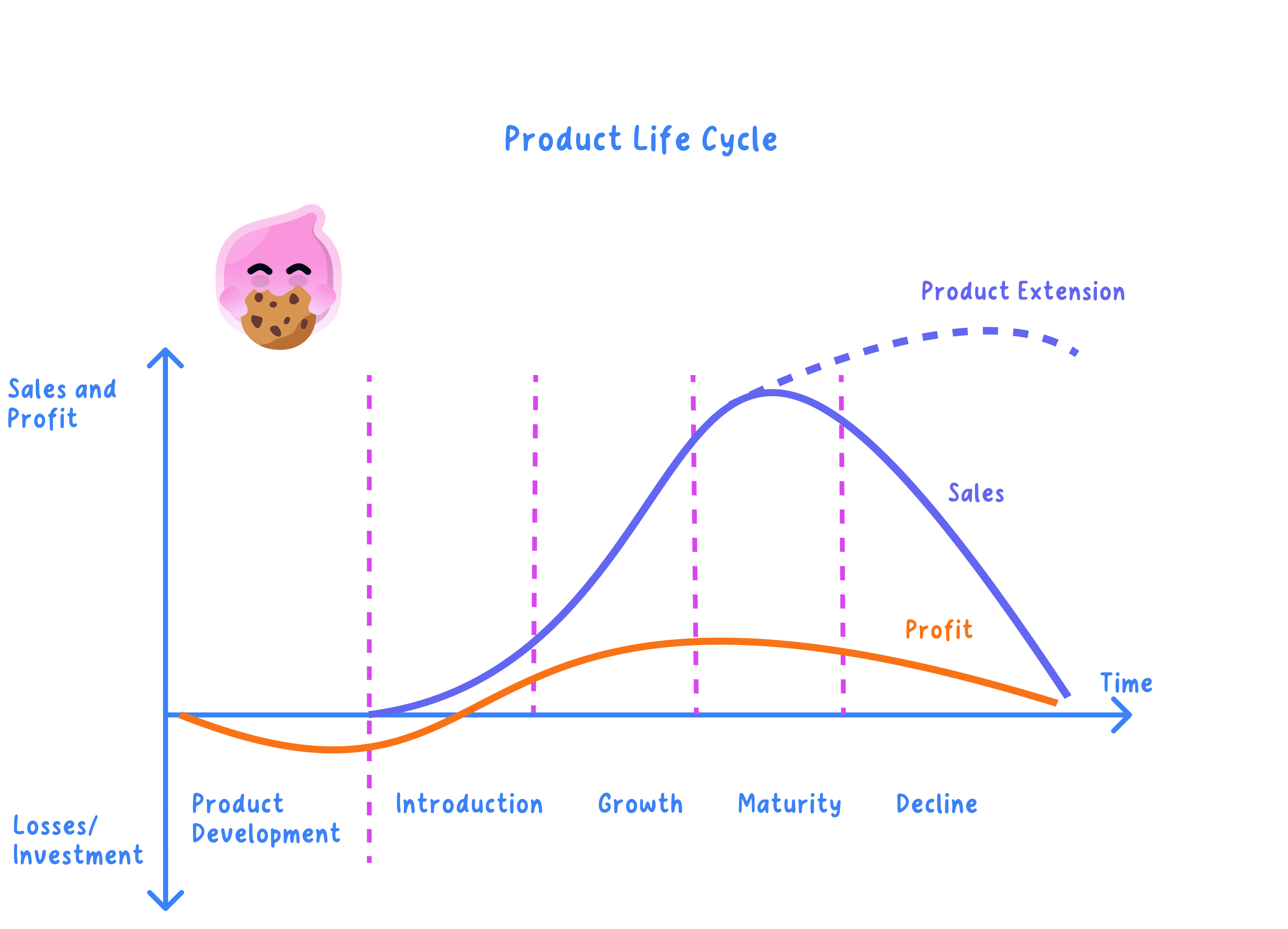
Do not read the stage from the age of the product. A long-established product with high, stable sales can still be in maturity rather than decline.
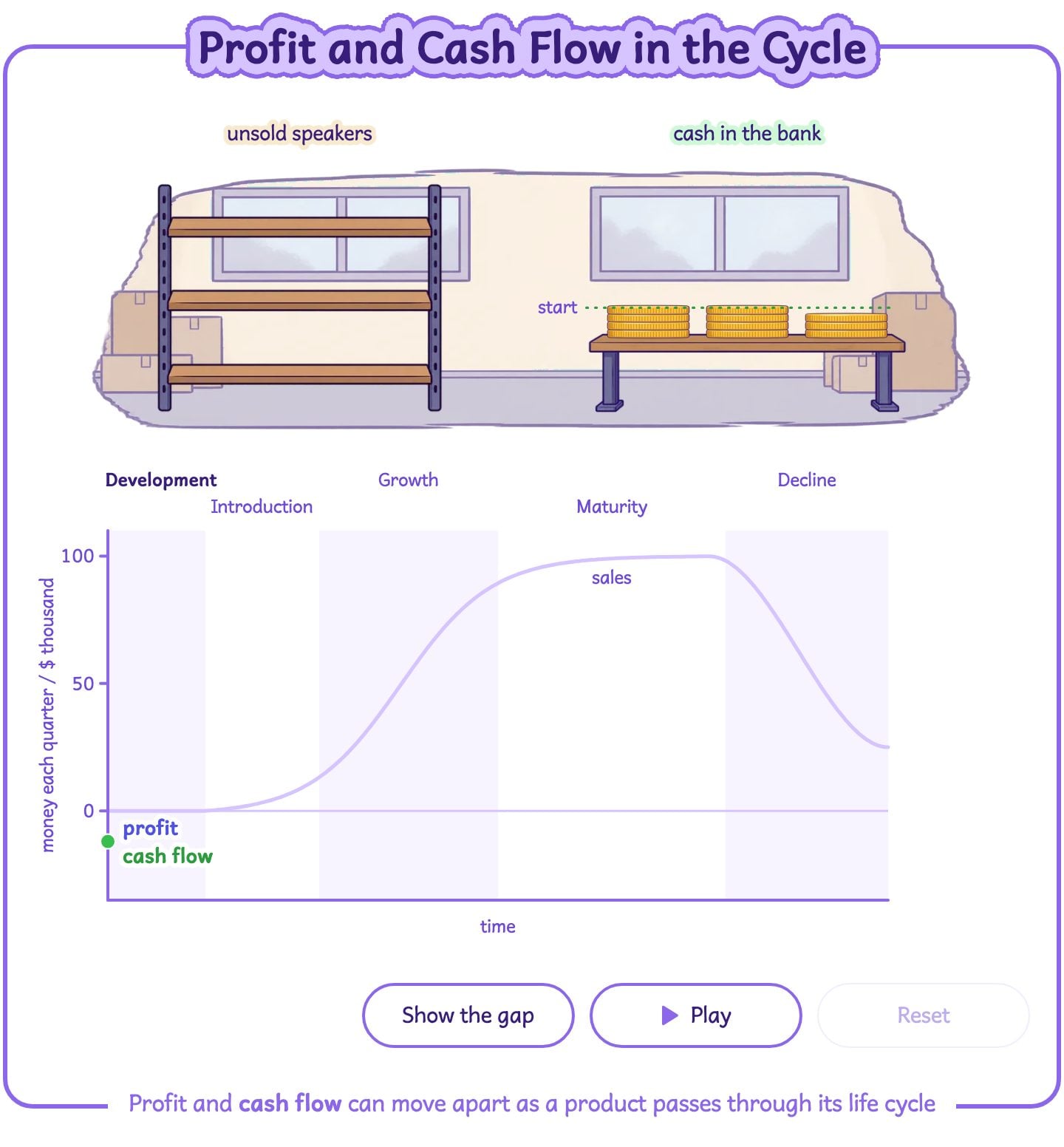
Move through the product life cycle and notice that profit and cash flow do not always move together.
Extension strategies try to delay decline
Extension strategy: an action intended to increase or prolong sales so a product stays viable for longer before decline.
- A business may find new markets or customer segments, promote new uses, update features or design, change packaging, adjust price or refresh promotion. Each aims to create another reason to buy the product.
- Benefit: extra sales can be generated from an existing product without developing a complete replacement. Drawback: extension costs money and may only delay an unavoidable decline if customers no longer value the underlying product.
A mature drink could be repositioned towards a new customer group with updated packaging and promotion, extending its sales if the new position matches a genuine customer need.
A product portfolio spreads risk across different products
Product portfolio: the complete range of products sold by a business.
Boston matrix: a portfolio tool that classifies products using market growth and relative market share.
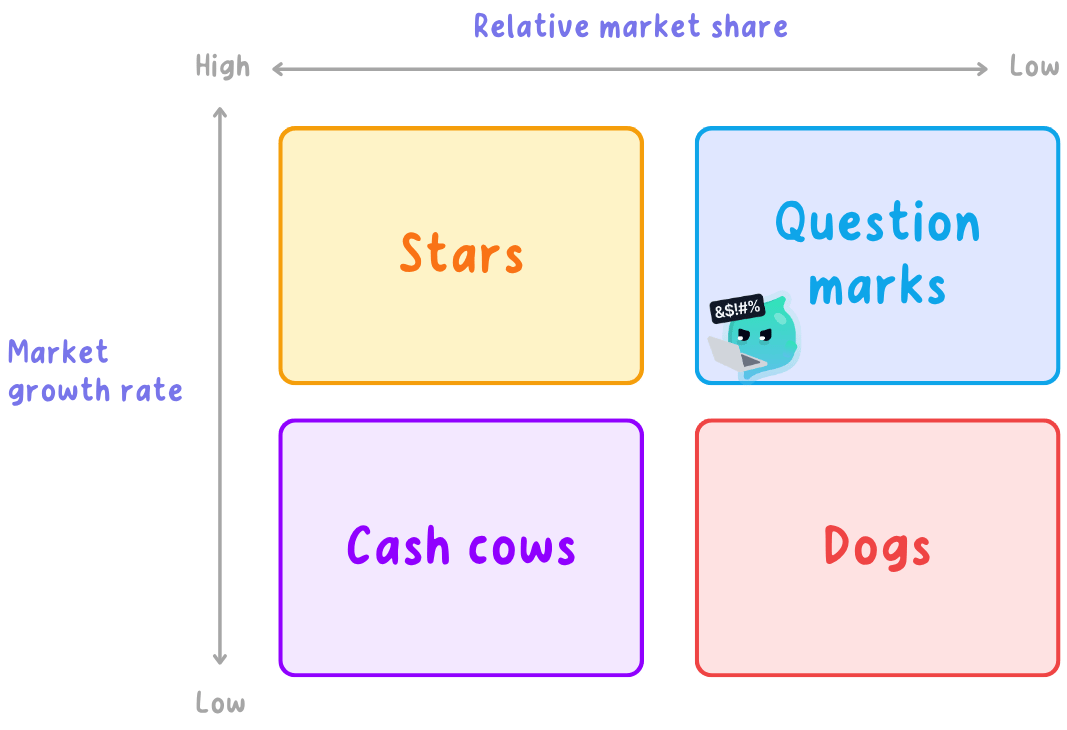
- Stars: high market share in a high-growth market. They can justify continued investment because the market opportunity is expanding.
- Cash cows: high market share in a low-growth market. They can generate cash with less need for major growth investment.
- Question marks: low market share in a high-growth market. Managers must decide whether further investment can build share or whether resources should go elsewhere.
- Dogs: low market share in a low-growth market. They may be candidates for withdrawal if they use resources without supporting the wider portfolio.
The portfolio should balance current cash with future growth
- A business with only mature or declining products may generate cash now but lack future growth, while a portfolio made only of new or fast-growing products may require heavy investment before enough cash is generated.
Use both Boston matrix axes. High market share alone does not make a product a star; the market must also have high growth.
- Identify a life-cycle stage from the pattern of sales, not simply the product's age.
- For an extension strategy, explain what new demand the action is meant to create and what it costs.
- For the Boston matrix, use both market growth and market share before deciding how the business should treat a product.
- Name the stages of the product life cycle.
- Why can a product make a loss during development or introduction?
- Give three possible extension strategies.
- What are the two axes of the Boston matrix?
- Why does a business benefit from a balanced product portfolio?
4.3.2a Cost plus and penetration pricing
Cost-plus and penetration pricing start from different priorities
- Cost-plus pricing starts with the business's cost and adds profit, while penetration pricing starts with winning customers quickly through a low launch price.
Cost-plus pricing adds a markup to unit cost
Cost-plus pricing: setting a price by calculating the unit cost and adding a chosen markup for profit.
- Advantages: the method is simple and makes the intended profit element visible in the price. It can be useful when costs are known and the business needs a consistent way to price many jobs or products.
- Disadvantages: it can ignore what customers are willing to pay and what rivals charge, so the resulting price may be too high to attract demand or lower than the market would have accepted.
A product has a unit cost of £8 and the business uses a 50% markup.
markup=0.50×£8=£4 \text{markup} = 0.50 \times £8 = £4 markup=0.50×£8=£4 selling price=£8+£4=£12 \text{selling price} = £8 + £4 = £12 selling price=£8+£4=£12A cost-plus price does not guarantee the business will make its planned total profit. Customers still have to buy enough units, and the unit-cost estimate must reflect the relevant business costs.
Penetration pricing sacrifices early margin to build sales and market share
Penetration pricing: setting a relatively low price when a product enters a market in order to attract customers and build market share quickly.
- Advantages: a low launch price can persuade customers to try an unfamiliar product and can build sales quickly in a market where established rivals already have loyal customers.
- Disadvantages: early profit per sale is low, rivals may respond with their own price cuts, and customers attracted mainly by the low price may leave when the business later raises it.
The better strategy depends on the market and the business objective
- Cost-plus can suit a business that knows its costs and wants a straightforward pricing rule, especially where customers cannot compare identical offers easily.
- Penetration is more suitable when gaining customers quickly matters, demand is price-sensitive and the business has enough finance to tolerate lower margins while the product becomes established.
- For cost-plus, calculate the markup from the unit cost before adding it to the price.
- For penetration, link the low price to trial, sales volume and market share rather than simply saying it attracts customers.
- Judge the strategy against competition, customer price sensitivity and the business's ability to accept lower margins.
- What is cost-plus pricing?
- A product costs £8 per unit and has a 50% markup. What is the selling price?
- Give one advantage and one disadvantage of cost-plus pricing.
- What is penetration pricing?
- Why might a new business be unable to sustain penetration pricing for long?
4.3.2b Competition, skimming and promotional pricing
Competition, skimming and promotional pricing suit different market situations
Competition pricing uses rival prices as the reference point
Competition pricing: setting a price with close reference to the prices charged by competitors.
- Advantage: this strategy suits markets where customers can compare similar products easily. Matching or pricing close to rivals reduces the risk that price-sensitive customers switch purely because of price.
- Disadvantage: a business may accept a low margin simply because rivals do, and a firm with higher costs may not be able to match a large competitor sustainably.
Price skimming starts high while the product is new or distinctive
Price skimming: setting a high launch price and reducing it over time as the product becomes less new or competition increases.
- Advantages: keen early buyers may accept a premium price, helping the business earn strong margins and recover development costs more quickly. A high price can also support an exclusive or innovative position.
- Disadvantages: the high price limits early demand and can encourage rivals to enter with cheaper alternatives. Skimming is therefore difficult when customers see little difference between competing products.
A genuinely innovative electronic product may launch at a premium price for early adopters, then fall in price as competitors enter and the technology becomes more widely available.
Promotional pricing reduces price temporarily to stimulate demand
Promotional pricing: temporarily reducing the effective price through a sale, discount or special offer to increase purchases.
- Advantages: a temporary offer can increase sales quickly, encourage trial, clear inventories or attract customers during a quiet period.
- Disadvantages: the business earns less on discounted sales and frequent promotions can train customers to wait for the next offer rather than buy at the normal price.
Promotional pricing is temporary. Do not confuse it with penetration pricing, where a deliberately low entry price is used to build market share when a product enters the market.
The product, rivals and objective determine which strategy fits
- Competition pricing becomes more relevant when products are similar and price comparison is easy. Skimming needs enough uniqueness and customers willing to pay for early access. Promotional pricing fits a short-term sales objective rather than a permanent position.
- The business must also consider its costs and cash position. A pricing strategy that attracts demand but leaves too little profit per sale or too little cash cannot be sustained simply because it increases sales.
- Use competition pricing when rival prices strongly influence customer choice.
- Use skimming only when the product has enough novelty or differentiation to justify the high launch price.
- For promotional pricing, explain why a temporary sales boost is worth the lower margin and what happens when the offer ends.
- When is competition pricing most suitable?
- What is price skimming?
- Give one advantage and one disadvantage of price skimming.
- What is promotional pricing?
- Why might frequent promotional pricing damage future profitability?
4.3.3 Place – distribution channels
Place is about making the product available where customers want to buy it
Distribution channel: the route used to make a product available to the final customer.
- The best channel depends on what is being sold, how customers prefer to shop and what the business can afford. A convenient channel can increase sales, while the wrong one can add cost or make the product harder to buy.
Retailers provide physical access and face-to-face service
Retailer: a business that sells goods directly to final customers through physical shops or other retail outlets.
- Advantages: customers can inspect, try or collect the product immediately, and staff can provide advice. Established retailers can also give a producer access to large numbers of shoppers without the producer opening its own stores.
- Disadvantages: physical outlets involve premises and staffing costs, opening hours and location limit access, and a producer using an independent retailer gives up some control over display, service and the final customer relationship.
E-tailers use e-commerce to reach customers online
E-tailer: a retailer that sells products to customers online.
E-commerce: buying and selling goods or services through electronic systems, especially the internet.
- Advantages: online selling can reach customers beyond one local area and take orders at any time. It may also avoid some high-street premises costs and provides useful data on browsing and purchasing behaviour.
- Disadvantages: customers cannot physically inspect many products before buying, delivery and returns create costs, and online price comparison makes competition intense. The business also depends on reliable technology and fulfilment.
- A furniture business may use showrooms because customers want to see and test expensive items before buying.
- A business selling standardised phone accessories may rely more heavily on e-commerce because customers need less advice and can compare specifications easily online.
Many businesses combine physical and online channels
- Using both channels can let customers research online, inspect in store, order for delivery or collect locally. This increases convenience but also requires the business to coordinate inventories, prices and customer service across both routes.
Do not assume online selling is automatically cheaper overall: website systems, digital marketing, warehousing, delivery and returns can replace some of the costs saved on physical shops.
- Start with the product and customer: do buyers need to see, try or receive advice about it?
- Compare the reach and convenience gained with the selling, delivery and service costs created.
- When recommending a channel, name the channel and link it directly to the business situation rather than listing both sets of advantages.
- What is a distribution channel?
- Give two advantages and two disadvantages of selling through physical retailers.
- What is the difference between an e-tailer and e-commerce?
- Give two advantages and two disadvantages of e-commerce.
- Why might a business use both physical and online distribution?
4.3.4a Promotion strategies for segments
Promotion should reach the right segment with the right message
Promotion: communication used to inform, persuade or remind customers about a business, brand or product.
- The best method depends on the target segment, the product, the objective and the budget. Reaching a large audience is not useful if most of that audience is unlikely to buy.
Advertising buys control over the message and audience
- Advertising uses paid media such as television, online platforms, outdoor displays or publications. It can build awareness quickly and can be targeted closely when the media provides detailed audience data.
- The drawback is cost and wasted reach: broad advertising can be expensive, while highly targeted digital advertising can still be ignored or blocked by users.
Sponsorship borrows the image and audience of an event or organisation
- Sponsorship links a brand with an event, team, activity or organisation. It can build recognition and positive associations among a clearly defined audience over a longer period.
- The risk is that sponsorship can be costly and the brand has less control over what happens around the sponsored activity. Negative publicity affecting the event or team can also affect the sponsor.
Trials and special offers encourage action now
- Product trials: free samples or temporary access can reduce the risk customers feel when trying an unfamiliar product. They are especially useful when experiencing the product is more persuasive than describing it.
- Trials cost the business products, staff time or service capacity, and many people who accept a free trial may never become paying customers.
- Special offers: discounts, vouchers, bundles or loyalty rewards can increase purchases quickly and encourage repeat visits.
- The drawback is lower margin and the risk that customers become deal-focused, waiting for discounts rather than valuing the product at its normal price.
Branding supports recognition and loyalty over time
- Branding uses a distinctive name, design, identity and reputation to make an offer recognisable and different from alternatives. Strong branding can reduce customers' perceived risk and support repeat purchases or premium pricing.
- Building a brand takes time and consistent investment, and a damaged reputation can reduce the value created by years of promotion.
- A new protein snack aimed at regular gym users might combine targeted online advertising with in-gym product trials.
- The advertising reaches the segment, while the trial lets customers judge taste before paying for an unfamiliar product.
The segment matters more than assumptions about age alone
- Businesses should use research on the actual segment's media habits and buying behaviour rather than assuming, for example, that all young customers use one platform or all older customers prefer traditional media.
- Identify the target segment and the promotion objective before choosing a method.
- Explain why the method reaches or persuades that specific segment.
- Balance the likely response against cost, wasted reach, lower margin or reputational risk.
- What are the main aims of promotion?
- Give one advantage and one disadvantage of advertising.
- Why can sponsorship help a brand reach a segment?
- When are product trials particularly useful?
- Why can frequent special offers weaken profitability or customer behaviour?
4.3.4b Above/below the line and PR
Above-the-line promotion builds broad awareness; below-the-line promotion targets more directly
Above-the-line promotion: paid promotion through mass media intended to reach a broad audience, such as television, radio, press or large-scale outdoor advertising.
Below-the-line promotion: more targeted promotional activity aimed directly at selected customers, such as sales promotions, direct communication or events.
- Above-the-line methods can create awareness quickly across a large market and suit products with broad appeal. Their disadvantages are high cost and wasted reach when many people exposed to the message are unlikely to buy.
- Below-the-line methods can focus spending on a chosen segment and make customer response easier to track. Their reach is narrower, and the business may need customer data, footfall or an existing relationship before it can target people effectively.
- A national television advert can make millions of consumers aware of a new household brand.
- A personalised voucher sent to existing customers reaches far fewer people but can be aimed at those most likely to respond.
Sales promotions create a short-term reason to buy
- Discounts, vouchers, loyalty rewards, samples and multi-buy offers can encourage trial, speed up purchases or clear inventory. They can be targeted at particular customer groups and the response is often measurable.
- The trade-off is lower margin or the cost of the reward, and repeated promotions can teach customers to delay purchases until another offer appears.
Public relations manages the image and reputation of the business
Public relations (PR): managing communication and relationships with the public in order to build, protect or repair the image of a business or brand.
- PR can involve media stories, events, community activity and communication when problems occur. Positive coverage can be credible because it is not presented as a normal paid advert, and a strong reputation can support trust and loyalty.
- The disadvantage is limited control: journalists, customers and other stakeholders decide how they respond, so coverage may be negative or the business's message may not be repeated exactly as intended.
Do not describe PR as free advertising. PR activity still takes time and money, and media coverage is not guaranteed or fully controlled by the business.
Businesses often combine broad reach with targeted follow-up
- A broad campaign can build awareness, while targeted sales promotions encourage action and PR supports reputation. The combination depends on the audience, objective and available budget rather than one method replacing all others.
- Distinguish broad mass-media reach from more targeted promotional activity.
- For PR, explain the effect on reputation or trust rather than simply calling it advertising.
- Judge the method by reach, targeting, cost, control and the objective of the campaign.
- What is above-the-line promotion?
- What is below-the-line promotion?
- Give one advantage and one disadvantage of each approach.
- How can sales promotions affect short-term demand and profit margin?
- What is public relations, and why does the business have less control over it than paid advertising?
4.3.4c Technology in promotion and branding
Digital promotion can target, measure and respond faster than traditional mass media
- Technology lets businesses aim promotion at selected users, measure responses quickly and change campaigns while they are running. The benefit is greater precision; the risk is dependence on data, platforms and customer attention.
Targeted online advertising focuses spending on likely customers
Targeted online advertising: digital advertising shown to selected users based on characteristics, interests, location or online behaviour.
- Advantages: the business can focus the budget on users who are more likely to be relevant and can track clicks, enquiries or purchases to judge performance.
- Disadvantages: targeting can be less effective when user data is limited or inaccurate, popular audiences can be expensive to reach, and customers may dislike advertising that feels intrusive.
Viral advertising relies on users spreading the message
Viral advertising: promotional content that users share rapidly through social networks, greatly extending its reach.
- Advantages: successful content can reach a very large audience with little additional media spending, and sharing by users can make the message feel more like social content than a conventional advert.
- Disadvantages: virality cannot be guaranteed and the business loses some control once content spreads. A joke, criticism or misunderstanding can travel just as quickly as the intended message.
E-newsletters keep contact with customers who have chosen to hear from the business
E-newsletter: a regular marketing email sent to subscribers with information such as new products, offers or brand content.
- Advantages: newsletters are relatively cheap to send at scale and reach people who have already shown interest in the business, making them useful for repeat purchases and relationship marketing.
- Disadvantages: crowded inboxes reduce attention, messages may be filtered as spam, and excessive emails can cause customers to unsubscribe.
Technology can strengthen a brand, but it can also expose weaknesses quickly
Brand: the identity and reputation that make a business or product recognisable and distinguish it from alternatives.
- A strong brand can build recognition, trust and loyalty, make new products easier to introduce and sometimes support a higher price because customers perceive less risk in choosing a familiar name.
- Digital channels help a brand communicate consistently and interact directly with customers, but negative reviews or criticism can also spread quickly and damage a reputation that took years to build.
- A small sportswear business can target local runners with online advertising, invite interested customers to an email list and use consistent visual branding across both channels.
- The technology improves reach and measurement, but the brand still depends on the product and customer experience matching the promises made online.
Do not assume digital promotion is automatically cheap or successful. The business may still pay heavily for competitive audiences, content creation, technology and skilled staff.
- Identify what the technology changes: targeting, reach, speed, measurement or customer contact.
- Link that benefit to the target segment or promotional objective in the situation.
- Balance it against cost, privacy, loss of control or the risk of damaging the brand online.
- What is targeted online advertising?
- Give one advantage and one disadvantage of targeted online advertising.
- Why is viral advertising difficult for a business to control?
- Why can e-newsletters be useful for customer retention?
- Give three benefits of building a strong brand.