4.2.1a Satisfying and retaining customers
Marketing starts with understanding and satisfying customer needs
Marketing: identifying customer needs and meeting them in a way that supports the business's objectives.
- Marketing is wider than promotion: it includes understanding what customers value and then shaping the product, price, distribution and communication around those needs.
Meeting needs helps win the sale and encourages positive word of mouth
- Customers may value price, quality, choice, convenience, reliability or service. A business that performs strongly on the needs its target customers care about is more likely to win sales from rivals.
- Satisfied customers may also recommend the business or leave positive reviews, which can attract other buyers without the business paying directly for that recommendation.
A takeaway that consistently delivers the correct order quickly and at a price its customers accept is more likely to win repeat business than a nearby rival that is slow or unreliable.
Relationships give customers reasons to return after the first purchase
- Businesses can build relationships through helpful after-sales service, responding to feedback and keeping useful contact through email, apps or social media rather than treating the sale as the end of the interaction.
- A strong relationship can make customers less willing to switch for a small price difference because they already trust the service and know what to expect.
Customer loyalty creates repeat sales and can lower the cost of generating revenue
Customer loyalty: when customers repeatedly choose the same business or brand rather than switching to competitors.
- Loyal customers provide repeat sales and can make future revenue more predictable. They may also buy a wider range of products as their trust in the business grows.
- Retaining a satisfied customer can cost less than constantly attracting replacements through advertising or introductory offers, although loyalty schemes and relationship marketing still have costs of their own.
- A supermarket loyalty scheme can reward repeat purchases with points or personalised offers.
- The scheme can also provide purchasing data that helps the supermarket make future offers more relevant to each customer.
Do not treat customer satisfaction and loyalty as the same thing: a customer can be satisfied with one purchase but still switch to a rival next time.
The three ideas reinforce each other
- Satisfying important needs makes a positive relationship more likely, and a positive relationship increases the chance of loyalty. Together they can support repeat sales and long-term profitability.
- Identify the customer need the business must satisfy in the situation.
- Trace how satisfying that need can affect repeat purchases, recommendations or switching behaviour.
- Keep satisfaction, relationships and loyalty distinct rather than using the terms interchangeably.
- What is marketing?
- Give three customer needs a business may try to satisfy.
- How can a business build a customer relationship after the sale?
- What is customer loyalty?
- Why can loyal customers be valuable to a business?
4.2.1b Orientation and market approach
Businesses can start with the market or start with the product
Market orientation: using research into customer needs as the starting point for product and marketing decisions.
Product orientation: focusing first on developing a product based on the business's own expertise, quality or innovation, then finding customers for it.
- Market orientation can reduce the risk of producing something customers do not want and helps the business respond to changing tastes. The trade-off is the time and cost of research, and following current preferences too closely can make the business less willing to lead with a new idea.
- Product orientation can create distinctive or technically advanced products and suits firms with strong specialist expertise. Its main risk is spending heavily on a product before knowing whether enough customers will value it.
Do not treat the two approaches as absolute opposites: many businesses innovate internally but still use customer research to refine features, price and launch decisions.
Market share shows the business's sales relative to the whole market
Market share: the percentage of total sales in a market made by one business or brand.
- A rising market share means the business is taking a larger proportion of total market sales, while a falling share means rivals are growing faster relative to it.
- Sales and market share can move differently. Sales can rise while market share falls if the whole market grows faster than the business, so the share should be compared over time rather than judged from sales alone.
A drinks business sells £2 million in a market with total sales of £20 million.
£2m£20m×100=10% \dfrac{£2\text{m}}{£20\text{m}} \times 100 = 10\% £20m£2m×100=10%Its market share is 10%. A later figure becomes useful when compared with this 10% starting point.
Mass and niche marketing choose different sizes of target market
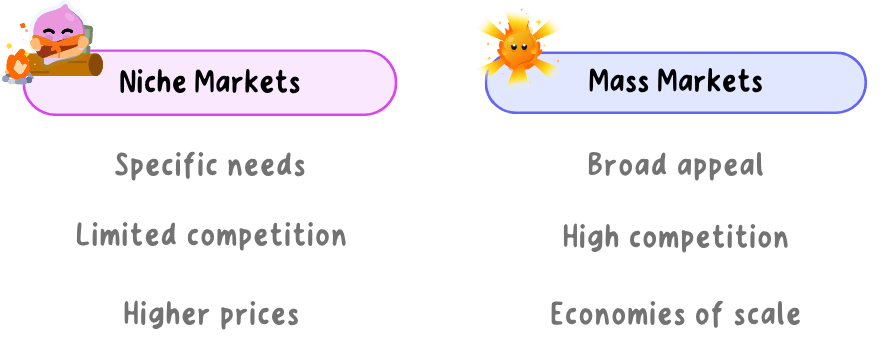
Mass marketing: targeting a broad market with a product designed to appeal to a large number of customers.
Niche marketing: targeting a small, clearly defined part of a market with specific needs.
- Mass marketing offers a much larger potential sales volume and can support economies of scale and strong brand awareness. The disadvantages are intense competition and the difficulty of making one offer satisfy very different customers.
- Niche marketing lets the business tailor the offer closely to one group's needs, which can support loyalty and premium prices. The disadvantages are a smaller customer base and greater dependence on the tastes of one narrow group.
The right approach depends on the product, resources and market
- A small specialist business may be better able to understand and serve a niche than compete for the whole market, while a large business with scale, distribution and promotion resources may be better placed to pursue a mass market.
- For orientation, link the approach to how much the business relies on customer research or its own product expertise.
- For market share, compare the percentage over time rather than judging sales in isolation.
- For mass versus niche, balance the size of the opportunity against competition, specialisation and the firm's resources.
- What is the difference between market and product orientation?
- How is market share calculated?
- Why can sales rise while market share falls?
- Give one advantage and one disadvantage of mass marketing.
- Give one advantage and one disadvantage of niche marketing.
4.2.2a Changing customer needs and spending
Customer needs and spending patterns change over time
- A product can lose sales even when the business has done nothing wrong operationally, because customer priorities, incomes, lifestyles and technology can change what people want to buy.
- Businesses therefore need to monitor sales trends, customer feedback and market research so they can distinguish a temporary fluctuation from a more lasting change in the market.
Needs can shift towards convenience, quality and wider values
- Convenience: customers may increasingly value online ordering, delivery, longer access or faster service, so businesses that make buying easier can gain an advantage.
- Quality and reliability: reviews and easy price comparison can make poor quality visible quickly, raising pressure on businesses to maintain consistent standards.
- Ethical and environmental concerns: some customers increasingly consider packaging, sourcing and environmental impact as well as price and quality, which can influence product and supplier choices.
Income, tastes and technology can redirect spending
Spending patterns: how consumers divide their spending between different products and services, and how that allocation changes over time.
- Income: when disposable income rises, some consumers may trade up to higher-quality or luxury products; when budgets are squeezed, demand can shift towards cheaper alternatives and value ranges.
- Tastes and trends: health concerns, fashion and changing lifestyles can increase demand for some products while reducing demand for others.
- Technology: new technology can create new ways of consuming and make older products less attractive, as digital services can replace physical alternatives.
- If customers shift towards plant-based food, a café may add new menu options rather than relying only on its existing range.
- The change can attract new customers, but the café should test demand before committing heavily because a trend may be weaker locally than it appears nationally.
The business response should match the type of change
- A change in customer needs may require a different product, quality level or service. A change in spending power may require a value range, smaller pack size or premium alternative, depending on which customers are affected.
- Changes in buying habits may also require different distribution or promotion, such as selling online or communicating through media that the target customers now use.
- Responding has costs, so managers should judge whether the change is significant and lasting enough to justify redesign, new equipment, retraining or promotion.
Do not assume every customer responds in the same way to a change in income or taste: identify which target group is affected and what that means for this business.
- Identify what has changed: need, income, taste, technology or buying habit.
- Trace how that change affects demand for the business's current offer.
- Judge whether the likely benefit of adapting is worth the cost and risk of the response.
- Give three ways customer needs can change over time.
- What are consumer spending patterns?
- How can lower disposable income affect spending choices?
- Give one way technology can change spending patterns.
- Why should a business test whether a market change is lasting before making a costly response?
4.2.2b Increased competition
More competition increases the pressure to win and keep customers
Competition: rivalry between businesses trying to sell similar products to the same or overlapping customers.
- Competition can increase when new firms enter, existing rivals expand, or online and overseas sellers gain easier access to the same customers.
- A market can therefore become more competitive even when no new local shop opens, because customers can compare and buy from businesses far beyond their immediate area.
Competition can reduce margins but also force improvement
- Price and profit pressure: easier comparison gives customers more alternatives, so a business may lose sales if its price is too high or reduce its profit per sale if it discounts to match rivals.
- Sales and market share: customers switching to rivals can reduce revenue and market share, especially when the business offers little reason to stay.
- Pressure to improve: stronger rivalry can encourage businesses to improve quality, remove waste, innovate and offer better service. These responses cost money but can make the firm more competitive over time.
The response does not have to be a price cut
- A business can compete on price when customers are highly price-sensitive, but a price cut reduces the amount earned on each sale and can trigger a price war that damages the whole market.
- It can instead differentiate through product quality, features, branding, convenience, delivery or customer service, giving customers a reason to stay even when another business is cheaper.
- Promotion and loyalty schemes can also protect awareness and repeat purchases, although the extra spending is worthwhile only if the sales or loyalty created justify the cost.
- A small independent café facing a low-price chain may be unable to win a sustained price war because its unit costs are higher.
- It may be better to compete through distinctive products, local service or atmosphere if those features matter to its target customers.
Do not assume increased competition is always bad for the business: it creates pressure and cost, but it can also drive improvements that make the business stronger.
The best response depends on why customers choose between rivals
- If customers mainly choose on price, cost control and competitive pricing matter more. If they choose on quality, brand, convenience or service, matching the cheapest rival may sacrifice profit without addressing the real reason for the choice.
- Identify how the competition has increased and which customers are at risk of switching.
- Choose a response that matches what those customers value, rather than automatically recommending a price cut.
- Balance the sales or market share protected against the cost or lower margin created by the response.
- Give three reasons competition in a market can increase.
- How can increased competition affect prices and profit margins?
- Give two ways competition can improve a business.
- Give three ways a business can respond without cutting price.
- Why might a small business avoid a price war with a large rival?
4.2.3 Market segmentation
Market segmentation divides customers into groups with similar needs
Market segmentation: dividing a market into groups of customers with similar characteristics or needs so the business can target them more effectively.
Market segment: one identifiable group within the market whose members share relevant characteristics or buying needs.
- Customers buying the same type of product can want very different things, so segmentation helps a business avoid designing one offer for everyone.
- A holiday business, for example, may serve families wanting convenience, young travellers wanting low prices and older customers wanting comfort, even though all three groups are buying a holiday.
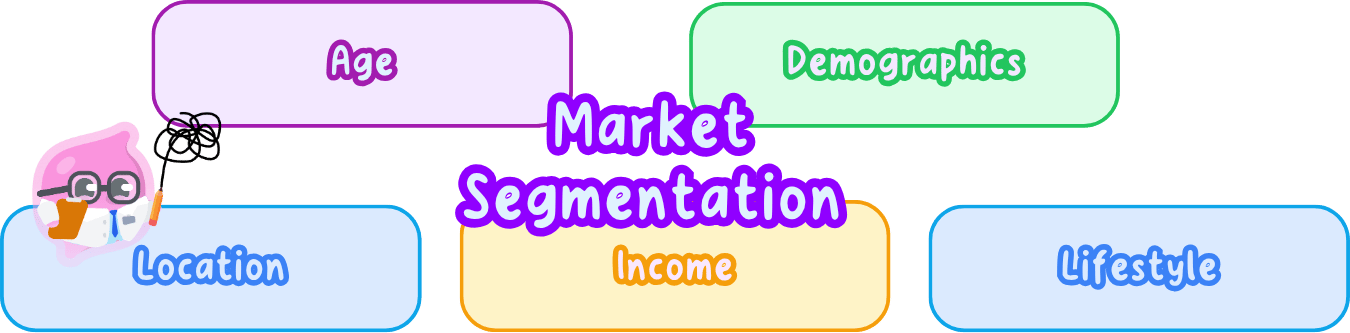
Edexcel uses five main bases for identifying segments
- Location: customers are grouped by where they live, such as country, region or climate. A clothing business may emphasise heavier coats in colder markets and lighter ranges in warmer ones.
- Demographics: customers are grouped by characteristics such as gender, family size or occupation, allowing products and communication to be adapted to relevant differences.
- Lifestyle: customers are grouped by interests, attitudes or how they live, such as fitness-focused or environmentally conscious consumers.
- Income: customers are grouped by spending power, helping a business decide whether to offer budget, mid-market or premium products.
- Age: customers are grouped into age ranges because products, media habits and buying priorities often differ between children, teenagers, adults and older consumers.
- A sportswear business might target a lifestyle segment of regular runners rather than everyone of the same age or income.
- It could then design running-specific products and advertise through channels used by that group, making the marketing more relevant.
Segmentation makes the marketing mix more precise
- A clearly defined segment lets the business tailor product features, price, distribution and promotion to the needs and behaviour of that group rather than spending equally on people who are unlikely to buy.
- Studying segments can also reveal underserved groups and possible gaps in the market, giving the business an opportunity to create a more specialised offer.
A segment still has to be worth targeting
- Researching and serving separate groups costs money, and a segment may be too small to justify its own product, packaging or promotion.
- Segments also change over time, and people within the same category are not identical, so businesses should avoid relying on outdated profiles or stereotypes.
Do not assume one customer belongs to only one segment: the same person can be grouped by location, age, income and lifestyle at the same time.
- Identify the segmentation basis from the customer information given.
- Link the chosen segment to a specific change in product, price, place or promotion.
- Consider whether the segment is large and profitable enough to justify targeting separately.
- What is market segmentation?
- Name the five Edexcel bases for market segmentation.
- How can lifestyle segmentation differ from age or income segmentation?
- How can segmentation make promotion more efficient?
- Give two limitations of market segmentation.