Interest rates affect businesses and consumer spending through the cost of borrowing
Definition
Interest rate: the cost of borrowing money, or the return from saving it, expressed as a percentage.
- A change in interest rates can reach a business in two ways. It changes the cost of the firm's own borrowing and it changes how much some consumers are willing or able to spend.
Example
A housebuilder can be affected twice by higher interest rates. Its own borrowing becomes more expensive, while potential buyers facing higher mortgage costs may delay purchasing a home.
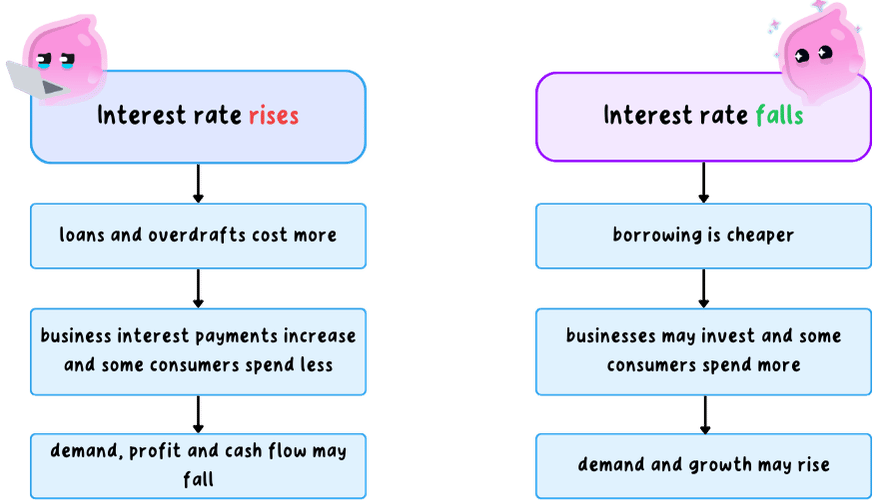
Higher interest rates
- Business borrowing becomes more expensive: interest payments on loans and overdrafts can rise, increasing costs and reducing the profit left after expenses.
- A business planning to borrow for new machinery or another branch may delay the investment if the expected repayments become too expensive.
- Consumer spending may fall: households with mortgages or other borrowing may have less disposable income after higher interest payments, while saving can become more attractive.
- Businesses selling non-essential or expensive products may see a larger fall in demand because customers can postpone those purchases more easily.
Lower interest rates
- Business borrowing becomes cheaper: lower interest costs can reduce expenses and make borrowing for investment more affordable.
- A business that had delayed opening a new site may decide the investment is now affordable because the cost of finance has fallen.
- Consumer spending may rise: some households have lower borrowing costs and saving offers a smaller return, so more income may be spent on goods and services.
Some businesses are affected more than others
- Businesses with large loans are more exposed to changes in borrowing costs. Debt-free businesses may feel little direct effect through their own finances.
- Businesses selling expensive products commonly bought using credit can also be strongly affected because the customer's cost of finance changes at the same time.
- A car dealer may be more sensitive to interest-rate changes than a convenience store because customers are much more likely to use borrowing when buying a car than when buying everyday groceries.
Exam technique
Check both channels for this topic: the firm's borrowing costs and its customers' spending. Which channel matters more depends on the business in the case.
Self review
- What is an interest rate?
- How can higher interest rates affect a business's own costs?
- How can higher interest rates affect consumer spending?
- How can lower interest rates encourage business investment?
- Why are some businesses more affected by interest-rate changes than others?