Risk, ownership and liability determine how much an owner can lose
- The form of ownership affects the financial risk faced by the owner. The possible loss from failure is very different for an unincorporated owner and a shareholder in a limited company.
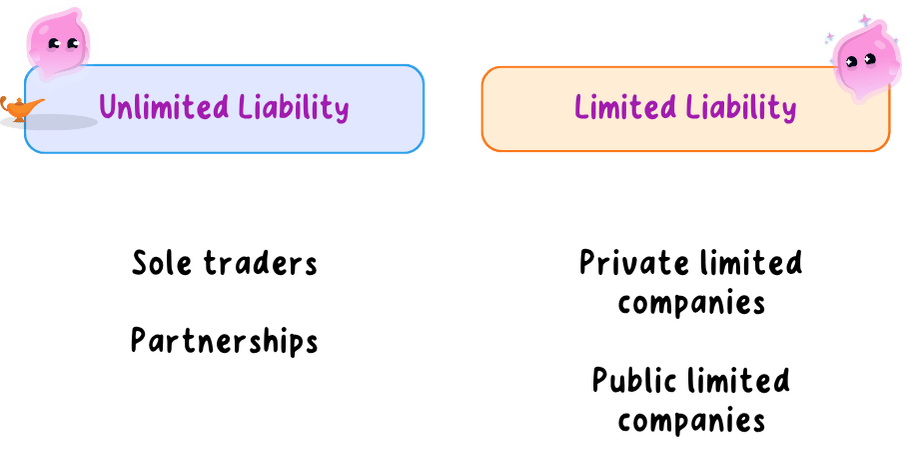
Unlimited liability
Definition
Unlimited liability: the owner is personally responsible for the business's debts, so personal savings and possessions may be at risk if the business cannot pay what it owes.
- There is no separate legal identity: sole traders and partnerships are unincorporated, so business debts are also the responsibility of the owner or partners.
- Personal wealth can be at risk: if the business cannot pay what it owes, the owner may have to use personal savings or other possessions to meet the debts.
- If a sole trader closes with £30,000 of unpaid business debts, the owner's responsibility does not stop at the money originally invested in the business.
- Risk can influence decisions: an owner with unlimited liability may be more cautious about borrowing heavily or making an expansion that could create large debts.
Limited liability
Definition
Limited liability: shareholders are normally responsible for company debts only up to the amount they have invested, so their personal assets are protected if the company fails.
- The company is legally separate: an incorporated company owes its own debts, so shareholders are not normally personally responsible for the full amount the company owes.
- The possible loss is capped: a shareholder may lose the value of the investment in the company, but personal assets are normally protected from company debts.
- A shareholder who invests £5,000 in a company that later fails may lose the £5,000 investment, but is not personally required to repay all of the company's remaining debts.
- Limited liability can encourage investment: people may be more willing to buy shares when they know the amount they can lose is limited.
Common Mistake
Do not read limited liability as a limit on the size or ambition of the business; it limits the owners' personal financial exposure if the company fails.
Public ownership can protect services but may weaken efficiency pressures
- Reason for public ownership: the government can ensure that an important service is provided even where serving every area or customer is not highly profitable.
- Public ownership can allow decisions to focus on service availability and wider public needs rather than only on returns to private shareholders.
- Reason against public ownership: without the same pressure from private owners and competitors, there may be less incentive to control costs or improve efficiency.
- If a publicly owned organisation makes persistent losses, government funds may be needed to support it, creating an opportunity cost for other public spending.
Ownership and liability change together as a business incorporates
- A business that grows from a small owner-managed operation into a company changes not only who can own it but also how financial risk is divided between the organisation and its owners.
- This can make incorporation attractive when potential debts become much larger, because the protection of limited liability becomes more valuable as the financial commitments of the business increase.
Self review
- What is the difference between limited and unlimited liability?
- Why can unlimited liability affect an owner's willingness to borrow or expand?
- Why can limited liability encourage investment in a company?
- Give one reason for public ownership.
- Give one reason against public ownership.