Revenue and costs are the building blocks of profit and break-even
- Revenue shows the value of sales, while fixed and variable costs show what the business has to pay to produce and operate; total cost combines the two types of cost.
Revenue depends on price and the quantity sold
Definition
Revenue: the value of a business's sales over a period of time.
Example
revenue=selling price×quantity sold
\text{revenue} = \text{selling price} \times \text{quantity sold}
revenue=selling price×quantity sold
£10×500=£5,000
£10 \times 500 = £5{,}000
£10×500=£5,000
Fixed costs stay constant with output while variable costs change
Definition
Fixed costs: costs that do not change directly when the level of output changes, such as rent or a fixed salary.
Variable costs: costs that change as output changes, such as raw materials, packaging or piece-rate labour.
- The simplest test is to ask what happens to the total cost when one more unit is produced: a cost that rises with the extra output is variable, while a cost that remains unchanged is fixed.
- Total variable cost rises with output, but total fixed cost remains unchanged within the relevant period even if no units are produced.
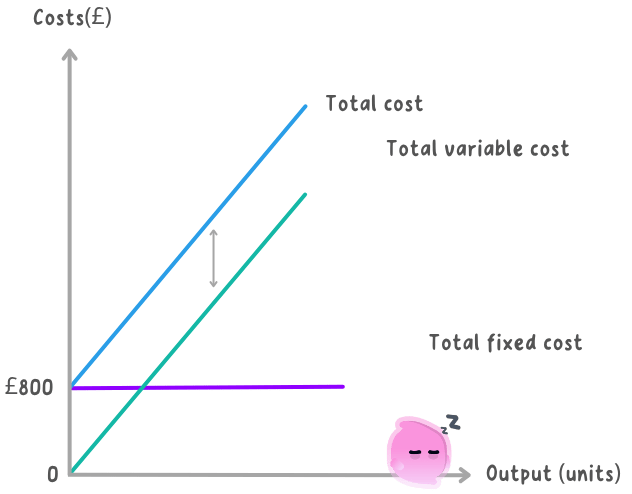
Common Mistake
Do not assume every wage payment is variable: a fixed monthly salary is a fixed cost, while piece-rate pay that rises with output is variable.
Total cost adds fixed and variable costs together
Definition
Total costs: the combined fixed and variable costs of the business at a given level of output.
Example
A business has fixed costs of £2,000, variable cost of £3 per unit and produces 500 units.
total variable costs=£3×500=£1,500 \text{total variable costs} = £3 \times 500 = £1{,}500 total variable costs=£3×500=£1,500 total costs=£2,000+£1,500=£3,500 \text{total costs} = £2{,}000 + £1{,}500 = £3{,}500 total costs=£2,000+£1,500=£3,500Changing output affects variable costs but not fixed costs in the same way
- If output in the example doubles from 500 to 1,000 units, total variable costs double from £1,500 to £3,000 while fixed costs stay at £2,000, giving total costs of £5,000.
- This difference is important for profit and break-even calculations because the level of output changes revenue and variable costs while fixed costs must still be covered.
Exam technique
- Use price multiplied by quantity sold for revenue.
- Classify a cost by whether its total changes when output changes, not by whether the payment feels large or important.
- Calculate total variable cost before adding fixed cost when total cost is not given directly.
Self review
- State the formula for revenue.
- What is a fixed cost? Give two examples.
- What is a variable cost? Give two examples.
- With fixed costs of £2,000 and total variable costs of £1,500, what are total costs?
- Why can a salary be a fixed cost while piece-rate pay is variable?