Business failure can result from finance problems, weak competitiveness or failure to adapt
Definition
Business failure: when a business is forced to stop trading because it can no longer continue operating, for example because it cannot meet its financial obligations or generate enough demand and cash to survive.
- The causes of failure often interact. A business that loses customers because it is uncompetitive can experience falling revenue, which then creates cash-flow problems and makes it harder to raise additional finance.
Example
A business can have valuable assets and customer orders but still fail if it does not have enough cash available when wages, rent or supplier payments are due.
Cash-flow problems can leave a business unable to pay its bills
- Cash-flow problems: a business fails if it cannot obtain enough cash to meet payments when they are due, even if it appears profitable overall.
- A firm may have made a profitable sale but still face a cash shortage if the customer will not pay for several weeks while wages and suppliers must be paid now.
- Lack of finance: a business may be unable to raise the money needed to survive a difficult period, replace essential assets or finance changes needed to remain competitive.
- A new business with little trading history may find lenders unwilling to provide more finance after an unexpected fall in sales.
Common Mistake
Do not use cash-flow problems and lack of finance as the same cause: cash flow is about having cash available at the right time, while lack of finance is about being unable to obtain enough funding.
Weak competitiveness can drive customers towards rival businesses
- Customers switch to stronger competitors: a business can lose demand if competitors offer lower prices, better quality, stronger customer service or products that customers prefer.
- If sales fall far enough, revenue may no longer cover the business's costs and the firm may be unable to continue.
- High costs can also weaken competitiveness: a business with higher costs than its rivals may have to charge higher prices or accept a lower profit margin, leaving it less able to respond to competition.
Failure to adapt can leave a business selling what the market no longer wants
- Customer tastes can move away from the firm's products: if the business continues offering products that customers no longer want, demand and revenue can decline.
- Technological change can make an existing product or business model less attractive: firms that fail to adopt new ways of producing, selling or delivering value may lose customers to businesses that do adapt.
- A video-rental business that continues relying on physical rentals while customers move to streaming can see its market disappear.
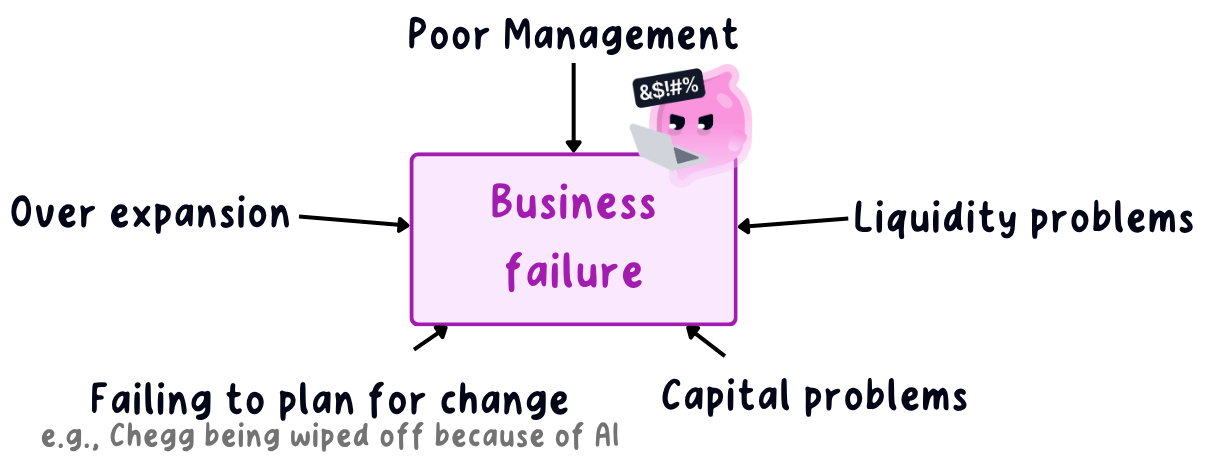
The causes of failure can reinforce one another
- Failure is often the end of a chain rather than one isolated event. A firm that fails to adapt may lose competitiveness, which reduces sales, creates cash-flow problems and makes lenders less willing to provide finance.
- Which cause is most serious depends on the business. A new firm with very little cash may be most vulnerable to finance problems, while an established business in a fast-changing market may be more threatened by failing to adapt.
Self review
- How can cash-flow problems cause a profitable business to fail?
- What is the difference between a cash-flow problem and a lack of finance?
- Why can weak competitiveness lead to business failure?
- How can failure to adapt to changing tastes or technology lead to failure?
- How can one cause of failure lead to another?