Quality means consistently meeting the standard customers expect
Quality: the extent to which a good or service meets the standards and expectations required by customers and is fit for its purpose.
- Poor quality can create returns, refunds, rework, complaints and lost repeat business. Quality management therefore matters in both manufacturing and services, even though the way quality is checked can differ.
Quality control relies on inspection to identify faults
Quality control: checking output against an agreed quality standard so faulty goods or poor service can be identified.
- In manufacturing, inspectors may test every finished unit or a sample from a batch, depending on the product, value, safety risk and cost of testing. Output that fails can be rejected, reworked or investigated.
- Advantages: inspection creates a clear barrier before defective output reaches customers and can be introduced without making every production employee responsible for the whole quality system.
- Disadvantages: faults may be found only after materials, labour and machine time have already been spent, inspectors add cost, and sampling may miss defects in untested units.
A drinks producer can check bottles from the line for fill level and seal quality. This can stop a faulty batch reaching shops, but any rejected bottles have already used ingredients, packaging and production time.
Total quality management makes quality everyone's responsibility
Total quality management (TQM): an approach in which quality is built into every stage of the organisation's work and employees take responsibility for preventing and correcting problems as they arise.
- Under TQM, employees check the quality of their own work and the inputs they receive from earlier stages, so a fault is more likely to be identified close to where it is created rather than after the whole product is finished.
- Advantages: finding problems earlier can reduce waste and rework, while wider responsibility can improve problem-solving and employee involvement when staff are properly trained and supported.
- Disadvantages: training and changing working practices take time and money, and the system is weaker if employees do not understand the standards or managers do not support the responsibility they are given.
Keep the distinction clear: quality control relies on checking output for faults, while TQM tries to build quality responsibility into the whole process so problems are prevented or corrected earlier.
Services need quality standards too, even though the service cannot be stored and checked first
- A service business can set standards for waiting time, accuracy, cleanliness or customer care and use observation, customer feedback or performance data to identify where service falls below the expected level.
- TQM principles can be particularly useful because employees delivering the service can identify and correct problems during the customer experience, although a poor interaction cannot always be undone after the customer has received it.
The appropriate approach depends on the cost and consequence of failure
- Final inspection remains valuable where a defect reaching the customer would be dangerous or very costly, while TQM becomes more attractive when preventing repeated faults and reducing waste across the process are major priorities. Businesses can also use elements of both.
- Distinguish the systems by where responsibility for quality sits and when problems are identified.
- For quality control, consider the protection gained against the cost of late detection and inspection.
- For TQM, balance earlier prevention and worker involvement against training and implementation demands.
- What does quality mean in business?
- What is quality control?
- What is TQM?
- Give one advantage and one disadvantage of each approach.
- How can a service business monitor or improve quality?
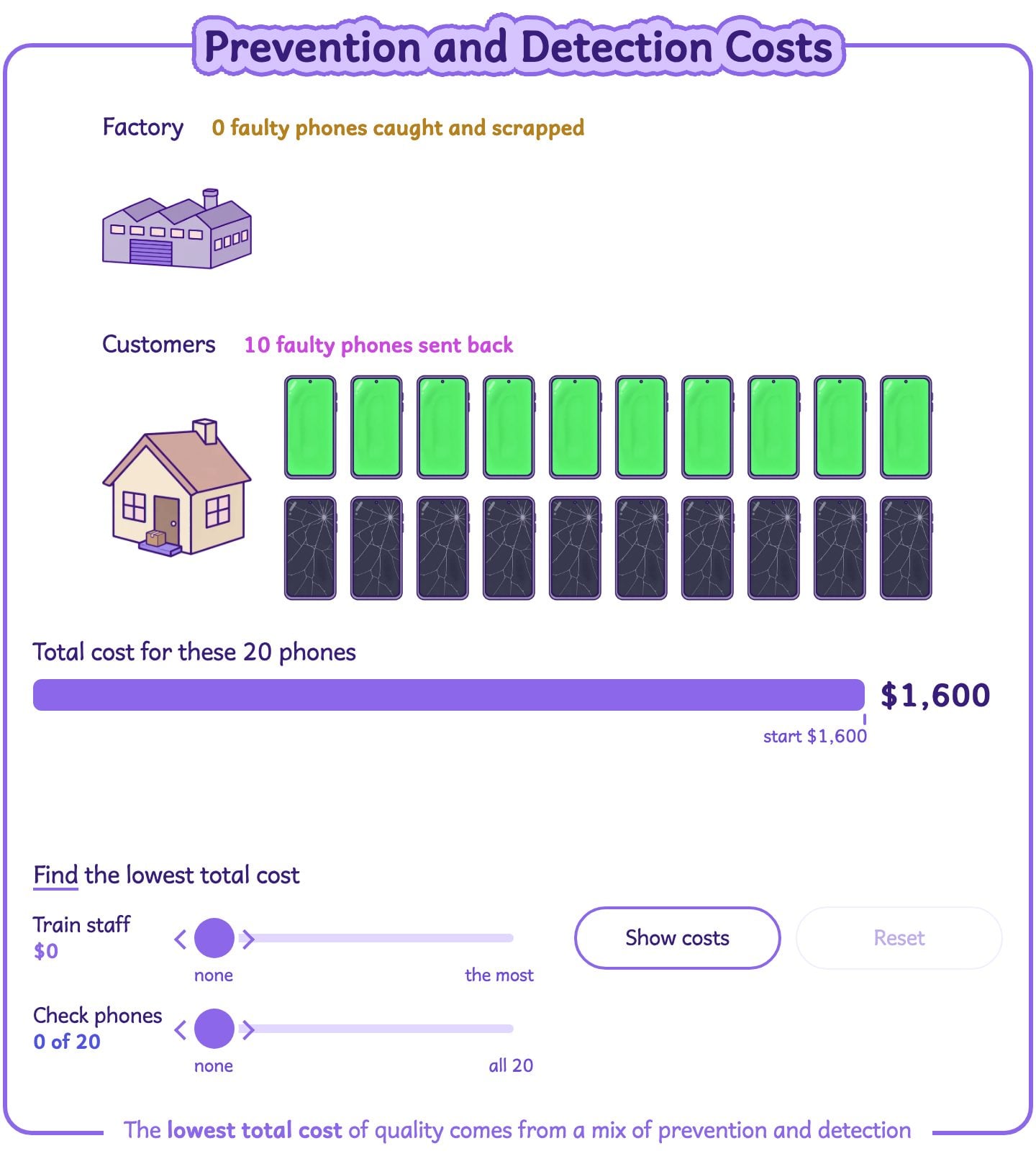
Adjust prevention and detection spending and look for the mix with the lowest total cost of quality.