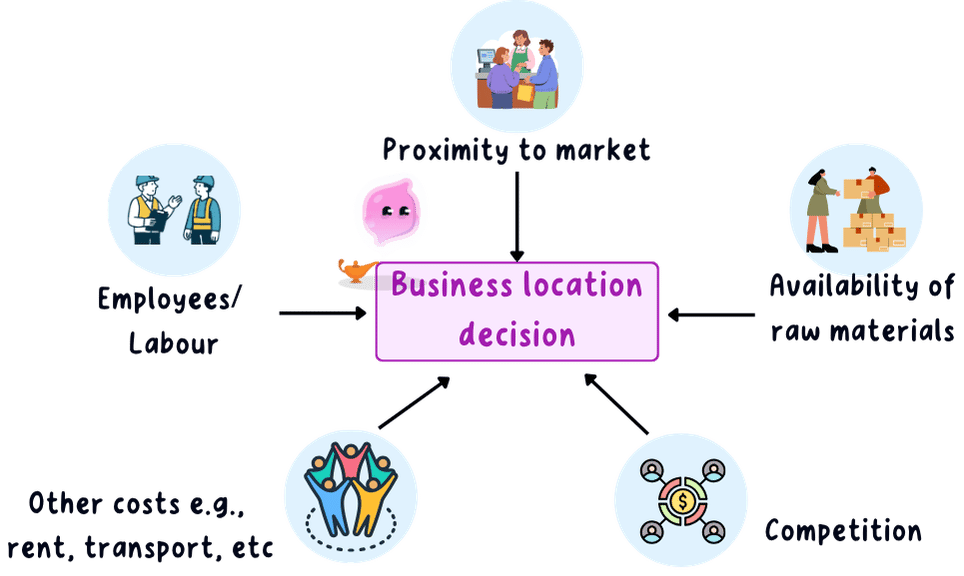
Location depends on what the business needs to be close to and what activity it carries out
- A location affects access to customers, workers, materials and competitors. The importance of each factor depends on the nature of the business activity, so the best location for one firm can be unsuitable for another.
Example
A jeweller may accept expensive premises on a busy shopping street to be close to customers, while a furniture manufacturer may prefer a larger site away from the town centre because customers do not need to visit the factory.
Proximity to the market
- Being close to customers can increase convenience and sales: shops, restaurants and personal services often rely on customers being able to reach them easily, so a location with high footfall can be valuable.
- A sandwich shop near offices can serve large numbers of workers at lunchtime, whereas the same shop in a quiet residential street may attract fewer customers during the working day.
Proximity to labour
- A business may need access to workers with particular skills: locating where suitable employees already live can make recruitment easier and reduce the need to train or relocate workers.
- A software business may choose a city with a large pool of programmers, while a labour-intensive factory may place more emphasis on having a large available workforce.
Proximity to materials
- Being close to raw materials can reduce transport time, cost or waste: this is especially important when inputs are bulky, heavy or perishable.
- A food processor using fresh fruit may locate close to farms so the ingredients arrive quickly and in good condition.
Proximity to competitors
- Being near competitors can help or harm a business: some businesses benefit when customers visit an area specifically to compare alternatives, while other firms prefer locations with less direct competition.
- Car dealerships often locate close together because buyers want to compare several cars, while a small convenience shop may avoid opening next to a large supermarket.
Nature of the business activity
- The activity determines which location factor matters most: customer-facing businesses often prioritise proximity to the market, manufacturers may prioritise materials or labour, and some firms can operate successfully without customers visiting the site at all.
- A location decision therefore involves trade-offs. A business may accept being farther from customers if the activity does not require customer visits and another factor, such as access to materials or labour, matters more.
Why a business may relocate
- The same factors can make an existing location less suitable over time. A business may relocate if its market moves, labour becomes difficult to recruit, a supplier base changes or competition becomes stronger.
- A manufacturer that begins using a different raw material may move closer to its new suppliers if transport becomes an important part of total cost.
Exam technique
Choose the factor that matches the activity. Proximity to the market is powerful for a customer-facing service, while proximity to materials is more likely to matter for a producer using bulky or perishable inputs.
Self review
- Name the four proximity factors in this article.
- Why might a shop want to be close to its market?
- Why might a manufacturer locate close to its materials?
- Why can locating close to competitors sometimes be useful?
- Give one reason an existing business might relocate.