5.2.1a Types of production process
Production method depends mainly on volume, variety and the resources available
Production process: the method a business uses to organise resources and turn inputs into finished goods or services.
- Job, batch and flow production trade flexibility against volume and unit cost. As demand for identical units rises, businesses can often move towards more repetitive and automated methods, although the right choice still depends on the product and finance available.
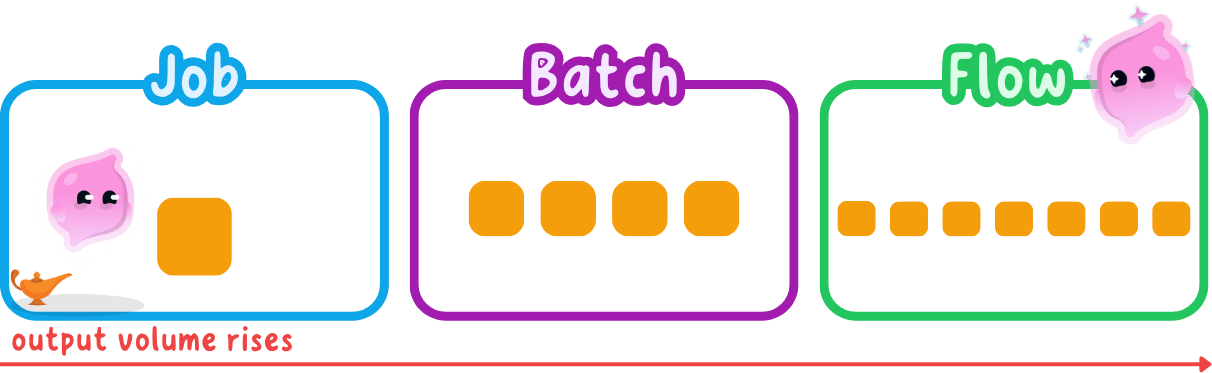
Job production maximises customisation but has high unit costs
Job production: producing one individual item or service at a time to a customer's specific requirements.
- Advantages: the business can customise closely, change the design for an individual customer and often charge a premium price for specialist quality or service.
- Disadvantages: production is relatively slow and usually relies on skilled labour, so output is low and cost per unit is high.
A business making a fitted kitchen for one customer's measurements can adapt the design throughout the job, but each order uses significant skilled labour and cannot be produced at mass-market speed.
Batch production balances variety with repeated production
Batch production: producing a group of identical items together, then changing the process before producing a different batch.
- Advantages: the business can make a reasonable volume while still offering different varieties, and repeated work can reduce unit cost compared with one-off job production.
- Disadvantages: changing from one batch to another can require cleaning, resetting or reprogramming equipment, creating downtime and cost; inventories can also build up between stages or while a batch waits to be sold.
A bakery can make a batch of white loaves followed by a batch of wholemeal loaves, giving customers variety without making every loaf as an individual job.
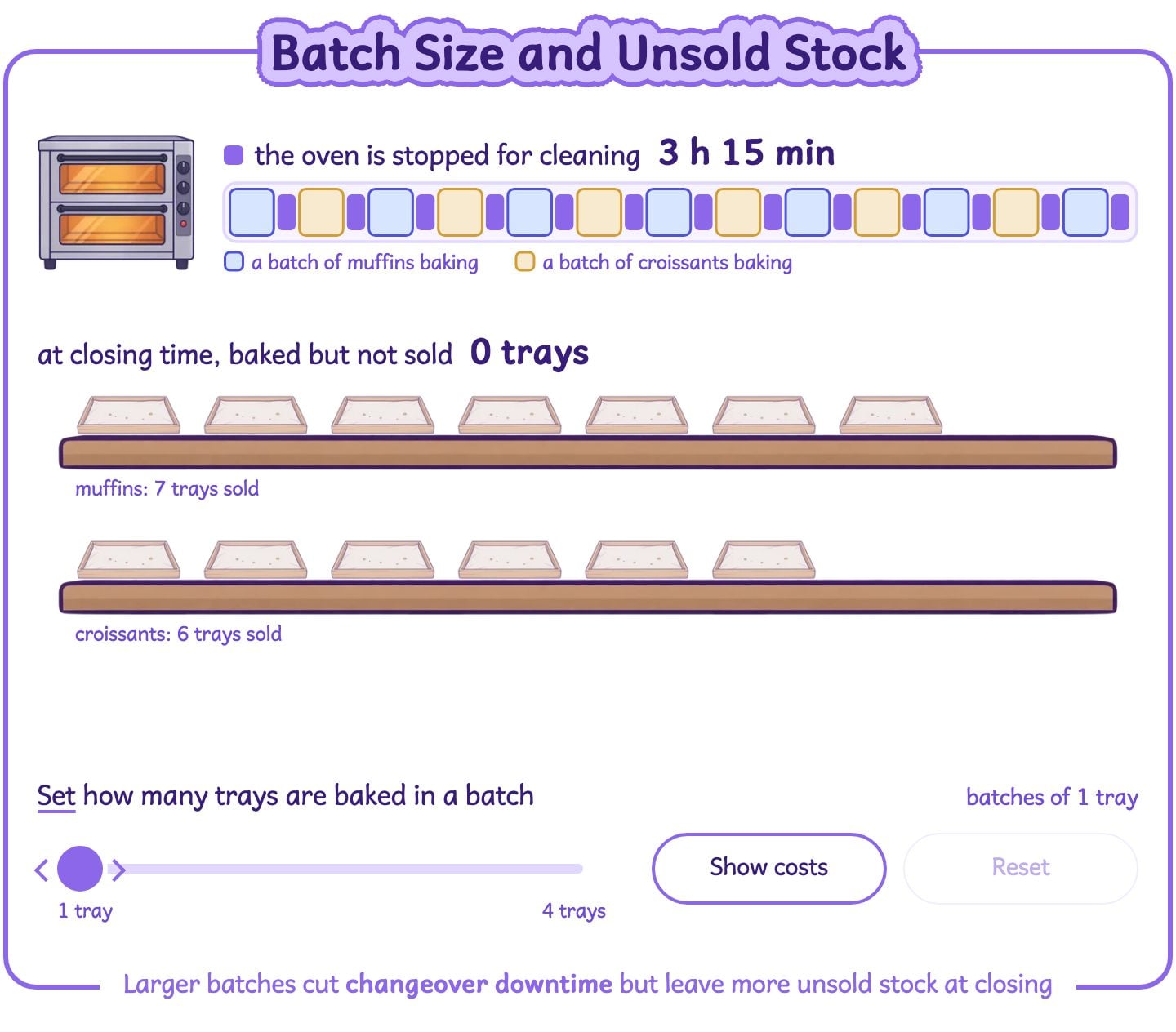
Change the batch size and watch changeover downtime fall while unsold stock at closing rises.
Flow production produces high volumes efficiently but sacrifices flexibility
Flow production: producing large numbers of standardised items continuously as each unit moves from one stage of production to the next.
- Advantages: continuous, repetitive production can create very high output, consistent quality and low unit costs when demand is large enough to use the line efficiently.
- Disadvantages: specialised equipment can be expensive to install, the process is less flexible when customer needs change, and a breakdown at one stage can disrupt the whole line.
Do not choose the production method from the type of product alone. The same product can be made by job, batch or flow methods depending on volume and customisation.
Labour-intensive and capital-intensive describe what the process relies on most
Labour-intensive production: production that relies relatively heavily on employees and their skills rather than machinery.
Capital-intensive production: production that relies relatively heavily on machinery, equipment and technology rather than direct labour.
- Labour-intensive production: can offer flexibility, personal service and lower initial spending on machinery, but wage costs continue over time and output or quality can depend heavily on worker skill and availability.
- Capital-intensive production: can produce high volumes consistently and reduce labour cost per unit, but requires major investment, maintenance and skilled technical support, while breakdowns can be costly.
Job production is often more labour-intensive and flow production is often more capital-intensive, but these are not fixed rules. Production method describes how output is organised; labour or capital intensity describes which resources the process relies on most.
The best process fits demand, customisation and finance
- Low-volume customised demand favours job production, repeated demand for several varieties can favour batch production, and high, predictable demand for standardised output can justify flow production.
- The business must also be able to finance the chosen process. A flow line may have the lowest potential unit cost but still be unsuitable when demand is uncertain or the business cannot afford the equipment.
- Use output volume and the amount of customisation to distinguish job, batch and flow production.
- Link the method to a trade-off such as unit cost, flexibility, quality consistency or setup investment.
- Keep the production method separate from labour or capital intensity and justify each from the resources used.
- What is the difference between job, batch and flow production?
- Give one advantage and one disadvantage of each production method.
- Why can a changeover between batches reduce efficiency?
- What is the difference between labour-intensive and capital-intensive production?
- Why can flow production be unsuitable even when it offers a low unit cost?
5.2.1b Impact of production and productivity
The production process affects cost, flexibility, quality and investment
- Job production gives the greatest scope for customisation but usually has high labour and unit costs. Flow production can achieve high output and low unit costs when demand is large and stable, but it needs substantial investment and is harder to adapt. Batch production sits between the two.
- Quality also depends on how the process is managed. Job production can support specialist craftsmanship, while flow production can produce highly consistent output; neither method guarantees better quality by itself.
- The workforce and financial risk change too: labour-intensive methods depend more on employee skills and wages, while capital-intensive systems commit more money to machinery and technology before the business knows how much will be sold.
- A furniture maker switching from one-off tables to a standardised flow line may reduce unit cost and increase output.
- The trade-off is less ability to change each table for individual customers and greater financial exposure if demand for the standard design falls.
Productivity measures output relative to the resources used
Productivity: the amount of output produced in relation to the resources used.
Labour productivity: the output produced per worker over a stated period.
- Production and productivity are different. A business can produce more simply by employing more workers; productivity rises only when output increases relative to the labour used.
Ten workers produce 2,000 units in one week.
2,00010=200 units per worker per week \dfrac{2{,}000}{10} = 200\text{ units per worker per week} 102,000=200 units per worker per weekAfter training, the same ten workers produce 2,500 units, so productivity rises to 250 units per worker per week, an increase of 25%.
Training, technology and motivation can improve productivity
- Training: can help employees use equipment more effectively, work faster and reduce mistakes, raising usable output for the same labour input.
- Technology: can automate or speed up tasks so each employee supports more output, although the business must pay for the equipment, maintenance and training.
- Motivation: can improve effort, attendance and care, but the effect depends on the employees and the way the motivational method is designed rather than motivation automatically producing more output.
Higher productivity can lower unit cost and increase capacity
- If the same wage bill supports more output, labour cost per unit falls. The business can use the saving to reduce price, increase profit margin or invest elsewhere, strengthening competitiveness if quality is maintained.
A weekly wage bill of £2,000 spread over 2,000 units gives labour cost of £1 per unit.
If productivity rises and the same workers produce 2,500 units, labour cost falls to £0.80 per unit.
- Higher productivity also lets the business meet more demand without increasing employee numbers at the same rate, so growth may require less recruitment and training than it otherwise would.
Do not chase productivity at the expense of usable quality. Faster output that creates more defects, waste or customer complaints may raise the measured number but leave the business worse off.
Productivity improvements can also create costs and employee concerns
- Training and technology cost money before the benefit is received, and poorly managed pressure for faster work can increase stress or reduce quality.
- If new technology means the same output needs fewer employees, workers may also fear redundancy, so consultation and retraining can matter to motivation and the success of the change.
- Compare productivity by dividing each business's or year's output by its own number of workers.
- Translate a productivity rise into a business effect such as lower labour cost per unit or extra capacity.
- Balance the improvement against investment cost, quality risk and possible employee effects.
- What is the difference between production and productivity?
- Eight workers make 1,600 units. What is labour productivity?
- Give three ways a business can improve productivity.
- How can higher productivity reduce unit cost?
- Why can a productivity improvement create risks as well as benefits?
5.2.2a Just-in-time and Kaizen
Lean production aims to remove waste while maintaining useful output and quality
Lean production: an approach to production that aims to reduce wasted materials, time, space and effort while maintaining the output and quality customers need.
- Edexcel focuses on two lean methods: just-in-time reduces the waste and cost of holding inventory, while Kaizen seeks continuous small improvements in how work is done.
Just-in-time keeps inventory low by matching deliveries closely to production needs
Just-in-time (JIT): an inventory system in which materials and components arrive close to the time they are needed for production, so the business holds very little inventory.
- JIT relies on accurate information and dependable suppliers. Instead of keeping a large safety inventory, the business coordinates smaller deliveries with expected customer orders or production schedules.
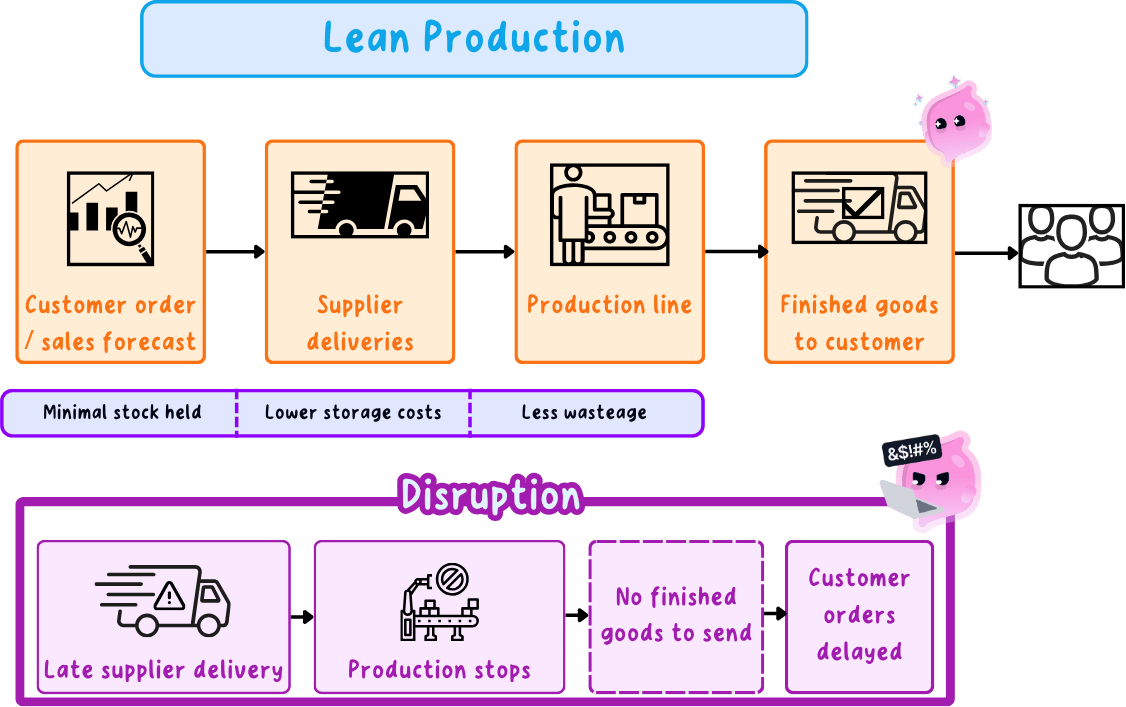
- Advantages: less cash is tied up in inventory, storage and handling costs fall, and there is less risk of stored goods being damaged, spoiled or becoming obsolete.
- Disadvantages: with little buffer inventory, a late or faulty delivery can stop production quickly. Frequent small deliveries may also increase transport cost or reduce opportunities for bulk discounts.
JIT removes inventory cost and inventory protection at the same time. Its suitability depends heavily on supplier reliability and the business's ability to coordinate deliveries accurately.
Kaizen builds improvement through many small worker-led changes
Kaizen: continuous improvement through frequent small changes to how work is organised and carried out, often using ideas from employees doing the job.
- Employees can identify wasted movement, awkward layouts, repeated errors or slow steps that managers may not notice. A small improvement may save only seconds or a little material each time, but repeated across high output the total saving can become significant.
- Advantages: many changes can be low-cost, improvements can accumulate over time, and involving employees in problem-solving can increase responsibility and engagement for some workers.
- Disadvantages: improvements are usually gradual rather than dramatic, meetings and training take time, and the approach loses credibility if managers ask for suggestions but rarely act on useful ideas.
- Workers notice that a commonly used tool is stored several metres from the production station.
- Moving it closer saves only a few seconds on each unit, but across thousands of units the time saving raises productivity without buying a new production line.
JIT and Kaizen reduce different forms of waste
- JIT mainly tackles unnecessary inventory and the cost of storing it; Kaizen tackles inefficiencies within the work itself. Both can lower unit costs, but each requires the right operating conditions rather than being automatically suitable for every business.
- For JIT, link low inventory to both lower holding costs and greater exposure to supply disruption.
- For Kaizen, describe continuous small improvements rather than a one-off major investment.
- Judge suitability from supplier reliability, inventory needs, employee involvement and the type of improvement the business needs.
- What is lean production?
- Give two advantages and two disadvantages of JIT.
- Why does JIT depend heavily on reliable suppliers?
- What is Kaizen?
- How can many small Kaizen changes produce a significant business benefit?
5.2.2b Using resources effectively
Using resources effectively means turning more of what the business pays for into useful output
Waste: materials, time, labour, space or other resources used without adding useful value to the product or service.
- A business pays for materials, employees, equipment, energy, time and premises. Using them effectively means reducing avoidable loss, waiting, rework and idle capacity so a larger share of those costs supports output customers can buy.
Waste can appear in materials, labour, time, space and equipment
- Materials: damaged inputs, excessive offcuts, spoiled goods or faulty units use resources without creating saleable output.
- Labour and time: employees waiting for parts, repeating unnecessary movements or redoing defective work are being paid while little or no extra saleable output is created.
- Space and equipment: excess inventory uses storage space, while machinery that is frequently idle or poorly maintained spreads its cost across fewer useful units.
A café that improves ordering so less food expires turns more of the ingredients it buys into customer sales, reducing material waste and disposal cost at the same time.
Effective resource use can lower costs and strengthen competitiveness
- Less waste means the business pays for fewer inputs, less rework and less unnecessary storage, which can lower cost per unit. The saving can support lower prices, higher profit margins or investment elsewhere.
- Making better use of labour and machinery can also increase productivity or capacity, allowing the business to meet more demand without resources rising at the same rate.
- Reducing material and energy waste can also lower the environmental impact of production, which may support the business's reputation where customers or other stakeholders value this.
Efficiency should not mean removing every spare resource
- Some spare capacity, inventory or employee time can protect the business from unexpected demand, delays or breakdowns. Cutting these buffers too far can make the operation cheaper in normal conditions but less resilient when something goes wrong.
- Pressure to work faster can also increase mistakes or stress if it is poorly managed, so resource efficiency should be judged alongside quality, reliability and employee effects.
Removing a resource is not automatically an efficiency gain. It is useful only if the business can maintain the output, quality and reliability it needs with less waste or lower cost.
- Identify which resource is being wasted or used more effectively.
- Trace the change to unit cost, productivity, capacity or another clear business effect.
- Consider whether cutting the resource too far could damage quality, resilience or employees.
- What does waste mean in lean production?
- Give three different examples of business resources being wasted.
- How can reducing waste lower unit cost?
- How can using resources effectively improve competitiveness?
- Why can cutting spare resources too far create problems?
5.2.3a Use of robotics
Robotics can raise output and consistency, but requires substantial investment
Robotics: the use of programmable machines to carry out production tasks automatically with limited direct human involvement.
- Robots are most useful for repetitive, precise or dangerous tasks, especially where a business produces large volumes and can spread the cost of the equipment across many units.
Robotics can improve productivity, consistency and safety
- Productivity and cost: robots can work quickly for long periods, allowing each employee to support more output and potentially reducing labour cost per unit once the system is operating at sufficient scale.
- Consistency and waste: a correctly programmed robot can repeat the same task very precisely, reducing variation and some production errors or material waste.
- Safety: machines can handle heavy, hot, hazardous or otherwise dangerous tasks, reducing employees' exposure to some workplace risks.
A car factory can use robotic arms for repetitive welding. The system can produce consistent joins at high speed while keeping employees away from sparks and heavy body panels.
The benefits have to justify the financial and organisational costs
- High initial and maintenance cost: buying, installing, programming and maintaining robotic systems can require major finance. A low-volume business may never produce enough units to recover that investment.
- Employee effects: some routine jobs may disappear or change, creating redundancy concerns and retraining needs. At the same time, the business may need more employees with programming, maintenance or technical skills.
- Flexibility and breakdown risk: specialised systems may need reprogramming or new tooling when products change, and a major breakdown can stop a large part of production until skilled repair is available.
Robots do not remove all labour costs. Businesses still need people to design, supervise, program, maintain and repair automated systems.
Robotics is most suitable where volume and repetition justify the fixed cost
- High and predictable demand, standardised repetitive tasks and significant safety or consistency benefits make robotics more attractive. Low volume, frequent customisation or limited access to finance make the investment harder to justify.
- Link the robot to a specific production task and explain what changes in productivity, consistency or safety.
- Balance lower long-run operating costs against the high fixed cost of purchasing and maintaining the system.
- Consider output volume, product flexibility and employee effects before judging whether robotics is suitable.
- What is robotics in production?
- Give three possible advantages of using robots.
- Give three possible disadvantages of robotics.
- How can robotics change the types of jobs a business needs?
- Why is high, stable output important when deciding whether robotics is worthwhile?
5.2.3b Balancing cost, quality and flexibility
Technology can improve production, but the business has to balance four competing priorities
Productivity: output produced in relation to the resources used.
Flexibility: the ability to change what is produced or how much is produced when demand changes.
- A production investment may reduce unit cost and raise productivity but also make the process less flexible, require major finance or change the quality customers receive. The best option depends on what the business is trying to compete on.
Higher productivity usually requires investment before the saving appears
- Automation can let each employee support much more output, lowering labour cost per unit at high volume. The trade-off is the purchase, installation, training and maintenance cost needed before those savings are realised.
- This means technology is more attractive when demand is high and stable enough to spread the fixed cost over many units; low or uncertain output makes the investment harder to recover.
Consistency can improve quality, but the cheapest method may not create the quality customers value
- Technology can reduce variation and some human error, which is valuable when customers expect every unit to be identical. However, a premium or customised product may depend on skilled judgement, personal service or hand-finishing that customers are willing to pay for.
A premium chocolate producer might automate mixing and packaging for consistency but keep hand-finishing where customers associate craftsmanship with the brand.
Highly efficient systems can be less flexible when customer demand changes
- A dedicated high-speed line is efficient when it repeats the same product, but changing design, size or volume may require reprogramming, new tooling or downtime. A more adaptable system may cost more per unit but respond faster to changing customer needs.
- The importance of flexibility therefore depends on the market. Standardised products with predictable demand can tolerate less flexibility than markets where designs and customer preferences change frequently.
Do not assume technology improves every objective at once. An investment can raise productivity while increasing fixed costs or reducing flexibility, so the trade-off must be identified.
The right balance follows the business's competitive priorities
- A business competing mainly on low price may prioritise unit cost and productivity, while one competing on customisation, variety or premium quality may accept higher costs to protect flexibility or specialist quality.
- Identify which of cost, productivity, quality and flexibility the technology improves.
- Then identify what the business may give up or spend more on to gain that improvement.
- Judge the balance from the firm's customer needs, output volume and competitive position.
- What does flexibility mean in production?
- How can technology increase productivity but also increase cost?
- Why can an automated process improve consistency but be less suitable for a customised product?
- Why can a highly efficient flow line be less flexible?
- Why might two businesses choose different technology even if both could afford the same system?