The product life cycle tracks how sales change over time
Product life cycle: the stages a product passes through as it is developed, launched, grows, matures and eventually declines.
- Development: the business spends on research, design and testing before sales begin, so the product creates cost without revenue.
- Introduction: sales start at a low level while customers learn about the product, so promotion is often heavy and profit may still be low or negative.
- Growth: sales rise quickly as awareness and distribution increase, while growing success can also attract more competitors.
- Maturity: sales reach a high level and growth slows as the market becomes established and competition for customers intensifies.
- Decline: sales fall as customer needs change, substitutes improve or rivals take demand, leaving the business to extend, replace or withdraw the product.
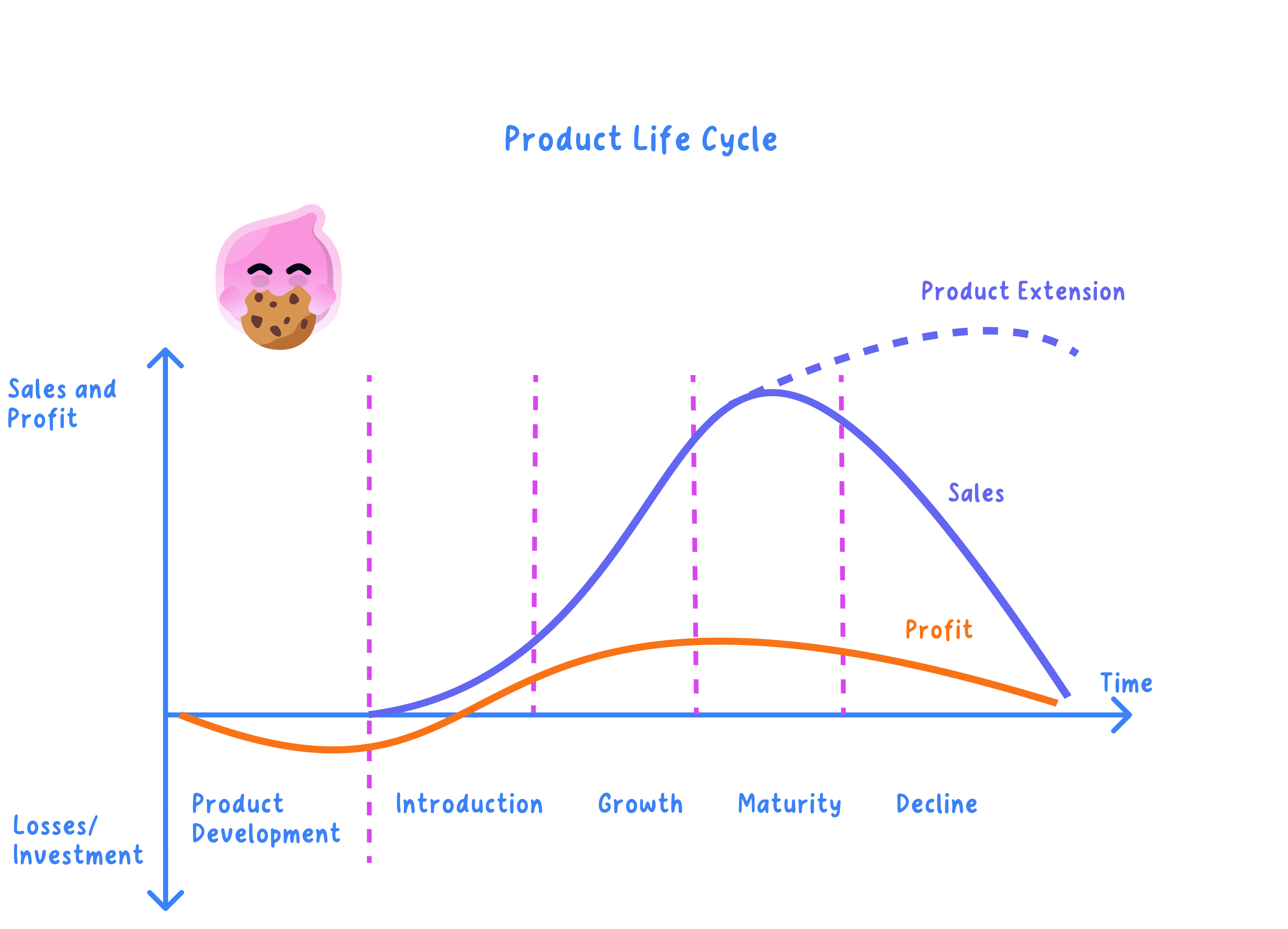
Do not read the stage from the age of the product. A long-established product with high, stable sales can still be in maturity rather than decline.

Move through the product life cycle and notice that profit and cash flow do not always move together.
Extension strategies try to delay decline
Extension strategy: an action intended to increase or prolong sales so a product stays viable for longer before decline.
- A business may find new markets or customer segments, promote new uses, update features or design, change packaging, adjust price or refresh promotion. Each aims to create another reason to buy the product.
- Benefit: extra sales can be generated from an existing product without developing a complete replacement. Drawback: extension costs money and may only delay an unavoidable decline if customers no longer value the underlying product.
A mature drink could be repositioned towards a new customer group with updated packaging and promotion, extending its sales if the new position matches a genuine customer need.
A product portfolio spreads risk across different products
Product portfolio: the complete range of products sold by a business.
Boston matrix: a portfolio tool that classifies products using market growth and relative market share.
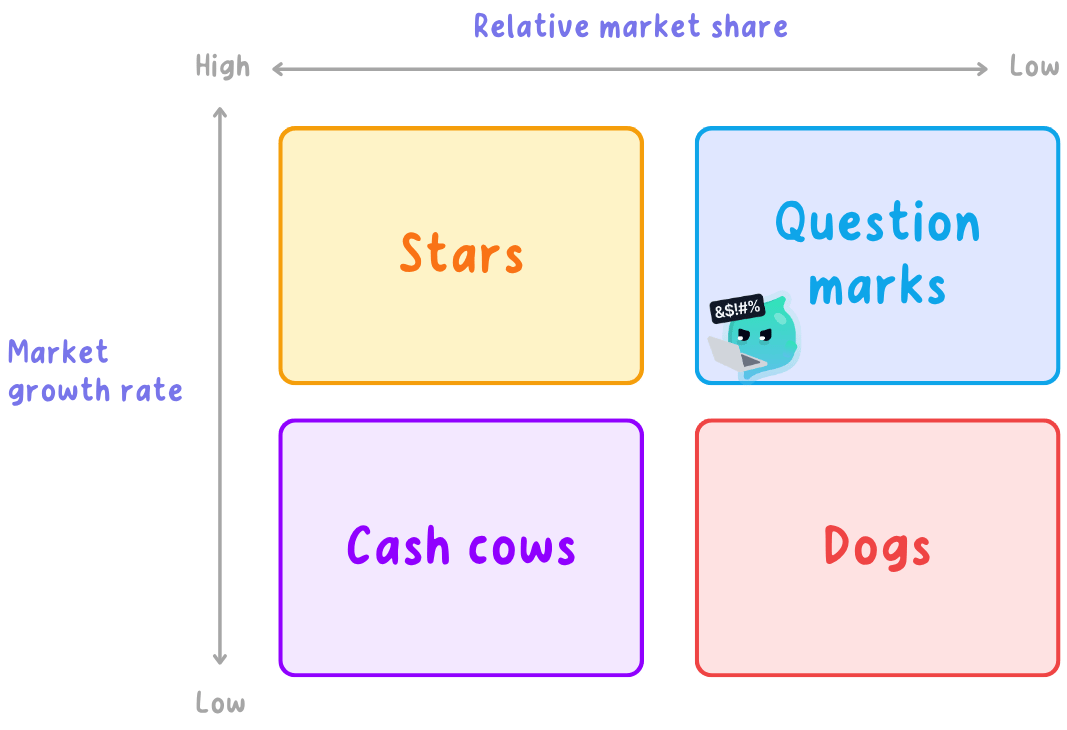
- Stars: high market share in a high-growth market. They can justify continued investment because the market opportunity is expanding.
- Cash cows: high market share in a low-growth market. They can generate cash with less need for major growth investment.
- Question marks: low market share in a high-growth market. Managers must decide whether further investment can build share or whether resources should go elsewhere.
- Dogs: low market share in a low-growth market. They may be candidates for withdrawal if they use resources without supporting the wider portfolio.
The portfolio should balance current cash with future growth
- A business with only mature or declining products may generate cash now but lack future growth, while a portfolio made only of new or fast-growing products may require heavy investment before enough cash is generated.
Use both Boston matrix axes. High market share alone does not make a product a star; the market must also have high growth.
- Identify a life-cycle stage from the pattern of sales, not simply the product's age.
- For an extension strategy, explain what new demand the action is meant to create and what it costs.
- For the Boston matrix, use both market growth and market share before deciding how the business should treat a product.
- Name the stages of the product life cycle.
- Why can a product make a loss during development or introduction?
- Give three possible extension strategies.
- What are the two axes of the Boston matrix?
- Why does a business benefit from a balanced product portfolio?