Businesses can start with the market or start with the product
Market orientation: using research into customer needs as the starting point for product and marketing decisions.
Product orientation: focusing first on developing a product based on the business's own expertise, quality or innovation, then finding customers for it.
- Market orientation can reduce the risk of producing something customers do not want and helps the business respond to changing tastes. The trade-off is the time and cost of research, and following current preferences too closely can make the business less willing to lead with a new idea.
- Product orientation can create distinctive or technically advanced products and suits firms with strong specialist expertise. Its main risk is spending heavily on a product before knowing whether enough customers will value it.
Do not treat the two approaches as absolute opposites: many businesses innovate internally but still use customer research to refine features, price and launch decisions.
Market share shows the business's sales relative to the whole market
Market share: the percentage of total sales in a market made by one business or brand.
- A rising market share means the business is taking a larger proportion of total market sales, while a falling share means rivals are growing faster relative to it.
- Sales and market share can move differently. Sales can rise while market share falls if the whole market grows faster than the business, so the share should be compared over time rather than judged from sales alone.
A drinks business sells £2 million in a market with total sales of £20 million.
£2m£20m×100=10% \dfrac{£2\text{m}}{£20\text{m}} \times 100 = 10\% £20m£2m×100=10%Its market share is 10%. A later figure becomes useful when compared with this 10% starting point.
Mass and niche marketing choose different sizes of target market
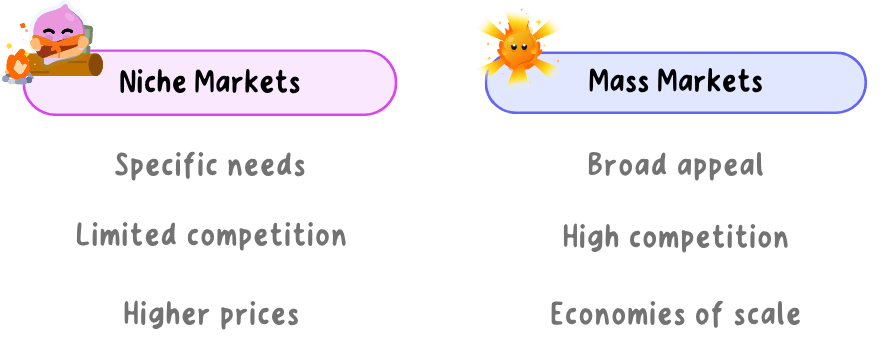
Mass marketing: targeting a broad market with a product designed to appeal to a large number of customers.
Niche marketing: targeting a small, clearly defined part of a market with specific needs.
- Mass marketing offers a much larger potential sales volume and can support economies of scale and strong brand awareness. The disadvantages are intense competition and the difficulty of making one offer satisfy very different customers.
- Niche marketing lets the business tailor the offer closely to one group's needs, which can support loyalty and premium prices. The disadvantages are a smaller customer base and greater dependence on the tastes of one narrow group.
The right approach depends on the product, resources and market
- A small specialist business may be better able to understand and serve a niche than compete for the whole market, while a large business with scale, distribution and promotion resources may be better placed to pursue a mass market.
- For orientation, link the approach to how much the business relies on customer research or its own product expertise.
- For market share, compare the percentage over time rather than judging sales in isolation.
- For mass versus niche, balance the size of the opportunity against competition, specialisation and the firm's resources.
- What is the difference between market and product orientation?
- How is market share calculated?
- Why can sales rise while market share falls?
- Give one advantage and one disadvantage of mass marketing.
- Give one advantage and one disadvantage of niche marketing.