Taylor, Maslow and Herzberg explain motivation in different ways
- Taylor focuses strongly on financial reward and measurable output, Maslow explains motivation through a hierarchy of human needs, and Herzberg separates factors that prevent dissatisfaction from factors that create positive motivation.
Example
A call centre could link bonus pay to sales in a Taylor-style approach, use teamwork and recognition to meet Maslow's social and esteem needs, and redesign jobs to give more responsibility in line with Herzberg.
Taylor linked motivation closely to pay and measurable output
- Taylor's approach assumed that money is a powerful reason for employees to work harder, so managers should organise work carefully, set clear output expectations and connect financial reward to performance.
- The job is broken into clear and standardised tasks so output can be measured, which allows the manager to compare performance and reward employees who produce more.
- Piece-rate pay follows this idea because the employee is paid according to the number of units produced, creating a direct financial incentive to increase output.
- Taylor's approach can work well where output is easy to count and the work is repetitive, because the employee can see a clear link between producing more and earning more.
- Its limitation is that a strong focus on quantity and pay can encourage rushed work or lower quality and can ignore other reasons people work hard, such as recognition, responsibility, enjoyment or good relationships.
Maslow argued that different needs motivate people at different stages
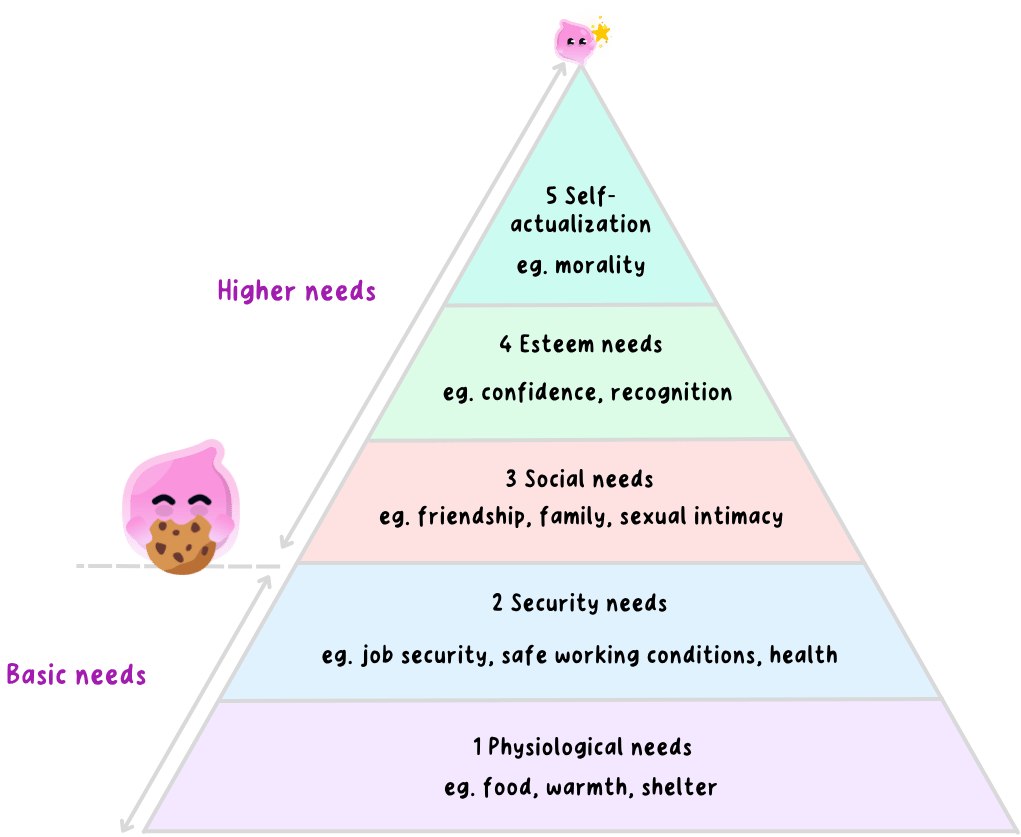
- Maslow arranged human needs in a hierarchy and argued that lower needs usually have to be satisfied enough before higher needs become a stronger source of motivation.
- Physiological needs: basic needs such as food and shelter can be supported through sufficient pay.
- Safety needs: security and protection can be supported through safe working conditions and reasonable job security.
- Social needs: belonging and relationships can be supported through teamwork, communication and positive working relationships.
- Esteem needs: recognition and respect can be supported through praise, status, responsibility or promotion.
- Self-actualisation: reaching personal potential can be supported through challenging work, development opportunities and the chance to use more of the employee's abilities.
- The management implication is to identify which need is not being met and use a suitable response, because giving more pay to someone seeking recognition or challenging work may do little to increase motivation.
Note
Maslow's hierarchy is a model rather than a precise rule for every employee: people can value the same needs differently, can seek several needs at once and may not move through the hierarchy in an identical order.
Herzberg separated hygiene factors from true motivators
- Herzberg's two-factor theory argues that removing dissatisfaction and creating positive motivation are two different management tasks rather than opposite ends of the same scale.
- Hygiene factors: pay, working conditions, job security, company policies and relationships can cause dissatisfaction when they are poor, so managers need them at an acceptable level before employees can be expected to feel positive about the job.
- Improving a poor hygiene factor can remove a source of unhappiness, but Herzberg argued that this does not necessarily make the work itself more satisfying or create lasting extra effort.
- Motivators: achievement, recognition, responsibility, advancement and interesting or challenging work can create satisfaction because they change what the employee experiences in the job itself.
- A manager applying Herzberg would therefore correct poor pay or working conditions first, then use recognition, responsibility and job enrichment to make the work more satisfying and motivating.
- A limitation is that employees do not all react in the same way, because pay may be a strong motivator for one person while another values recognition, responsibility or interesting work more highly.
Common Mistake
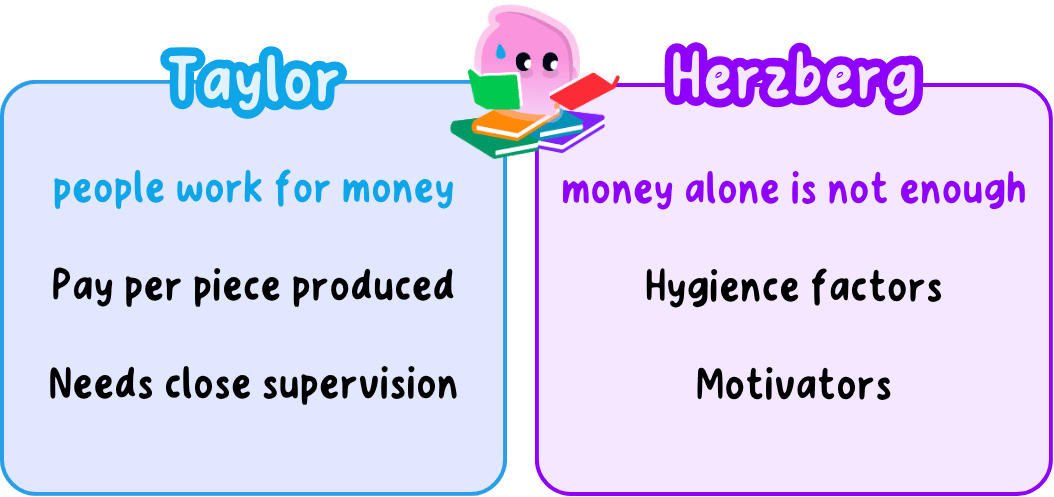
Do not mix Taylor and Herzberg on pay: Taylor places strong emphasis on financial reward as a motivator, while Herzberg treats pay mainly as a hygiene factor that can prevent dissatisfaction when it is adequate.
The theories lead managers towards different approaches
- Taylor points managers towards measurable output and financial incentives, Maslow encourages them to identify the employee need that is not being met, and Herzberg encourages them to remove dissatisfaction while also improving the content of the job.
- A business can use ideas from more than one theory at the same time, because an employee may need adequate pay and security while also responding to recognition, responsibility or challenging work.
Exam technique
- Keep each core idea with the correct theorist: Taylor links financial reward to output, Maslow uses a hierarchy of needs, and Herzberg separates hygiene factors from motivators.
- When a business situation is given, identify the employee problem or need first, then explain why the manager's action fits that theory and how it could change motivation or behaviour.
- Be especially careful with pay: it is central to Taylor, can help meet lower needs in Maslow, and is mainly a hygiene factor in Herzberg.
Self review
- How does Taylor link pay to employee output?
- Name Maslow's five needs in order from the lowest to the highest.
- How would a manager use Maslow's hierarchy to choose a way of motivating an employee?
- What is the difference between a hygiene factor and a motivator in Herzberg's theory?
- How does Taylor's view of pay differ from Herzberg's?