2.4.1a Importance of motivation
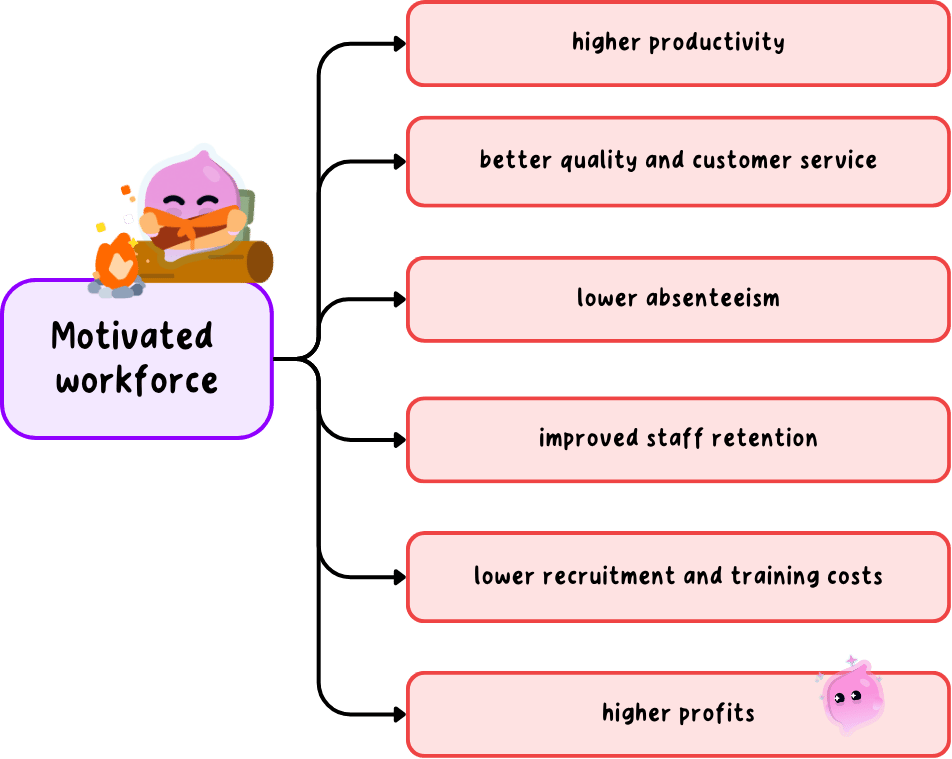
Motivation can help a business attract, retain and get more from its employees
Motivation: the willingness and desire of an employee to put effort into their work and perform well.
- Motivation matters because the way employees feel about their work can influence whether people want to join the business, whether existing employees want to stay, and how much effort and care they put into the job.
Motivation matters in three main ways
- Attracting employees: a business with a reputation for fair treatment, worthwhile work and good opportunities may attract more or stronger applicants, giving it a wider choice when recruiting.
- Retaining employees: motivated employees may be more willing to stay with the business, reducing labour turnover and the disruption and cost of repeatedly recruiting and training replacements.
- Productivity: motivated employees may put in greater effort, concentrate more carefully and cooperate more effectively, which can increase output per worker or reduce mistakes and waste.
A restaurant that keeps an experienced, motivated team may spend less time replacing staff and may provide faster, more consistent service because employees know the job and want to perform it well.
Poor motivation can create the opposite effects
- Low motivation can contribute to higher labour turnover or absence and may reduce effort, service quality or productivity, creating recruitment costs, disruption and weaker customer service.
- These outcomes are not caused by motivation alone, so a business should not assume that every absence, resignation or productivity problem has the same cause.
- Identify whether the effect is on attracting employees, retaining employees or productivity.
- Explain the change in employee behaviour, such as greater effort, stronger commitment or willingness to stay.
- Then link that behaviour to a business result such as lower recruitment costs, better service or higher productivity.
- What is motivation?
- How can a business's reputation for motivating staff help recruitment?
- How can motivation help a business retain employees?
- How can motivation affect productivity?
- Give one business cost that can result from poor employee motivation.
2.4.1b Motivational theories
Taylor, Maslow and Herzberg explain motivation in different ways
- Taylor focuses strongly on financial reward and measurable output, Maslow explains motivation through a hierarchy of human needs, and Herzberg separates factors that prevent dissatisfaction from factors that create positive motivation.
A call centre could link bonus pay to sales in a Taylor-style approach, use teamwork and recognition to meet Maslow's social and esteem needs, and redesign jobs to give more responsibility in line with Herzberg.
Taylor linked motivation closely to pay and measurable output
- Taylor's approach assumed that money is a powerful reason for employees to work harder, so managers should organise work carefully, set clear output expectations and connect financial reward to performance.
- The job is broken into clear and standardised tasks so output can be measured, which allows the manager to compare performance and reward employees who produce more.
- Piece-rate pay follows this idea because the employee is paid according to the number of units produced, creating a direct financial incentive to increase output.
- Taylor's approach can work well where output is easy to count and the work is repetitive, because the employee can see a clear link between producing more and earning more.
- Its limitation is that a strong focus on quantity and pay can encourage rushed work or lower quality and can ignore other reasons people work hard, such as recognition, responsibility, enjoyment or good relationships.
Maslow argued that different needs motivate people at different stages
- Maslow arranged human needs in a hierarchy and argued that lower needs usually have to be satisfied enough before higher needs become a stronger source of motivation.
- Physiological needs: basic needs such as food and shelter can be supported through sufficient pay.
- Safety needs: security and protection can be supported through safe working conditions and reasonable job security.
- Social needs: belonging and relationships can be supported through teamwork, communication and positive working relationships.
- Esteem needs: recognition and respect can be supported through praise, status, responsibility or promotion.
- Self-actualisation: reaching personal potential can be supported through challenging work, development opportunities and the chance to use more of the employee's abilities.
- The management implication is to identify which need is not being met and use a suitable response, because giving more pay to someone seeking recognition or challenging work may do little to increase motivation.
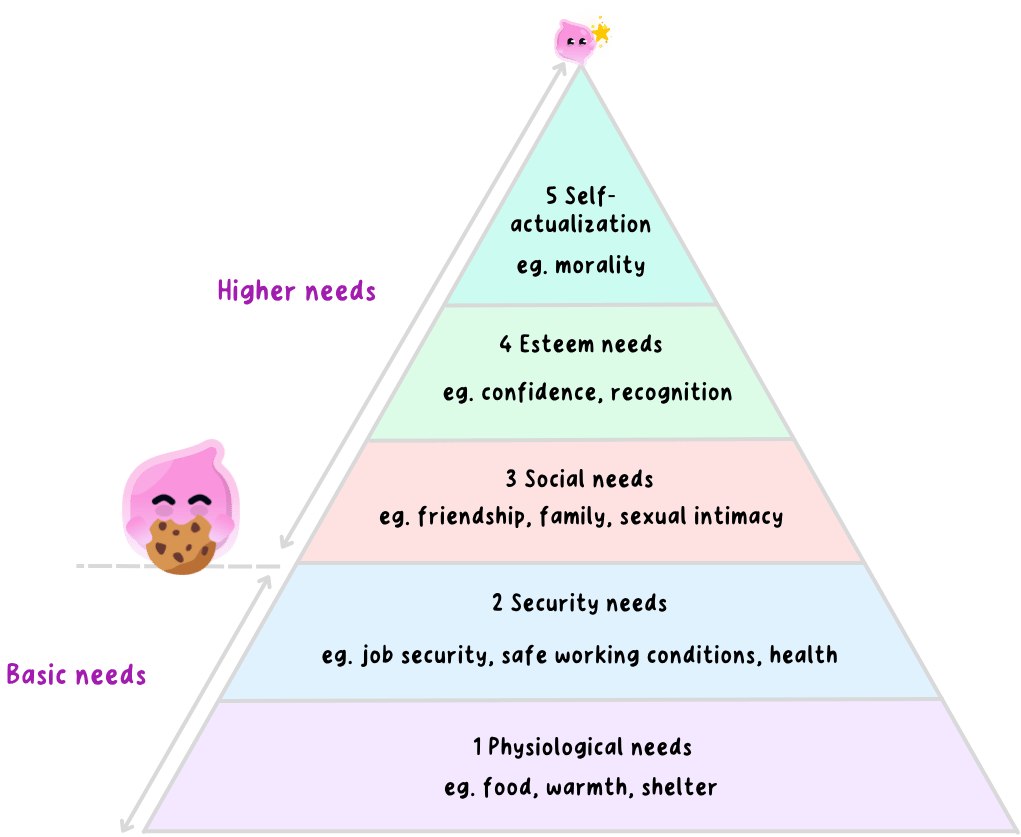
Maslow's hierarchy is a model rather than a precise rule for every employee: people can value the same needs differently, can seek several needs at once and may not move through the hierarchy in an identical order.
Herzberg separated hygiene factors from true motivators
- Herzberg's two-factor theory argues that removing dissatisfaction and creating positive motivation are two different management tasks rather than opposite ends of the same scale.
- Hygiene factors: pay, working conditions, job security, company policies and relationships can cause dissatisfaction when they are poor, so managers need them at an acceptable level before employees can be expected to feel positive about the job.
- Improving a poor hygiene factor can remove a source of unhappiness, but Herzberg argued that this does not necessarily make the work itself more satisfying or create lasting extra effort.
- Motivators: achievement, recognition, responsibility, advancement and interesting or challenging work can create satisfaction because they change what the employee experiences in the job itself.
- A manager applying Herzberg would therefore correct poor pay or working conditions first, then use recognition, responsibility and job enrichment to make the work more satisfying and motivating.
- A limitation is that employees do not all react in the same way, because pay may be a strong motivator for one person while another values recognition, responsibility or interesting work more highly.
Do not mix Taylor and Herzberg on pay: Taylor places strong emphasis on financial reward as a motivator, while Herzberg treats pay mainly as a hygiene factor that can prevent dissatisfaction when it is adequate.
The theories lead managers towards different approaches
- Taylor points managers towards measurable output and financial incentives, Maslow encourages them to identify the employee need that is not being met, and Herzberg encourages them to remove dissatisfaction while also improving the content of the job.
- A business can use ideas from more than one theory at the same time, because an employee may need adequate pay and security while also responding to recognition, responsibility or challenging work.
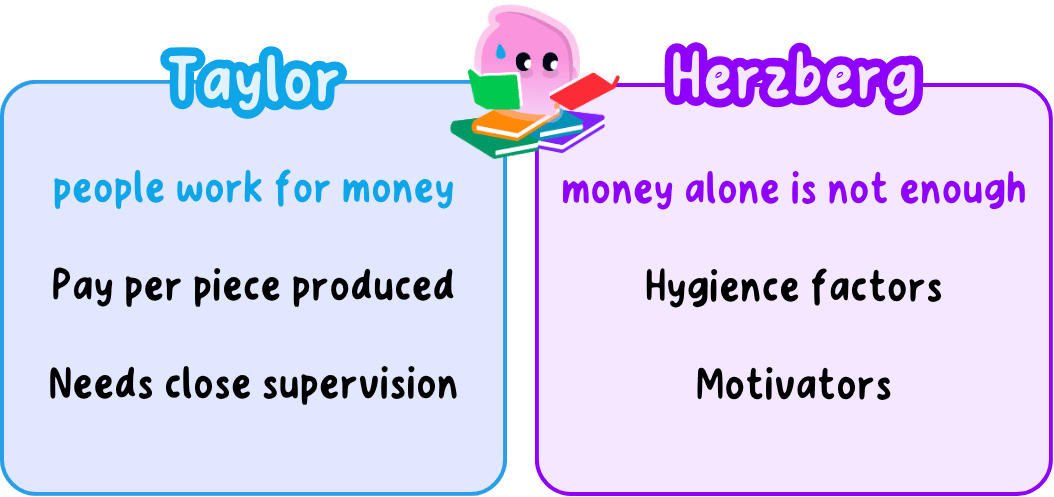
- Keep each core idea with the correct theorist: Taylor links financial reward to output, Maslow uses a hierarchy of needs, and Herzberg separates hygiene factors from motivators.
- When a business situation is given, identify the employee problem or need first, then explain why the manager's action fits that theory and how it could change motivation or behaviour.
- Be especially careful with pay: it is central to Taylor, can help meet lower needs in Maslow, and is mainly a hygiene factor in Herzberg.
- How does Taylor link pay to employee output?
- Name Maslow's five needs in order from the lowest to the highest.
- How would a manager use Maslow's hierarchy to choose a way of motivating an employee?
- What is the difference between a hygiene factor and a motivator in Herzberg's theory?
- How does Taylor's view of pay differ from Herzberg's?
2.4.2a Financial methods of motivation
Financial methods motivate through pay and rewards with monetary value
Remuneration: the financial reward an employee receives for their work, including wages or salary.
- Edexcel identifies five financial methods of motivation: remuneration, bonus, commission, promotion and fringe benefits, and each rewards employees in a different way.
A car dealership might pay a basic salary, add commission for each car sold, offer a bonus for reaching a team target and give a successful salesperson the chance of promotion.
Remuneration provides the regular financial reward for work
- Advantage: competitive wages or salaries can help attract and retain employees because the job is financially worthwhile and provides a reliable reward for working.
- Disadvantage: higher regular pay raises labour costs every pay period and does not guarantee greater effort if poor motivation is caused by factors such as management, working conditions or the job itself.
Financial rewards work best when the reward matches the behaviour the business wants and is valuable to the employee receiving it.
Bonus and commission link extra pay to performance
- Bonus: an extra payment for achieving a target or strong performance.
- Advantage: it can focus employees on a specific goal because the extra reward depends on achieving it.
- Disadvantage: an unrealistic or unfair target can frustrate employees, while a narrow target may encourage them to ignore other important parts of the job.
- Commission: pay linked directly to the amount or value an employee sells.
- Advantage: it gives sales staff a direct financial reason to increase sales because earning more depends on selling more.
- Disadvantage: it can encourage excessive pressure on customers or too much focus on sales quantity rather than customer needs and long-term relationships.
Do not confuse bonus with commission: a bonus is an extra payment for meeting a target or performance goal, while commission varies with the employee's sales.
Promotion and fringe benefits can increase the value of staying with the business
- Promotion: moving an employee into a more senior role, usually with higher pay, status or responsibility.
- Advantage: the possibility of career progress can motivate employees who value status, responsibility and higher future earnings and can encourage them to stay with the business.
- Disadvantage: promotion opportunities are limited by the number of senior positions and an employee who is repeatedly overlooked may become demotivated.
- Fringe benefits: additional rewards alongside normal pay, such as staff discounts, private health cover or a company car.
- Advantage: they can make the overall reward package more attractive and help retain employees without relying only on higher basic pay.
- Disadvantage: benefits cost the business money and may have little motivational effect on employees who do not value the particular benefit offered.
- Match the reward to the job and the behaviour the business wants to encourage.
- Use commission for a clear link to individual sales and bonuses for specific targets or performance goals.
- Use promotion or fringe benefits when career progress or retention matters, then explain the cost or limitation of the chosen method.
- What is remuneration?
- What is the difference between a bonus and commission?
- Give one advantage and one disadvantage of promotion as a motivator.
- Give one advantage and one disadvantage of fringe benefits.
- Why might a financial reward fail to motivate every employee in the same way?
2.4.2b Non-financial methods of motivation
Non-financial methods change the experience of the job rather than the employee's pay
- Edexcel identifies three non-financial methods of motivation: job rotation, job enrichment and autonomy, and each changes a different part of the employee's experience at work.
Job rotation adds variety by moving employees between tasks
Job rotation: moving an employee between different tasks or jobs to increase variety and broaden experience.
- Advantages: changing tasks can reduce boredom from repeating the same work, and employees learn a wider range of jobs so the business has more flexibility when somebody is absent or demand changes.
- Disadvantages: rotation may only move an employee between tasks that are equally repetitive, and time is needed to train employees for unfamiliar work so productivity may fall while they learn.
A supermarket worker could rotate between tills, restocking shelves and online-order picking, giving more variety while also making the employee able to cover several parts of the store.
Job enrichment makes the work more challenging and responsible
Job enrichment: making a job more challenging and rewarding by adding greater responsibility, achievement or opportunities to use skills.
- Advantages: more demanding work can give employees a stronger sense of achievement and recognition, while the extra responsibility can develop skills and make the employee feel trusted and valued.
- Disadvantages: richer jobs may require extra training and support, and an employee who does not want or feel ready for more responsibility may experience the change as pressure rather than motivation.
An experienced café employee could be given responsibility for training new starters and checking that opening procedures are completed, adding challenge and responsibility rather than merely giving them more of the same tasks.
Autonomy gives employees more control over how they do their work
Autonomy: giving employees freedom to make some decisions about how they organise or carry out their work.
- Advantages: greater control can make employees feel trusted and responsible, and people close to the work can often solve problems or make routine decisions quickly without waiting for a manager.
- Disadvantages: inexperienced employees may make poor decisions without enough guidance, and giving different people freedom to choose their own methods can lead to inconsistent work or reduced managerial control.
A department supervisor could be allowed to organise the daily rota and decide how routine customer problems are handled, while senior managers still set the wider rules and targets.
The right method depends on what is reducing motivation
- Job rotation is most useful when repetition and boredom are the problem, job enrichment suits capable employees who need greater challenge or responsibility, and autonomy suits employees who have the skills and judgement to work with less direct supervision.
- A method can fail when it does not match the employee or the job, so managers need to consider the worker's skills, the amount of support required and how much control the business can safely give away.
- Keep the three methods distinct: rotation means different tasks, enrichment means more challenge and responsibility, and autonomy means more control over how work is done.
- Use the business problem to choose the method, such as rotation for boredom or autonomy when a capable employee is waiting unnecessarily for managerial approval.
- After choosing the method, explain both how it could improve motivation and one reason it may not work well in that business.
- What is job rotation, and give one advantage and one disadvantage of using it?
- How does job enrichment differ from job rotation?
- Give one advantage and one disadvantage of job enrichment.
- What is autonomy, and why might it motivate an experienced employee?
- Why can autonomy create problems when employees are not ready for the extra freedom?