Market segmentation divides customers into groups with similar needs
Definition
Market segmentation: dividing a market into groups of customers with similar characteristics or needs so the business can target them more effectively.
Market segment: one identifiable group within the market whose members share relevant characteristics or buying needs.
- Customers buying the same type of product can want very different things, so segmentation helps a business avoid designing one offer for everyone.
- A holiday business, for example, may serve families wanting convenience, young travellers wanting low prices and older customers wanting comfort, even though all three groups are buying a holiday.
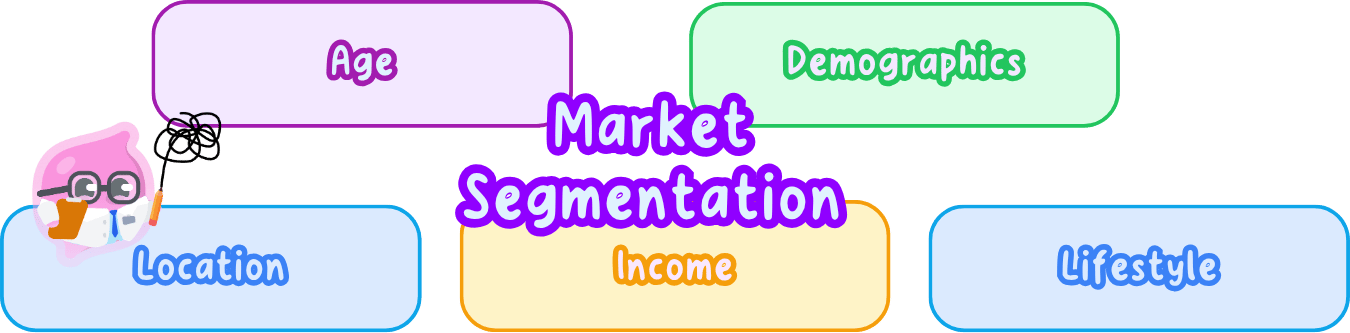
Edexcel uses five main bases for identifying segments
- Location: customers are grouped by where they live, such as country, region or climate. A clothing business may emphasise heavier coats in colder markets and lighter ranges in warmer ones.
- Demographics: customers are grouped by characteristics such as gender, family size or occupation, allowing products and communication to be adapted to relevant differences.
- Lifestyle: customers are grouped by interests, attitudes or how they live, such as fitness-focused or environmentally conscious consumers.
- Income: customers are grouped by spending power, helping a business decide whether to offer budget, mid-market or premium products.
- Age: customers are grouped into age ranges because products, media habits and buying priorities often differ between children, teenagers, adults and older consumers.
Example
- A sportswear business might target a lifestyle segment of regular runners rather than everyone of the same age or income.
- It could then design running-specific products and advertise through channels used by that group, making the marketing more relevant.
Segmentation makes the marketing mix more precise
- A clearly defined segment lets the business tailor product features, price, distribution and promotion to the needs and behaviour of that group rather than spending equally on people who are unlikely to buy.
- Studying segments can also reveal underserved groups and possible gaps in the market, giving the business an opportunity to create a more specialised offer.
A segment still has to be worth targeting
- Researching and serving separate groups costs money, and a segment may be too small to justify its own product, packaging or promotion.
- Segments also change over time, and people within the same category are not identical, so businesses should avoid relying on outdated profiles or stereotypes.
Common Mistake
Do not assume one customer belongs to only one segment: the same person can be grouped by location, age, income and lifestyle at the same time.
Exam technique
- Identify the segmentation basis from the customer information given.
- Link the chosen segment to a specific change in product, price, place or promotion.
- Consider whether the segment is large and profitable enough to justify targeting separately.
Self review
- What is market segmentation?
- Name the five Edexcel bases for market segmentation.
- How can lifestyle segmentation differ from age or income segmentation?
- How can segmentation make promotion more efficient?
- Give two limitations of market segmentation.