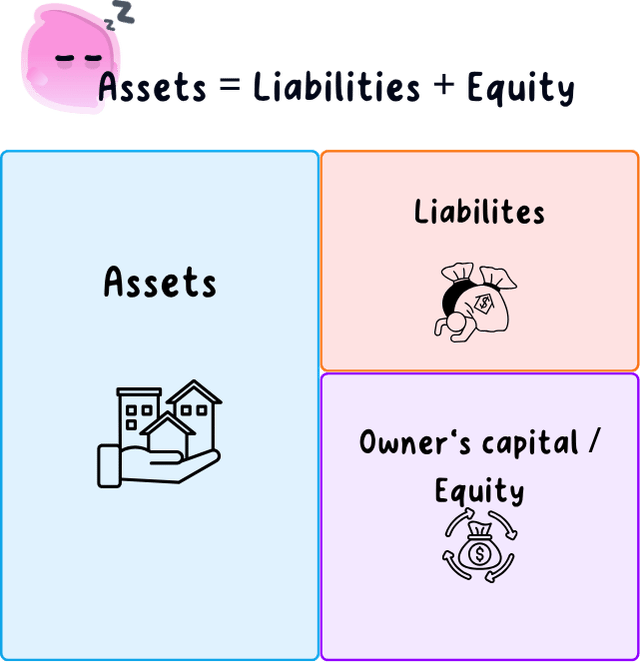
The statement of financial position is a snapshot of what the business owns and owes
Statement of financial position: a financial statement showing a business's assets, liabilities and capital position at a particular date.
- Unlike the statement of comprehensive income, which covers a period of trading, the statement of financial position describes the business at one specific date.
- Its main Edexcel features are non-current assets, current assets, current liabilities, non-current liabilities and capital employed.
Assets are separated by how long they remain in the business
Non-current assets: assets held for long-term use in the business, usually for more than one year, such as premises, machinery or vehicles.
Current assets: assets expected to be used, sold or converted into cash within one year, such as inventories, trade receivables and cash.
- A delivery van used for several years is a non-current asset, whereas inventory held for sale and money owed by customers are current assets because they form part of the shorter trading cycle.
- The distinction is about how the asset is used and how long it remains in the business, not simply how expensive it is.
Liabilities are separated by when they must be repaid
Current liabilities: amounts the business expects to pay within one year, such as trade payables or an overdraft.
Non-current liabilities: amounts owed that are due after more than one year, such as a long-term bank loan.
- Trade payables belong to current liabilities because suppliers normally expect payment within the short term, while a loan repayable over several years is a non-current liability.
- A liability does not become current simply because the amount is large; the key question is when the amount is due for repayment.
Do not classify an item by its name alone: a loan can be current or non-current depending on when repayment is due.
Capital employed measures the long-term finance tied up in the business
Capital employed: the long-term finance invested in the business and used to generate its operating profit.
- One way to identify capital employed from the statement is total assets minus current liabilities, because current liabilities are short-term finance rather than long-term capital.
Selected statement figures bring the categories together
| Selected figures from Harbour Cycles Ltd | £ |
|---|---|
| Non-current assets | 150,000 |
| Current assets | 30,000 |
| Total assets | 180,000 |
| Current liabilities | 18,000 |
| Non-current liabilities | 40,000 |
| Capital employed | 162,000 |
- Harbour's capital employed is £180,000 minus £18,000 = £162,000, showing the amount of long-term finance supporting the assets used by the business.
- The £40,000 non-current liability is shown separately because it is a long-term obligation rather than a short-term liability due within the year.
- Classify assets by how long they are held or take to become cash.
- Classify liabilities by when they must be repaid.
- When capital employed is needed, identify the long-term finance position rather than treating current liabilities as part of it.
- What does a statement of financial position show?
- Give two examples each of non-current and current assets.
- What is the difference between current and non-current liabilities?
- What is capital employed?
- If total assets are £180,000 and current liabilities are £18,000, what is capital employed?