Lean production aims to remove waste while maintaining useful output and quality
Definition
Lean production: an approach to production that aims to reduce wasted materials, time, space and effort while maintaining the output and quality customers need.
- Edexcel focuses on two lean methods: just-in-time reduces the waste and cost of holding inventory, while Kaizen seeks continuous small improvements in how work is done.
Just-in-time keeps inventory low by matching deliveries closely to production needs
Definition
Just-in-time (JIT): an inventory system in which materials and components arrive close to the time they are needed for production, so the business holds very little inventory.
- JIT relies on accurate information and dependable suppliers. Instead of keeping a large safety inventory, the business coordinates smaller deliveries with expected customer orders or production schedules.
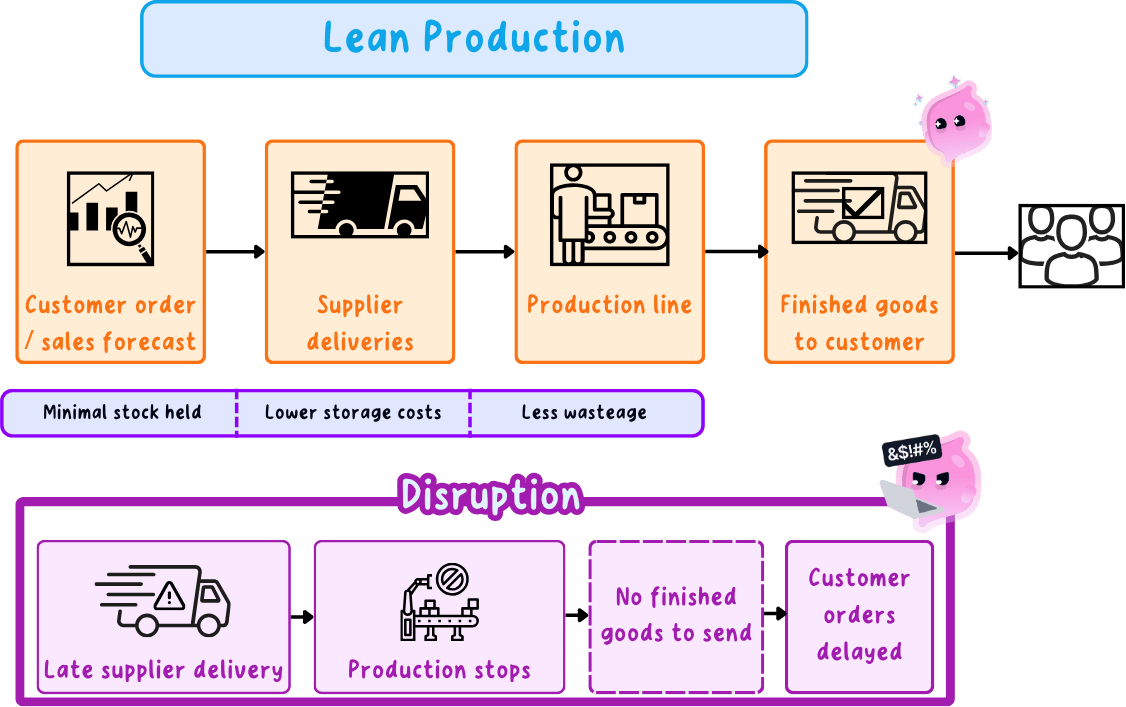
- Advantages: less cash is tied up in inventory, storage and handling costs fall, and there is less risk of stored goods being damaged, spoiled or becoming obsolete.
- Disadvantages: with little buffer inventory, a late or faulty delivery can stop production quickly. Frequent small deliveries may also increase transport cost or reduce opportunities for bulk discounts.
Common Mistake
JIT removes inventory cost and inventory protection at the same time. Its suitability depends heavily on supplier reliability and the business's ability to coordinate deliveries accurately.
Kaizen builds improvement through many small worker-led changes
Definition
Kaizen: continuous improvement through frequent small changes to how work is organised and carried out, often using ideas from employees doing the job.
- Employees can identify wasted movement, awkward layouts, repeated errors or slow steps that managers may not notice. A small improvement may save only seconds or a little material each time, but repeated across high output the total saving can become significant.
- Advantages: many changes can be low-cost, improvements can accumulate over time, and involving employees in problem-solving can increase responsibility and engagement for some workers.
- Disadvantages: improvements are usually gradual rather than dramatic, meetings and training take time, and the approach loses credibility if managers ask for suggestions but rarely act on useful ideas.
Example
- Workers notice that a commonly used tool is stored several metres from the production station.
- Moving it closer saves only a few seconds on each unit, but across thousands of units the time saving raises productivity without buying a new production line.
JIT and Kaizen reduce different forms of waste
- JIT mainly tackles unnecessary inventory and the cost of storing it; Kaizen tackles inefficiencies within the work itself. Both can lower unit costs, but each requires the right operating conditions rather than being automatically suitable for every business.
Exam technique
- For JIT, link low inventory to both lower holding costs and greater exposure to supply disruption.
- For Kaizen, describe continuous small improvements rather than a one-off major investment.
- Judge suitability from supplier reliability, inventory needs, employee involvement and the type of improvement the business needs.
Self review
- What is lean production?
- Give two advantages and two disadvantages of JIT.
- Why does JIT depend heavily on reliable suppliers?
- What is Kaizen?
- How can many small Kaizen changes produce a significant business benefit?