Changes in revenue or costs can move the break-even point
- Break-even changes when selling price, fixed costs or variable cost per unit changes because those changes alter either the revenue earned per unit or the contribution available to cover fixed costs.
- The direction matters: a lower break-even output means fewer units must be sold before profit begins, while a higher break-even output means the business must sell more before covering all costs.
A higher selling price lowers break-even if costs stay unchanged
- A higher selling price increases contribution per unit, so each sale covers more of the fixed costs and fewer units are needed to break even.
- On a break-even chart, a higher price makes the total revenue line steeper, so it crosses the total cost line at a lower quantity of output; a lower price has the opposite effect.
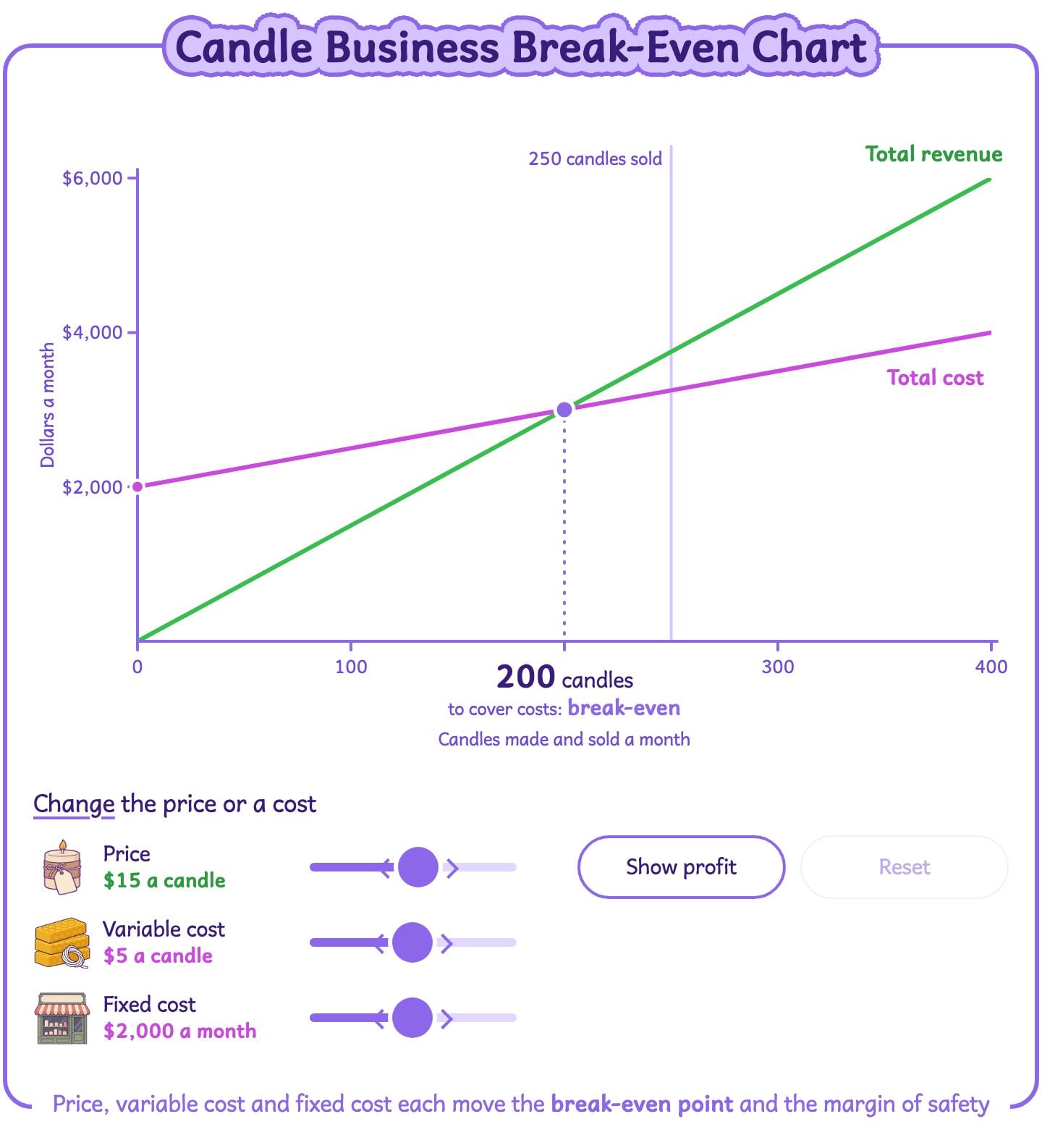
Drag price, variable cost and fixed cost, and watch the break-even point and margin of safety move.
Higher fixed or variable costs raise break-even
- Higher fixed costs increase the amount that must be covered before profit begins, so the total cost line shifts upwards and the break-even point moves to a higher output.
- A higher variable cost per unit reduces contribution, so the total cost line becomes steeper and break-even also rises; lower fixed or variable costs move break-even in the opposite direction.
Example
- Start with price £10, variable cost £3 and fixed costs £2,000, giving contribution of £7 and break-even of about 286 units.
- If price rises to £12, contribution becomes £9 and break-even falls to about 223 units.
- If fixed costs instead rise to £2,800 while contribution stays £7, break-even rises to 400 units.
- If variable cost rises to £5 while price stays £10, contribution falls to £5 and break-even also rises to 400 units.
A change in the quantity sold can change profit without moving break-even
- If the business sells fewer units but its price, fixed costs and variable cost per unit stay unchanged, the break-even output stays in the same place even though actual profit falls or a loss becomes more likely.
- Selling more units moves actual output further beyond break-even and increases profit, but it does not by itself reduce the number of units needed to break even.
Common Mistake
Do not say that higher sales volume lowers the break-even point: break-even moves when price or costs change, while selling more changes the business's position relative to that point.
The business effect depends on whether the change moves break-even towards or away from expected sales
- A lower break-even output gives the business a larger cushion if expected sales stay unchanged, because demand can fall further before total revenue drops below total costs.
- A higher break-even output increases risk if expected sales are close to the new break-even point, because a smaller fall in sales would push the business into loss.
Exam technique
- Identify whether the change affects selling price, fixed cost, variable cost per unit or only the quantity sold.
- Explain how the change affects contribution or the amount of fixed costs that must be covered.
- Then state whether break-even rises, falls or stays unchanged and what that means for the business's risk of loss.
Self review
- What happens to break-even if the selling price rises and costs stay unchanged?
- What happens to break-even if fixed costs rise?
- Why does a higher variable cost per unit raise break-even?
- If sales quantity falls but price and costs are unchanged, what happens to the break-even output?
- Why does a lower break-even output reduce the risk of making a loss when expected sales stay the same?