1.6.1 Government spending
Government spending provides public services but is constrained by the money available
Taxation: money collected by the government from people and businesses.
Public services: services provided or funded by government for the public, such as healthcare, education, transport infrastructure, policing and defence.
- Businesses are affected by both sides of government spending. They use public services and infrastructure, while taxation helps provide the money needed to fund them.
A new rail line can create orders for construction businesses while it is built, then reduce travel and transport times for firms that use the route once it opens.
How public services support business activity
- Education: provides businesses with workers who already have basic knowledge and skills, reducing the amount of training employers must provide themselves.
- Healthcare: supports the health of the workforce, which can reduce absence and help businesses maintain productivity.
- Infrastructure: roads, railways, ports, power and communications can help businesses move goods, reach customers and operate more efficiently.
- Law, order and defence: a stable environment with protected property and enforceable contracts gives businesses greater confidence to trade and invest.
Government spending can also create demand for businesses
- When government departments buy goods and services or pay firms to complete projects, the businesses that win those contracts receive revenue directly from public spending.
- A programme to build schools or hospitals can create orders for construction firms and for suppliers of equipment, furniture and services.
Taxation and constraints on public spending
- Taxation provides government revenue: governments collect taxes from incomes, business activity and spending, then use that revenue to help fund public services.
- Taxation can affect businesses and consumers: some taxes reduce the profit left to a business, while taxes on incomes or spending can affect how much consumers have available or how much they pay for products.
- Public spending is constrained by available finance: governments face competing demands for limited revenue, so spending more on one service can mean less money is available for another.
- Borrowing can increase spending in the short term: but borrowed money must be repaid and creates interest costs, so borrowing does not remove the need to make choices about future spending.
The effect on a business depends on what it gains and what it pays
- A firm may gain significantly from educated workers, good infrastructure or a government contract while also paying taxes. Another firm may receive fewer direct benefits, so the balance can differ between businesses.
Keep the two strands linked but separate: government spending provides public services, while taxation and limited finance constrain how much can be spent.
- What is taxation?
- Give three public services and explain how they can support businesses.
- How can government spending create demand for businesses?
- How can taxation affect a business or its customers?
- Why is public spending constrained?
1.6.2a Infrastructure and legislation
Governments affect business activity through infrastructure and legislation
Infrastructure: the basic facilities a country needs, such as roads, railways, ports, power and communications.
Legislation: laws passed by the government that businesses must obey.
- Infrastructure affects how efficiently businesses can operate, while legislation sets rules that can change their costs and decisions.
A new bypass may shorten a haulage firm's delivery times, while a new safety requirement may make the same firm spend more on equipment or training.
Infrastructure provision
- Good transport infrastructure can reduce time and cost: reliable roads, railways and ports can allow faster deliveries, make suppliers easier to reach and help businesses serve larger markets.
- An exporter may benefit from a better port because goods can reach overseas customers more quickly and with fewer delays.
- Reliable power and communications support operations: electricity, broadband and telecommunications allow production, payments, online selling and communication with customers and suppliers to run reliably.
- Poor infrastructure can increase costs and disrupt output: unreliable transport, power or communications can cause delays, wasted time and lost production, making a firm less competitive.
Legislation
- Legislation can require businesses to change how they operate: laws can affect employment practices, consumer treatment, health and safety and environmental behaviour.
- Compliance can raise costs: businesses may need to pay higher wages, buy safer equipment, change packaging or processes, keep records or train staff in order to meet legal requirements.
- A new safety requirement may force a factory to install machine guards and train employees, increasing costs before any additional output is produced.
- Legislation can also create benefits: safer working practices can reduce accidents and absence, while stronger consumer protection can increase confidence in businesses that comply.
- Breaking the law creates additional risk: a business that fails to comply may face fines, compensation claims, disruption and damage to its reputation.
The overall effect varies by business
- Infrastructure matters most where transport, power or communications are important to the firm's activity. Legislation also affects firms differently because the cost of complying depends on what the business does and how much its existing practices must change.
For infrastructure, trace the effect to time, reliability or cost. For legislation, trace the required change to the business's costs or decisions.
- What is infrastructure?
- Explain two ways good infrastructure can help a business.
- How can poor infrastructure make a business less competitive?
- Give two ways legislation can increase a firm's costs.
- How can legislation also benefit a business?
1.6.2b Trade policy
Trade policy affects businesses through tariffs and membership of trading blocs
Tariff: a tax placed on imported goods.
Trading bloc: a group of countries that agree to reduce barriers to trade between members.
- Trade policy changes the conditions under which businesses buy from and sell to other countries. The effect depends on whether a firm is a domestic producer, an importer, an exporter or a combination of these.
A tariff on imported steel can help a domestic steel producer by making foreign steel more expensive, while increasing costs for a car manufacturer that relies on imported steel.
Tariffs
- Tariffs make imported goods more expensive: the tax raises the cost of bringing goods into the country and can therefore increase their selling price.
- Domestic producers may become more competitive: if imported alternatives become more expensive, products made by domestic firms may look better value and gain sales.
- Importers can face higher costs: businesses that buy materials or finished goods from abroad may pay more, reducing profit unless they cut other costs or increase their own prices.
- Exporters can also be affected by tariffs in foreign markets: if another country places a tariff on the firm's exports, those products become more expensive for customers there and may lose competitiveness.
Trading blocs
- Membership can improve access to member markets: lower trade barriers between members can make it easier or cheaper for a business to sell to customers in other member countries.
- A manufacturer can treat several member countries as a larger potential market when goods can move between them with fewer trade barriers.
- Membership can reduce the cost of imported inputs from other members: businesses may be able to buy materials or components from suppliers in member countries without the tariffs that would otherwise raise costs.
- Competition can increase: firms from other member countries also gain easier access to the domestic market, so local businesses may face more rivals.
- Businesses outside the bloc may face a disadvantage: a non-member exporter may face tariffs or other barriers when selling into the bloc, making its products less competitive than goods produced inside it.
Trade policy can help one business and hurt another
- A tariff can protect a domestic producer while raising the costs of an importer. Membership of a trading bloc can open foreign markets for an exporter while also exposing it to stronger competition at home.
- The impact therefore depends on the firm's role in international trade and on how important imported inputs and overseas customers are to its business model.
Identify the firm's position first: a domestic producer competing with imports, an importer and an exporter can experience the same tariff very differently.
- What is a tariff?
- How can a tariff help a domestic producer?
- How can a tariff increase costs for an importer?
- Give two possible benefits to a business of membership of a trading bloc.
- Why can membership of a trading bloc also increase competition?
1.6.3 The effect of interest rates
Interest rates affect businesses and consumer spending through the cost of borrowing
Interest rate: the cost of borrowing money, or the return from saving it, expressed as a percentage.
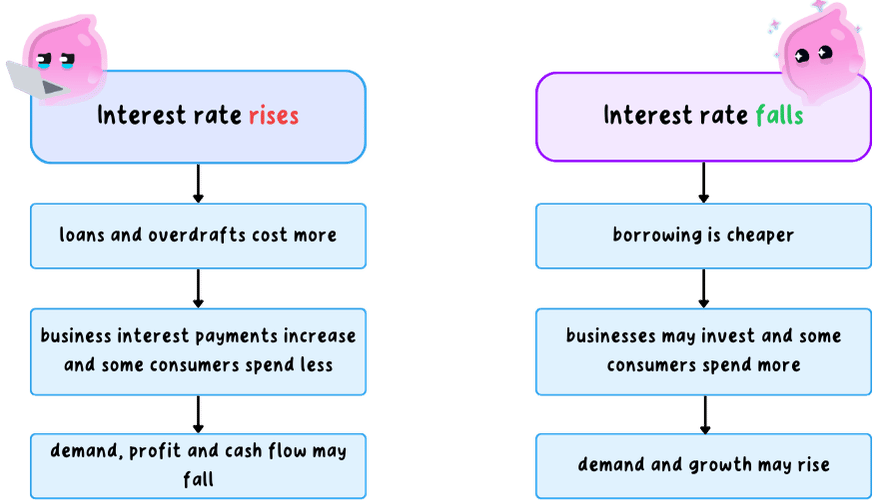
- A change in interest rates can reach a business in two ways. It changes the cost of the firm's own borrowing and it changes how much some consumers are willing or able to spend.
A housebuilder can be affected twice by higher interest rates. Its own borrowing becomes more expensive, while potential buyers facing higher mortgage costs may delay purchasing a home.
Higher interest rates
- Business borrowing becomes more expensive: interest payments on loans and overdrafts can rise, increasing costs and reducing the profit left after expenses.
- A business planning to borrow for new machinery or another branch may delay the investment if the expected repayments become too expensive.
- Consumer spending may fall: households with mortgages or other borrowing may have less disposable income after higher interest payments, while saving can become more attractive.
- Businesses selling non-essential or expensive products may see a larger fall in demand because customers can postpone those purchases more easily.
Lower interest rates
- Business borrowing becomes cheaper: lower interest costs can reduce expenses and make borrowing for investment more affordable.
- A business that had delayed opening a new site may decide the investment is now affordable because the cost of finance has fallen.
- Consumer spending may rise: some households have lower borrowing costs and saving offers a smaller return, so more income may be spent on goods and services.
Some businesses are affected more than others
- Businesses with large loans are more exposed to changes in borrowing costs. Debt-free businesses may feel little direct effect through their own finances.
- Businesses selling expensive products commonly bought using credit can also be strongly affected because the customer's cost of finance changes at the same time.
- A car dealer may be more sensitive to interest-rate changes than a convenience store because customers are much more likely to use borrowing when buying a car than when buying everyday groceries.
Check both channels for this topic: the firm's borrowing costs and its customers' spending. Which channel matters more depends on the business in the case.
- What is an interest rate?
- How can higher interest rates affect a business's own costs?
- How can higher interest rates affect consumer spending?
- How can lower interest rates encourage business investment?
- Why are some businesses more affected by interest-rate changes than others?