Globalisation creates opportunities and threats for businesses
Definition
Globalisation: the increasing connections between countries as businesses trade, invest and operate across national borders.
- Improved communication, transport and international trade have made it easier for businesses to reach customers, suppliers and production locations in other countries.
Example
A small UK toy producer may gain access to customers abroad through online marketplaces, but the same global links also allow overseas toy producers to compete for its customers in the UK.
Opportunities from globalisation
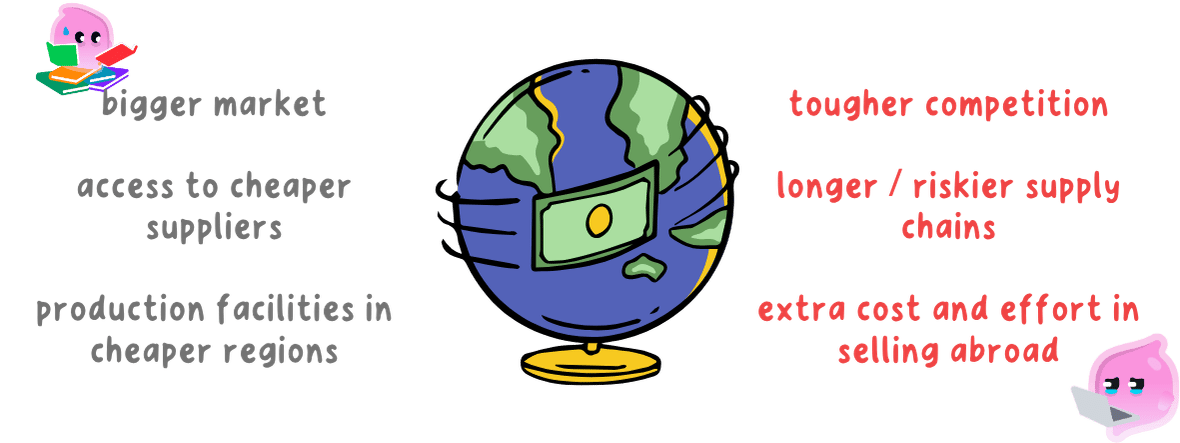
- Access to larger markets: businesses can sell to customers in more countries, increasing the potential size of the market and creating opportunities for higher sales.
- A digital business can make the same product available to customers in many countries without opening a physical store in each one.
- Access to lower-cost suppliers or production: businesses may source materials or locate production in countries where costs are lower, helping them reduce unit costs or remain price-competitive.
- A clothing business may source fabric or manufacture garments abroad if doing so lowers its costs while maintaining the required quality.
- Access to a wider range of resources and knowledge: businesses can work with suppliers, employees and partners in different countries, giving access to skills, materials or ideas that may not be as readily available at home.
Threats from globalisation
- Greater competition: domestic businesses can face competitors from other countries, putting pressure on prices, quality, customer service and market share.
- A local manufacturer may lose customers if imported products offer a similar quality at a lower price.
- Longer and riskier supply chains: relying on overseas suppliers can increase the distance, time and complexity involved in obtaining materials and expose the firm to disruption in other countries.
- Extra cost and complexity when selling abroad: businesses entering foreign markets may have to adapt products, promotion or distribution and deal with unfamiliar laws, languages and customer preferences.
The effect depends on the business
- A competitive business may be able to use globalisation to reach more customers and reduce costs. A less efficient business may be more exposed to international competitors that can offer lower prices or better products.
- The same feature can create both an opportunity and a threat. Easier international trade allows a business to enter foreign markets, but also makes it easier for foreign firms to enter its home market.
Exam technique
For this topic, avoid treating globalisation as automatically positive or negative. Use the business in front of you to decide whether larger markets and lower costs outweigh stronger competition and international risk.
Self review
- What is globalisation?
- Give two opportunities globalisation can create for a business.
- How can globalisation increase competition for a domestic business?
- Why can an international supply chain be riskier than a local one?
- Why might globalisation help one business but threaten another?