3.4.1a Main features of the income statement
The statement of comprehensive income shows how trading produces operating profit
Statement of comprehensive income: a financial statement showing a business's revenue, costs and profit over a period of time, often called an income statement.
- The statement works down from revenue to gross profit and then operating profit, showing how different costs reduce the value created by sales during the period.
- Edexcel uses the IAS term revenue. Sales revenue is also widely used, and in this context both mean the value of the business's sales.
Sales revenue and cost of sales determine gross profit
Cost of sales: the direct cost of the goods or services that generated the sales revenue for the period.
Gross profit: the profit remaining after cost of sales is subtracted from revenue.
- Gross profit therefore shows what remains from sales after the direct cost of the items sold has been covered, before the other expenses of running the business are deducted.
Expenses reduce gross profit to operating profit
Operating profit: the profit remaining after operating expenses are deducted from gross profit.
- Expenses are the other costs of running the business that are not included in cost of sales, such as rent, wages, marketing, insurance and utilities.
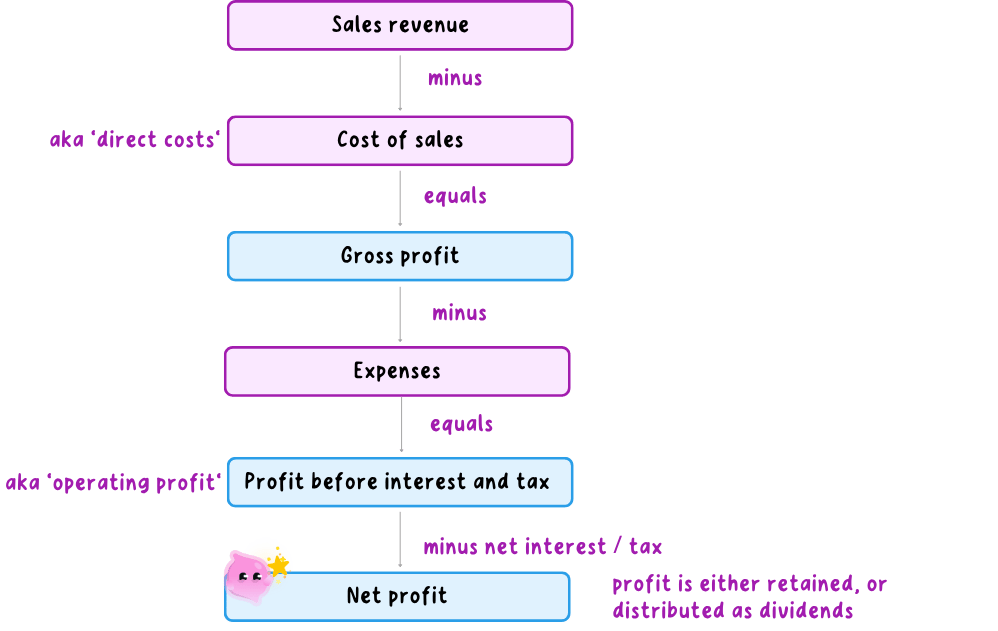
Edexcel uses the term operating profit for the stage often called profit before interest and tax (PBIT); both terms are widely used, but use operating profit in Edexcel answers.
A complete example shows the order of the statement
- Riverside Café has sales revenue of £100,000, cost of sales of £60,000 and operating expenses of £25,000 for the year.
| Statement of comprehensive income, year ended 31 Dec | £ |
|---|---|
| Sales revenue | 100,000 |
| Cost of sales | (60,000) |
| Gross profit | 40,000 |
| Expenses | (25,000) |
| Operating profit | 15,000 |
- The £40,000 gross profit comes from £100,000 minus £60,000, then expenses of £25,000 reduce it to an operating profit of £15,000.
Do not subtract all expenses before finding gross profit: cost of sales is deducted from revenue first, then the other operating expenses are deducted from gross profit.
Gross and operating profit reveal different parts of business performance
- Gross profit focuses on the relationship between sales revenue and cost of sales, while operating profit also reflects the other expenses needed to run the business.
- This separation is useful because a business can have a healthy gross profit but a much smaller operating profit when its operating expenses are high.
- Read the statement in order: sales revenue, cost of sales, gross profit, expenses, operating profit.
- Use revenue minus cost of sales for gross profit.
- Use gross profit minus expenses for operating profit and keep the two profit figures distinct.
- What does a statement of comprehensive income show?
- What is cost of sales?
- State the calculation for gross profit.
- State the calculation for operating profit.
- Using the example, why is operating profit lower than gross profit?
3.4.1b Use in decision making and profit
The income statement supports decisions by showing where profit has changed
- A profit figure becomes more useful when it is compared with an earlier period, a target or another business, because the comparison shows whether performance has improved or weakened.
- Managers can then trace the change through revenue, cost of sales, gross profit and expenses rather than reacting to the final operating profit figure alone.
For Edexcel, you need to interpret a statement of comprehensive income and use its figures in decisions; you are not required to construct one from scratch.
Comparing gross and operating profit helps locate the problem
- If gross profit falls, managers should investigate changes in revenue or cost of sales, such as weaker sales, lower selling prices or higher direct costs.
- If gross profit stays similar but operating profit falls, the change points more strongly towards higher operating expenses such as rent, wages, marketing or utilities.
- A shop's gross profit stays at £40,000, but operating profit falls from £20,000 to £15,000.
- Because gross profit is unchanged, operating expenses must have increased by £5,000, so the owner should investigate those expenses before blaming the product's direct costs.
The figures can guide pricing, cost control and growth decisions
- Falling gross profit may lead managers to review selling prices, sales volumes, suppliers or production costs, but the best response depends on what caused the fall and how customers may react.
- Rising operating expenses may prompt tighter cost control, while improving profits can give the business more confidence to invest or expand, provided cash flow and other business conditions also support the decision.
Do not jump from one falling figure to one automatic solution: use the statement to identify which part changed, then judge the response in the context of the business.
Profit rewards risk and can finance the future of the business
- Profit provides a return to owners for taking the risk of investing in the business and can be distributed to them or retained within the business.
- Retained profit can finance future growth without borrowing, while a record of profit can make the business more attractive to potential investors and lenders.
- Profit is not the only measure of success, and a business may accept lower profit temporarily when it is investing for future growth or pursuing another objective, so profit should be interpreted alongside the wider situation.
- Compare the figures rather than judging one profit number in isolation.
- Use gross profit to investigate revenue and cost of sales, then operating profit to investigate the effect of operating expenses.
- Link any suggested decision to the cause shown by the figures and the likely consequence for the business.
- Why is a profit figure more useful when compared with another figure?
- If gross profit falls, which two broad parts of the statement should managers investigate?
- If gross profit is unchanged but operating profit falls by £5,000, what does that suggest?
- Give two reasons profit is important to a business.
- Why should a manager avoid choosing a response before identifying what caused profit to change?
3.4.2a Main features of the statement
The statement of financial position is a snapshot of what the business owns and owes
Statement of financial position: a financial statement showing a business's assets, liabilities and capital position at a particular date.
- Unlike the statement of comprehensive income, which covers a period of trading, the statement of financial position describes the business at one specific date.
- Its main Edexcel features are non-current assets, current assets, current liabilities, non-current liabilities and capital employed.
Assets are separated by how long they remain in the business
Non-current assets: assets held for long-term use in the business, usually for more than one year, such as premises, machinery or vehicles.
Current assets: assets expected to be used, sold or converted into cash within one year, such as inventories, trade receivables and cash.
- A delivery van used for several years is a non-current asset, whereas inventory held for sale and money owed by customers are current assets because they form part of the shorter trading cycle.
- The distinction is about how the asset is used and how long it remains in the business, not simply how expensive it is.
Liabilities are separated by when they must be repaid
Current liabilities: amounts the business expects to pay within one year, such as trade payables or an overdraft.
Non-current liabilities: amounts owed that are due after more than one year, such as a long-term bank loan.
- Trade payables belong to current liabilities because suppliers normally expect payment within the short term, while a loan repayable over several years is a non-current liability.
- A liability does not become current simply because the amount is large; the key question is when the amount is due for repayment.
Do not classify an item by its name alone: a loan can be current or non-current depending on when repayment is due.
Capital employed measures the long-term finance tied up in the business
Capital employed: the long-term finance invested in the business and used to generate its operating profit.
- One way to identify capital employed from the statement is total assets minus current liabilities, because current liabilities are short-term finance rather than long-term capital.
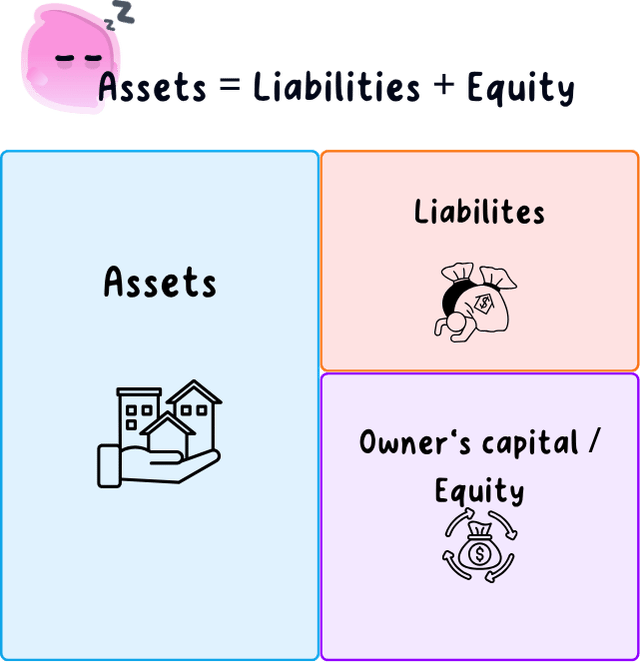
Selected statement figures bring the categories together
| Selected figures from Harbour Cycles Ltd | £ |
|---|---|
| Non-current assets | 150,000 |
| Current assets | 30,000 |
| Total assets | 180,000 |
| Current liabilities | 18,000 |
| Non-current liabilities | 40,000 |
| Capital employed | 162,000 |
- Harbour's capital employed is £180,000 minus £18,000 = £162,000, showing the amount of long-term finance supporting the assets used by the business.
- The £40,000 non-current liability is shown separately because it is a long-term obligation rather than a short-term liability due within the year.
- Classify assets by how long they are held or take to become cash.
- Classify liabilities by when they must be repaid.
- When capital employed is needed, identify the long-term finance position rather than treating current liabilities as part of it.
- What does a statement of financial position show?
- Give two examples each of non-current and current assets.
- What is the difference between current and non-current liabilities?
- What is capital employed?
- If total assets are £180,000 and current liabilities are £18,000, what is capital employed?
3.4.2b Interpreting the statement
Interpreting the statement means comparing what the business owns, owes and how those figures are changing
- The statement of financial position is a snapshot at one date, so interpretation comes from comparing categories within the statement and, where possible, comparing the figures with another year or another business.
- A single increase is not automatically good or bad: more non-current assets may reflect investment, while more liabilities may have financed that investment and also create future repayment commitments.
For Edexcel, you interpret the statement and draw conclusions from the figures; you are not required to construct a statement of financial position from scratch.
Current assets and current liabilities give an early view of short-term pressure
- When current assets are greater than current liabilities, the business has more short-term resources than short-term obligations, although the quality of those assets still matters.
- A large amount of cash is available immediately, while inventories first have to be sold and trade receivables first have to be collected, so two businesses with the same total current assets can have different short-term positions.
Current assets of £30,000 against current liabilities of £18,000 provide a £12,000 excess of current assets, but managers should still check how much of the £30,000 is cash, receivables or inventory.
Changes in assets and liabilities can reveal how the business is developing
- A rise in non-current assets can indicate investment in premises, machinery or vehicles, but the interpretation is stronger when the source of finance and the effect on performance are also considered.
- A rise in non-current liabilities can mean greater use of long-term borrowing, which may support expansion but also increases the amount the business will have to repay in future.
| £ | Year 1 | Year 2 | Change |
|---|---|---|---|
| Non-current assets | 50,000 | 70,000 | +20,000 |
| Non-current liabilities | 10,000 | 35,000 | +25,000 |
- The figures suggest the business has invested £20,000 more in non-current assets while long-term borrowing has risen by £25,000, so the expansion appears to have been financed heavily through debt and should be judged alongside the returns generated by the investment.
Do not assume that rising assets always mean stronger performance or that rising liabilities always mean weakness: explain what the change may represent and what consequence it could create.
Comparisons make the snapshot more meaningful
- Comparing the statement over time can show whether short-term obligations, borrowing or investment are increasing or decreasing, while comparison with a similar business can show whether the position is unusual for the industry.
- The statement still records only one date and contains financial information, so it cannot by itself show customer satisfaction, employee quality, brand strength or future demand.
- Start with a comparison, such as current assets against current liabilities or this year against last year.
- Explain what the change may indicate rather than labelling an increase as automatically good or bad.
- Link the interpretation to a possible business consequence, then recognise when more information would be needed for a firm judgement.
- Why is a statement of financial position described as a snapshot?
- Why should current assets be compared with current liabilities?
- Why can £30,000 of current assets held mostly as inventory be weaker than the same total held mostly as cash?
- What might a rise in both non-current assets and non-current liabilities suggest?
- Why is comparing two years usually more useful than looking at one statement alone?