1.4.1a Proximity and nature of activity
Location depends on what the business needs to be close to and what activity it carries out
- A location affects access to customers, workers, materials and competitors. The importance of each factor depends on the nature of the business activity, so the best location for one firm can be unsuitable for another.
A jeweller may accept expensive premises on a busy shopping street to be close to customers, while a furniture manufacturer may prefer a larger site away from the town centre because customers do not need to visit the factory.
Proximity to the market
- Being close to customers can increase convenience and sales: shops, restaurants and personal services often rely on customers being able to reach them easily, so a location with high footfall can be valuable.
- A sandwich shop near offices can serve large numbers of workers at lunchtime, whereas the same shop in a quiet residential street may attract fewer customers during the working day.
Proximity to labour
- A business may need access to workers with particular skills: locating where suitable employees already live can make recruitment easier and reduce the need to train or relocate workers.
- A software business may choose a city with a large pool of programmers, while a labour-intensive factory may place more emphasis on having a large available workforce.
Proximity to materials
- Being close to raw materials can reduce transport time, cost or waste: this is especially important when inputs are bulky, heavy or perishable.
- A food processor using fresh fruit may locate close to farms so the ingredients arrive quickly and in good condition.
Proximity to competitors
- Being near competitors can help or harm a business: some businesses benefit when customers visit an area specifically to compare alternatives, while other firms prefer locations with less direct competition.
- Car dealerships often locate close together because buyers want to compare several cars, while a small convenience shop may avoid opening next to a large supermarket.
Nature of the business activity
- The activity determines which location factor matters most: customer-facing businesses often prioritise proximity to the market, manufacturers may prioritise materials or labour, and some firms can operate successfully without customers visiting the site at all.
- A location decision therefore involves trade-offs. A business may accept being farther from customers if the activity does not require customer visits and another factor, such as access to materials or labour, matters more.
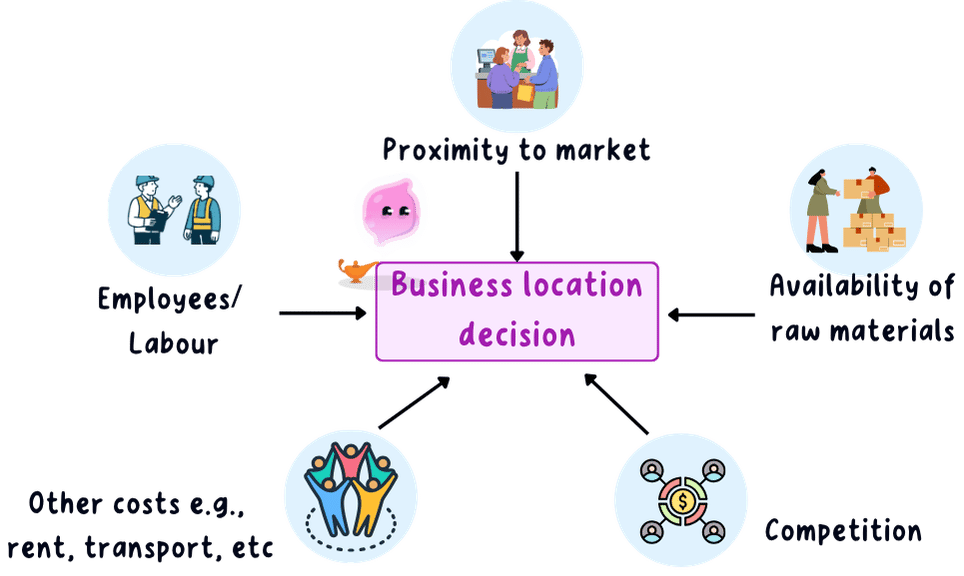
Why a business may relocate
- The same factors can make an existing location less suitable over time. A business may relocate if its market moves, labour becomes difficult to recruit, a supplier base changes or competition becomes stronger.
- A manufacturer that begins using a different raw material may move closer to its new suppliers if transport becomes an important part of total cost.
Choose the factor that matches the activity. Proximity to the market is powerful for a customer-facing service, while proximity to materials is more likely to matter for a producer using bulky or perishable inputs.
- Name the four proximity factors in this article.
- Why might a shop want to be close to its market?
- Why might a manufacturer locate close to its materials?
- Why can locating close to competitors sometimes be useful?
- Give one reason an existing business might relocate.
1.4.1b Internet and legal controls
The internet, legal controls and trade blocs can change where a business locates
- A business does not always need customers to visit its premises. The internet can reduce the importance of a prime customer-facing site, while laws and trade arrangements can make some locations more or less attractive.
An online clothing retailer can sell nationally from a large out-of-town warehouse because customers order through the website rather than visiting the warehouse.
E-commerce can reduce the need for prime retail premises
E-commerce: buying and selling goods and services online.
- E-commerce can reduce the need for a prime retail location: a business that sells online can reach customers without relying on passing trade, so premises can be chosen for operational convenience rather than visibility.
- An online seller may choose a lower-cost warehouse with good delivery access instead of paying for a shop in a busy shopping centre.
- Fixed premises still matter for many businesses: restaurants, gyms, hairdressers and other businesses that customers must visit still depend heavily on where the premises are located.
- Some businesses combine e-commerce and fixed premises: physical locations can provide customer access, collection or service while the website extends the market beyond the local area.
Legal controls can rule a site in or out
- Laws and regulations can restrict the use of a location: planning controls, licences or other legal requirements can determine whether a particular activity is allowed at a site.
- A business may find a site attractive because of its customers and transport links but still be unable to operate there if the permitted use does not cover the planned activity.
Trade blocs can make an international location more attractive
Trade bloc: a group of countries that agree to reduce barriers to trade between members.
- Membership of a trade bloc can influence international location decisions: reduced trade barriers between member countries can make it easier or cheaper for a business located inside the bloc to serve customers across the member market.
- A manufacturer may place production inside a trade bloc when doing so improves access to customers in other member countries compared with exporting from outside the bloc.
Changes in these factors can cause relocation
- A business may relocate when technology changes the type of premises it needs. A retailer that moves more sales online may need less expensive shop space but more warehouse capacity.
- Changes in legal controls or trading arrangements can also alter the advantages of an existing site, making another country or region more suitable for future operations.
For the internet strand, first decide whether customers need to visit the business; that tells you whether a prime physical location still matters.
- What is e-commerce?
- How can e-commerce reduce the need for a prime retail location?
- Why do some businesses still need fixed premises?
- How can legal controls affect a location decision?
- Why might locating inside a trade bloc be attractive to a manufacturer?