Current and acid-test ratios compare short-term assets with short-term debts
Definition
Current ratio: current assets divided by current liabilities, showing how the business's short-term assets compare with its short-term debts.
Acid-test ratio: current assets excluding inventory divided by current liabilities, giving a stricter view of the short-term position.
- Both ratios use current liabilities as the denominator because they focus on amounts the business must pay within one year.
- The acid test removes inventory because inventory first has to be sold before it becomes cash, so it may be less useful for paying an urgent bill than cash or money due from customers.
The current ratio uses all current assets
Example
A business has current assets of £30,000 and current liabilities of £18,000.
current ratio=£30,000£18,000≈1.67:1 \text{current ratio} = \dfrac{£30{,}000}{£18{,}000} \approx 1.67:1 current ratio=£18,000£30,000≈1.67:1- A current ratio of 1.67:1 means the business has £1.67 of current assets for each £1 of current liabilities at that date.
- That figure does not show how quickly those assets can become cash, so the composition of current assets still matters.
The acid test removes inventory before making the same comparison
Example
The same business has £12,000 of inventory within its £30,000 of current assets.
acid-test ratio=£30,000−£12,000£18,000=1:1 \text{acid-test ratio} = \dfrac{£30{,}000 - £12{,}000}{£18{,}000} = 1:1 acid-test ratio=£18,000£30,000−£12,000=1:1- The 1:1 result means the non-inventory current assets equal the current liabilities, which is a tighter position than the current ratio alone suggests.
- The gap between the two ratios becomes especially informative when a large share of current assets is held as inventory.
Common Mistake
- Do not subtract inventory from current liabilities in the acid test; inventory is removed from current assets.
- Do not assume a higher ratio is always better, because excess cash or slow-moving inventory can mean resources are being used inefficiently.
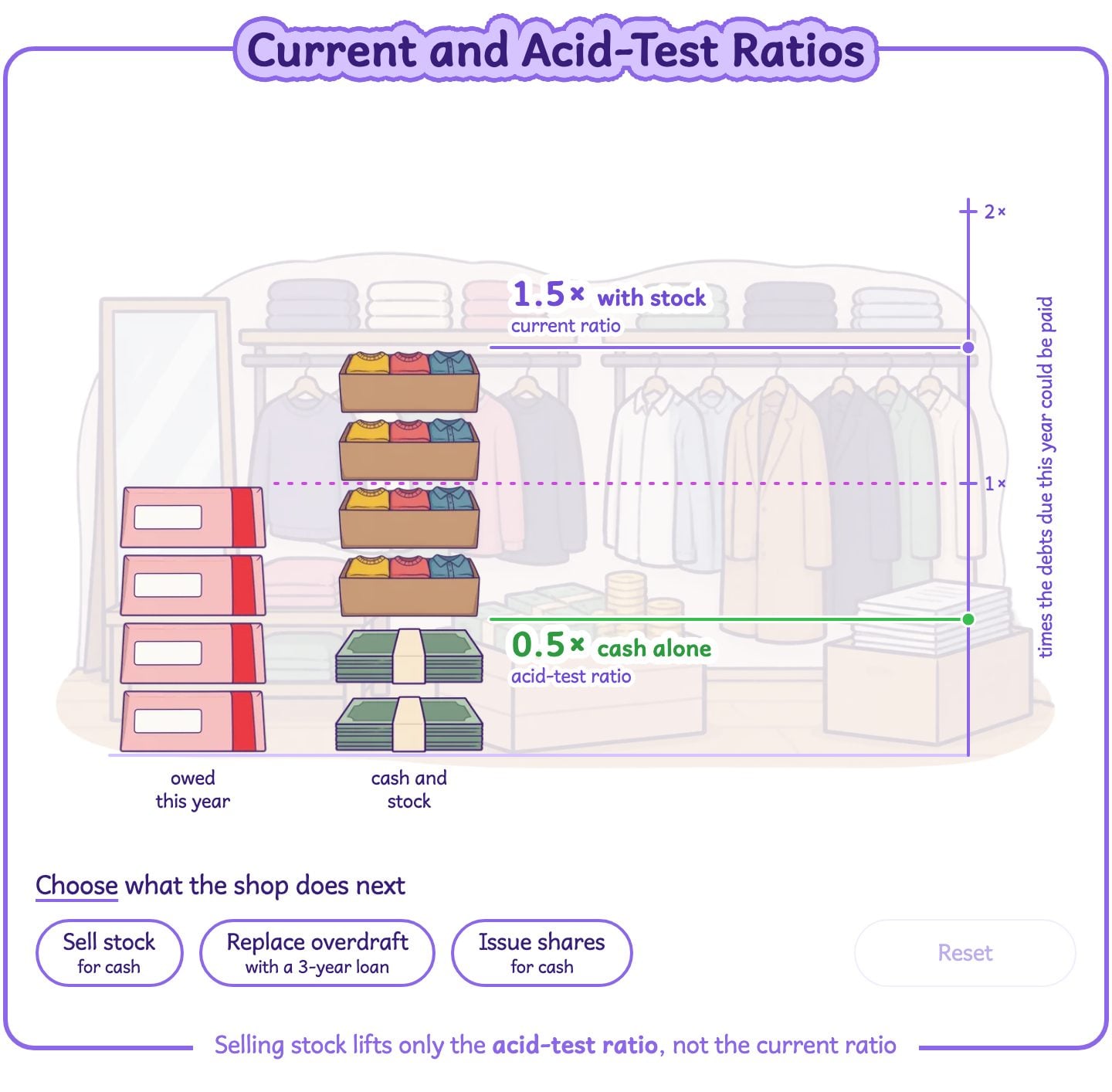
Sell some stock and watch the acid test ratio change while the current ratio stays the same.
The ratios become meaningful when compared and interpreted together
- Compare the ratios with earlier years and with similar businesses, because the amount of inventory needed and the speed of customer payments differ between industries.
- A falling current ratio alongside an even faster fall in the acid test can indicate that the business is becoming more dependent on selling inventory to meet short-term obligations.
Exam technique
- Use all current assets for the current ratio, but remove inventory before calculating the acid test.
- Write the result as a ratio to 1 and translate it into what the business has for each £1 of current liabilities.
- Compare the two ratios and the trend over time before judging the short-term position.
Self review
- State the calculation for the current ratio.
- Why does the acid test remove inventory?
- Current assets are £30,000 and current liabilities are £18,000. What is the current ratio?
- Using the same figures and inventory of £12,000, what is the acid-test ratio?
- Why can a high current ratio still require further investigation?