3.2.1a Paying costs and avoiding insolvency
Cash keeps a business able to pay what is due now
Cash: money the business has available to make payments now, including money held in its bank account.
Insolvency: the position where a business cannot pay its debts when they fall due, which can force it to stop trading.
- Cash is needed to pay suppliers for materials and inventories, overheads such as rent and energy, and employees' wages or salaries when those payments become due.
- These payments cannot always wait for the business's customers to pay, so a business can be trading successfully but still face a cash shortage if receipts arrive too late.
Cash is like fuel in a car: the journey may be worthwhile overall, but the car still stops if the fuel runs out before the next refill.
Running out of cash can stop normal operations very quickly
- If suppliers are not paid they may stop delivering, while late wage payments can damage morale and cause employees to leave, making it harder for the business to keep operating.
- If the business cannot raise enough cash to meet debts when they fall due, it becomes insolvent and may ultimately have to stop trading even if it owns valuable assets or expects future sales.
A building contractor may have profitable projects underway but still face insolvency if customers pay after wages, suppliers and other bills are due and the business has no cash reserve or finance available.
Managing the timing of cash helps prevent insolvency
- Businesses can protect their cash position by encouraging customers to pay on time, negotiating suitable payment periods with suppliers and keeping access to a cash reserve or agreed short-term finance.
- The next step is forecasting when cash will enter and leave the business so a shortage can be identified before a payment is missed.
- Name the payment the business needs cash for, such as suppliers, overheads or employees.
- Trace what happens if the business cannot make that payment when it is due.
- Link a continuing inability to pay debts to insolvency rather than assuming that low cash automatically means the business has made a loss.
- Name three groups of payments a business needs cash to make.
- What is insolvency?
- How can late customer payments create a cash shortage?
- Why can a business with valuable assets still become insolvent?
- Give two ways a business can reduce the risk of running out of cash.
3.2.1b Difference between cash and profit
Cash and profit measure different things
Cash: money the business has available to make payments now.
Profit: the amount left when total costs are subtracted from revenue over a period of time.
- Profit measures whether revenue is greater than costs over a period, while cash measures whether money is available at a particular time to make payments.
- The timing can differ because business transactions do not always move cash at the same moment that revenue or costs are recorded.
Credit sales can increase revenue before the cash arrives
- When a business sells on credit, the sale contributes to revenue in the trading period even though the customer may not pay until weeks later, so the sale can contribute to profit before it increases the bank balance.
- If many customers owe money while wages and suppliers must be paid now, the business can report a profit yet still have too little cash to meet its immediate payments.
- A business makes a credit sale in March but the customer will not pay until May, so March records the sale while the cash inflow appears later.
- If wages and supplier bills fall due before May, the business may need cash from elsewhere even though the sale has improved its trading result.
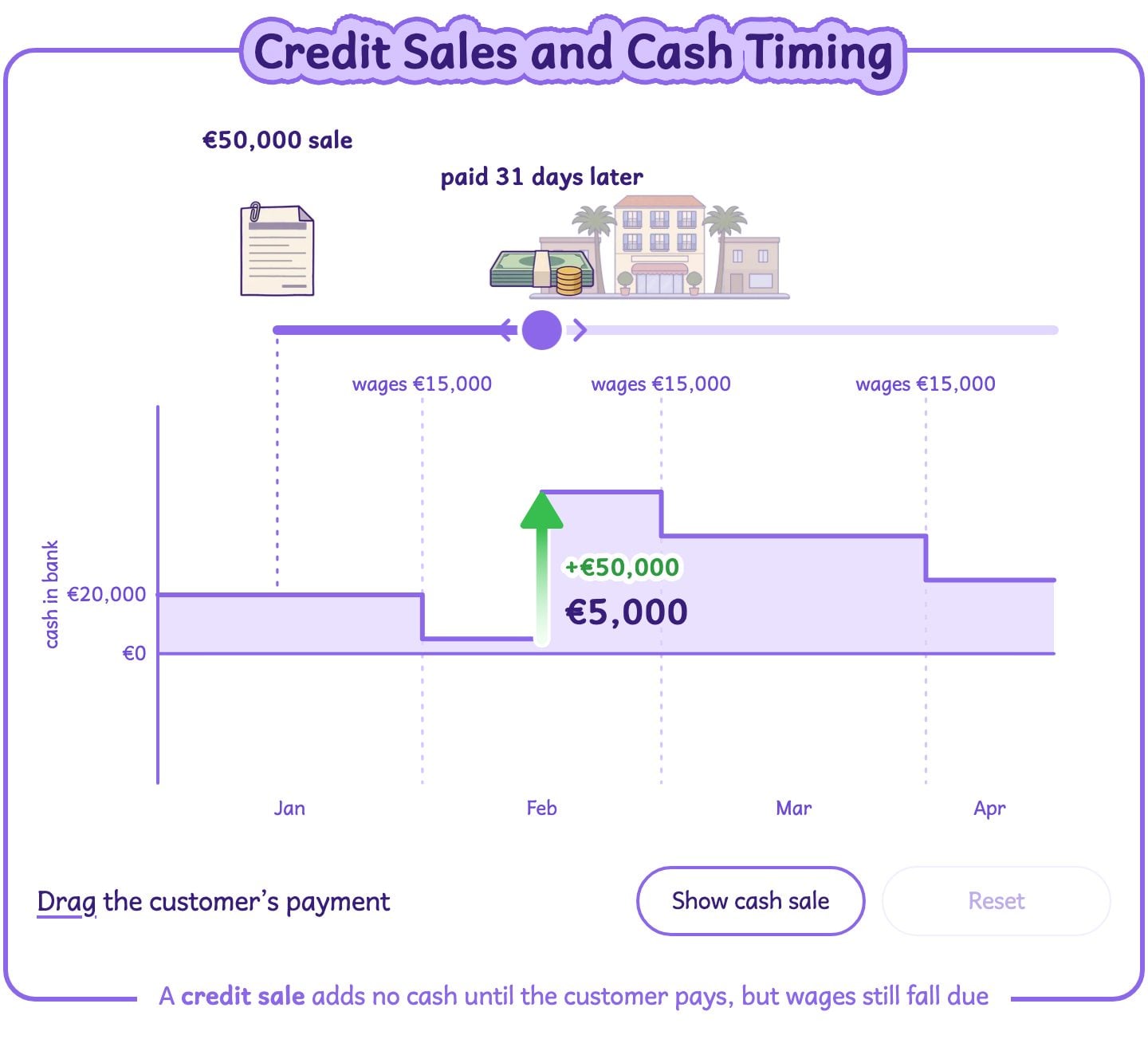
Follow the credit sale and see that cash does not arrive until the customer pays, though wages are due.
Some cash movements do not create profit
- Taking a loan or receiving new investment raises cash, but neither is sales revenue, so the cash increase does not by itself mean the business has made a profit.
- Buying a non-current asset or repaying borrowed capital uses cash, but these payments are not treated in the same way as the ordinary trading costs used to calculate profit for that period.
Do not use the words cash and profit as if they mean the same thing: a cash inflow can come from borrowing, and a profitable credit sale may not provide cash until later.
A healthy business needs both profit and enough cash at the right time
- A profitable but cash-poor business can fail because it cannot make payments when they are due, while a cash-rich business can still be unprofitable if its bank balance has been boosted by borrowing rather than successful trading.
- Managers therefore monitor profit to judge trading performance and cash to judge whether the business can continue paying its short-term commitments.
- Ask whether the item changes trading revenue or costs, cash, or both.
- For a credit sale, separate when the sale is recorded from when the customer actually pays.
- When explaining business failure, show how a lack of cash prevents payments even if profit is positive.
- What is the difference between cash and profit?
- Why can a credit sale affect profit before it affects cash?
- Why does taking a loan increase cash but not profit?
- How can a profitable business still run out of cash?
- Why might a cash-rich business still be making a loss?
3.2.2a Cash inflows and outflows
Cash-flow forecasts record when money is expected to enter and leave the business
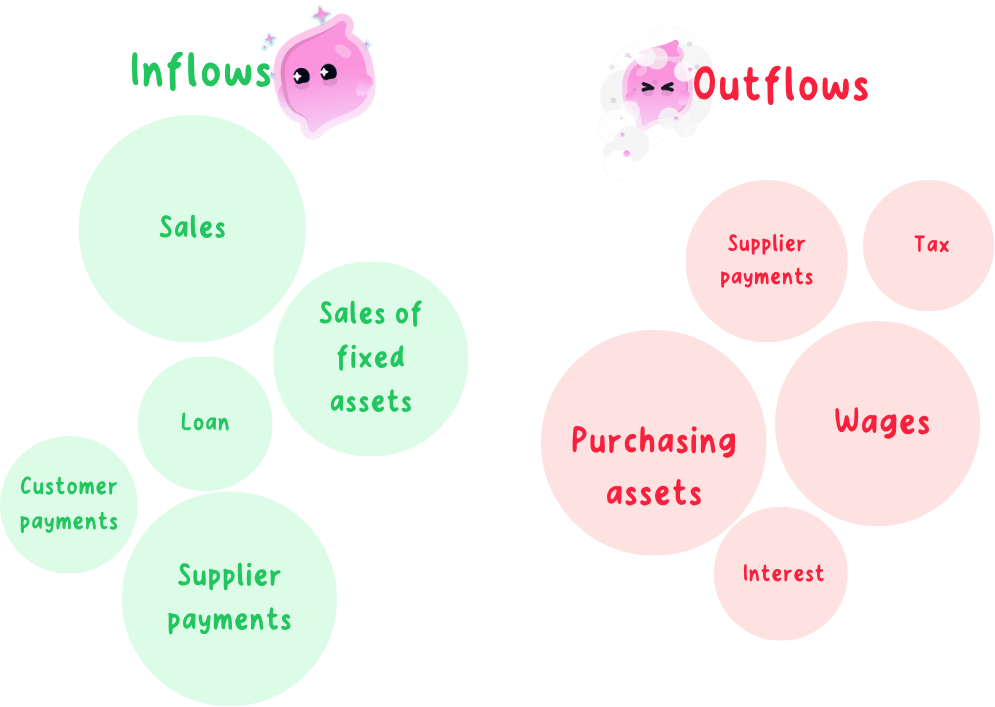
Cash inflow: money expected to enter the business, such as customer payments, borrowing, owner investment or money received from selling an asset.
Cash outflow: money expected to leave the business, such as payments to suppliers, wages, rent or loan repayments.
- A cash-flow forecast places each amount in the period when the money is expected to move, so it focuses on the timing of cash rather than when a sale or purchase was first agreed.
- For example, if a credit customer buys in March but is expected to pay in May, the forecast records the cash inflow in May because that is when the business expects to receive the money.
Inflows include trading receipts and finance entering the business
- Customer payments from sales are usually the main inflow, but a business can also receive cash from a bank loan, new owner investment or the sale of an asset.
- A loan is still an inflow even though it is not revenue or profit, because a cash-flow forecast records money moving into the bank account rather than the reason the money was received.
Outflows include operating payments and other cash leaving the business
- Regular outflows can include inventory purchases, wages, rent and utilities, while one-off outflows can include buying equipment or making a large repayment.
- A large one-off payment can make one month much weaker than the others, which is why the timing of an outflow matters when managers interpret a forecast.
- A market stall expects £4,000 of customer payments in January.
- Its expected outflows are £1,500 for inventory, £900 for wages and £600 for rent.
- Inflows are greater than outflows, so the business receives more cash than it pays out during the month.
Forecasting the timing gives managers a chance to act early
- If expected outflows are unusually high or an inflow is delayed, managers can see the pressure before the month begins and may be able to delay spending, chase customer payments or arrange short-term finance.
- The forecast is based on estimates, so managers should update it when the timing or amount of expected receipts and payments changes.
- Classify an item by the direction of the cash movement: money received is an inflow and money paid is an outflow.
- Place the amount in the period when cash is expected to move, especially when credit delays payment.
- Do not exclude loans or owner investment just because they are not revenue; they are still cash inflows.
- What is a cash inflow? Give two examples.
- What is a cash outflow? Give two examples.
- Why is a bank loan recorded as a cash inflow?
- A credit customer buys in March and pays in May. In which month is the inflow forecast?
- Why can a one-off equipment payment create a weak cash-flow month?
3.2.2b Net cash flow and balances
Net cash flow changes the balance carried from one period to the next
Net cash flow: the difference between total cash inflows and total cash outflows during a period.
- A positive net cash flow means more cash entered than left during the period, while a negative net cash flow means outflows were greater than inflows.
Opening and closing balances link the periods together
Opening balance: the amount of cash the business has at the start of a period.
Closing balance: the amount of cash left at the end of a period, which becomes the next period's opening balance.
- The closing balance is found by adding the period's net cash flow to its opening balance, so a negative net cash flow reduces the cash available but does not necessarily make the closing balance negative.
A complete forecast shows the carry-forward clearly
- The forecast below shows the full Edexcel cash-flow sequence: cash inflows, cash outflows, net cash flow, opening balance and closing balance.
| £ | March | April | May | June |
|---|---|---|---|---|
| Cash inflows | 12,000 | 10,000 | 8,000 | 13,000 |
| Cash outflows | 9,500 | 14,000 | 11,000 | 10,500 |
| Net cash flow | 2,500 | (4,000) | (3,000) | 2,500 |
| Opening balance | 3,000 | 5,500 | 1,500 | (1,500) |
| Closing balance | 5,500 | 1,500 | (1,500) | 1,000 |
- In March, net cash flow is £12,000 minus £9,500 = £2,500, so the £3,000 opening balance rises to a £5,500 closing balance and that £5,500 becomes April's opening balance.
- May has a negative net cash flow of £3,000 and begins with only £1,500, so the closing balance becomes negative £1,500 and warns that the business needs action before May arrives.
- Do not treat a negative net cash flow as a loss: it only means more cash left than entered during that period.
- Do not drop a minus sign when adding a negative net cash flow to the opening balance.
- A negative closing balance is a forecast warning, not evidence that the calculation must be wrong.
Interpret the closing balances as well as the monthly movement
- A single negative net cash flow may be manageable when a strong opening balance keeps the closing balance positive, while repeated falls in the closing balance show that the cash position is becoming progressively weaker.
- A negative forecast closing balance gives managers time to improve inflows, reduce or delay outflows, or arrange suitable finance before the shortage occurs.
- Calculate net cash flow first, one period at a time.
- Add net cash flow to the opening balance, then carry the closing balance into the next period.
- When interpreting the forecast, focus on where the closing balance becomes weak or negative and explain what the business may need to do.
- State the formula for net cash flow.
- State the formula for closing balance.
- Why does a closing balance become the next period's opening balance?
- Using the table, why does May end with a negative £1,500 balance?
- Why can net cash flow be negative while the closing balance remains positive?