1.1.1a Financial aims and objectives
Financial aims give a business clear money and market targets
Financial aim: a business objective concerned with financial performance, such as survival, profit, sales, market share or financial security.
- A business objective is a specific goal the business sets and uses to judge its progress.
- Financial aims influence decisions about prices, costs, investment and how much risk the business is willing to take.
- Sofia opens a sandwich shop with limited savings, so keeping the shop open and paying its bills matters more at first than becoming the biggest shop in town.
Think of a financial aim as the finish line the owner is choosing, because different finish lines lead to different business decisions.
The five financial aims measure different kinds of progress
- Survival: remaining in business by taking in enough cash to meet payments such as wages, rent and suppliers.
- It is especially important for new firms, businesses with little cash available and firms facing a sudden fall in demand.
- During a quiet first winter, Sofia may accept a very small profit if the shop can still pay its bills and continue trading into spring.
- Profit: earning more revenue than the business spends.
- Profit rewards the owner for taking the risk of running the business and can provide finance for future investment.
- Once the sandwich shop has regular customers, Sofia may set a monthly profit target so she can take an income and save towards new equipment.
- Sales: increasing the quantity or value of goods and services sold.
- Higher sales can increase revenue and may help a business spread some costs over a larger output.
- A drinks producer may aim to sell more bottles next year by reaching more retailers or attracting more customers.
- Market share: the percentage of total market sales made by the business.
- Market share shows the firm's position against competitors rather than only looking at its own sales.
- A supermarket can increase its own sales but still lose market share if the total grocery market grows faster than its sales do.
- Financial security: building a stable financial position so the business can meet its commitments and cope with difficult periods.
- A financially secure business is less likely to depend immediately on new borrowing when sales fall or an unexpected cost appears.
- A family bakery may keep a cash reserve instead of spending every pound it earns, giving it protection if sales fall or an expensive oven needs replacing.
- Do not use sales and market share interchangeably.
- Do not use survival and financial security interchangeably.
Similar aims need different evidence
- Sales refer to what the business itself sells, while market share compares those sales with total sales across the whole market.
- Survival is about continuing to trade now, while financial security is about being strong enough to cope with future problems.
- What is a financial aim?
- Name the five financial aims in this article.
- Why is survival often important to a new business?
- What is the difference between sales and market share?
- How is financial security different from survival?
1.1.1b Non-financial aims and objectives
Non-financial aims are goals that are not mainly about money
Non-financial aim: an objective that is not primarily measured in money, such as achieving a social purpose, gaining personal satisfaction, taking on a challenge or keeping independence and control.
- Non-financial aims can be just as important as profit to the owner. They help explain why two businesses in the same market may make very different decisions.
- Ravi leaves a well-paid office job to open a bike-repair shop. He could earn more as an employee, but he wants to choose his own direction and spend his working day doing something he enjoys.
A social enterprise may deliberately accept a smaller financial return if using more of its income to train disadvantaged workers helps achieve its social objective.
The four non-financial aims
- Social objectives: aiming to benefit society or the environment. A business might support its local community, create employment opportunities, reduce waste or trade in a socially responsible way.
- A café may employ and train people who have struggled to find work because creating opportunities is part of what the business exists to do.
- Personal satisfaction: gaining enjoyment, pride or fulfilment from owning and running the business. The owner may value the work itself, the relationships built with customers or the achievement of creating something of their own.
- Ravi may prefer one successful repair shop that he enjoys running to a larger chain that earns more but gives him less time doing the work he likes.
- Challenge: wanting to test personal ability by turning an idea into a successful business and solving the problems involved in keeping it running and developing it.
- An entrepreneur may launch a new business partly because proving that the idea can work provides a demanding personal challenge.
- Independence and control: being able to make the key decisions and set the direction of the business rather than working under someone else's instructions.
- A skilled worker may become a sole trader so they can choose which customers to serve, what hours to work and how the business develops.
Do not mix the two lists: survival, profit, sales, market share and financial security are financial aims, while social objectives, personal satisfaction, challenge, and independence and control are non-financial aims.
How non-financial aims affect business decisions
- A non-financial aim can lead the owner to accept less profit. Paying higher wages, using more expensive ethical suppliers or keeping the business small can all support a non-financial objective while increasing costs or limiting revenue.
- The owner's priorities matter. Someone who values independence may refuse outside investment because a new investor could expect influence over decisions, even if the extra finance would allow faster growth.
- A social objective can also support the business. Customers who share the same values may become more loyal, so a decision that increases costs can still strengthen the firm's reputation and future revenue.
- What is a non-financial aim?
- Name the four non-financial aims in this article.
- Explain how a social objective can affect a business decision.
- Why might an owner value independence and control more than faster growth?
- How can a non-financial aim reduce profit but still benefit the business?
1.1.2 Why aims and objectives change
A firm's aims change as the business and its circumstances change
Objective: a goal a business works towards. Objectives are reviewed because the conditions facing a business do not stay the same.
- A business may begin with one priority and later need another. The important point is not simply that objectives change, but what changed in the business or its environment and why that makes a different objective more suitable.
- A start-up may initially focus on survival. After several years of reliable trading, stronger cash flow and a larger customer base can make profit, higher sales or a larger market share more realistic priorities.
A gym planning a second site may abandon expansion and switch its priority to survival if customer numbers suddenly collapse. Once demand recovers, expansion can become realistic again.
Why aims and objectives change
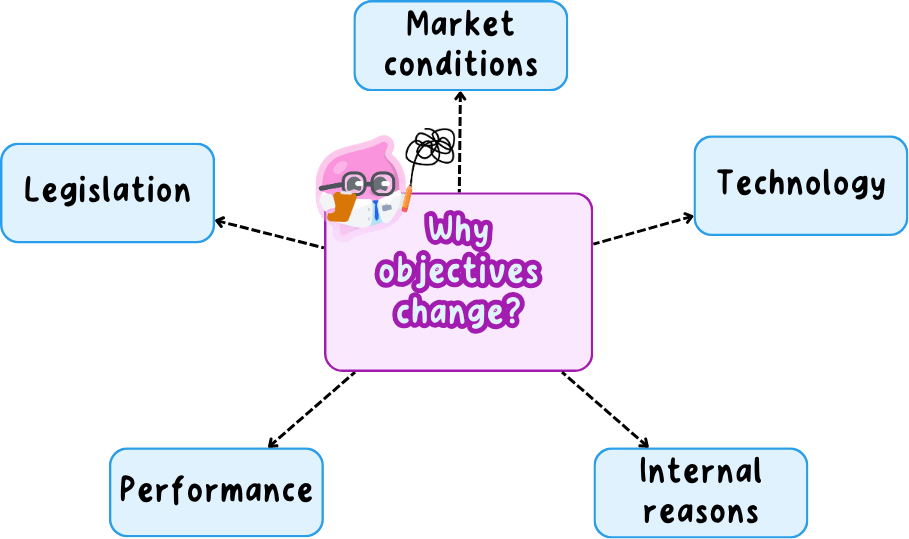
- Market conditions: changes in demand and competition can alter what a business needs to achieve. Falling demand may make survival and financial security more important, while a growing market may create opportunities to increase sales or market share.
- A restaurant may postpone a planned expansion when customers cut discretionary spending, because protecting cash becomes more important than opening another site.
- Technology: new technology can create opportunities, change customer expectations or make existing ways of operating less competitive. A business may therefore set new objectives linked to online sales, productivity or adapting its products.
- A retailer that previously relied on one physical shop may set an objective to increase online sales after e-commerce makes a much wider market accessible.
- Performance: the results a business achieves affect what it can realistically target next. Strong performance can support more ambitious objectives, while weak performance may force the business to reduce its ambitions.
- A business that has achieved steady profits may decide it can now afford to target higher sales or market share, while one making repeated losses may return to survival and financial security.
- Legislation: new laws can change the standards a business must meet or the costs it faces. This may create new objectives or force existing ones to be adjusted.
- New environmental rules could lead a manufacturer to set an objective to reduce waste or emissions because its previous methods no longer meet legal requirements.
- Internal reasons: changes inside the business, such as a new owner, new management, different finances or a change of strategy, can alter what the organisation is trying to achieve even when the outside market has not changed.
- A founder who valued independence may sell the business to new owners who are more willing to bring in outside finance and pursue expansion.
The direction of the change matters
- The same objective can become more or less important over time. Survival is not only a start-up objective: an established business can return to it after a severe fall in demand or a major financial problem.
- Changes can also reverse. A business that delays expansion during a downturn may return to objectives such as higher sales or market share when demand, performance and financial security improve.
For this topic, link the trigger to the new priority. For example, weaker demand makes survival more important, while stronger performance can make higher sales or market share realistic.
- Name the five reasons in this article why aims and objectives may change.
- How could weaker market conditions change a firm's objectives?
- How can new technology cause a business to set a different objective?
- Why can strong performance lead to more ambitious objectives?
- Give one internal reason a firm's aims might change.