3.1.1a Short-term and long-term needs
Finance needs differ by how long the money is required
Short-term finance need: money needed for less than one year, usually to keep day-to-day operations running.
Long-term finance need: money needed for a year or more, usually for assets or plans that will benefit the business over several years.
- Short-term needs include paying wages and overheads during a quiet period, buying inventories before they are sold, covering a timing gap between paying suppliers and receiving customer payments, or dealing with an urgent repair.
- Long-term needs include buying premises, machinery or vehicles, developing a new product, or funding growth that will take several years to generate its full return.
The timescale should fit the need, just as you would not use a 25-year mortgage to pay one taxi fare or expect to pay for a building within a few weeks.
Matching the timescale helps protect cash flow
- A short-lived need should normally be financed for a short period because the business expects normal trading cash to remove the need soon.
- A long-term asset or expansion plan needs finance that remains available for longer, otherwise the business could face repayment while much of its money is still tied up in an asset or project.
A café may need short-term finance to cover wages during a quiet winter month, but a new oven used for several years creates a long-term finance need.
The purpose of the spending tells you which need it is
- Do not classify a need only by the size of the payment: a large inventory purchase can still be short term if the stock will be sold soon, while a smaller piece of equipment can be long term if it is used for years.
- Ask how long the business will benefit from the spending and how soon the money used to fund it can realistically be repaid.
- Identify what the business needs the money for before deciding whether the need is short term or long term.
- Use the length of the benefit or cash gap, not the size of the payment, as the main clue.
- Explain why a mismatch could put pressure on cash flow if repayment is due before the need has ended.
- What is a short-term finance need?
- Give two examples of short-term finance needs.
- What is a long-term finance need?
- Why is buying machinery usually a long-term finance need?
- Why can using very short-term finance for a long-term asset create a cash-flow problem?
3.1.1b Finance to start up or expand
Businesses need finance before they start trading and when they grow
Start-up finance: money needed to set up a new business and begin trading before enough revenue is being earned.
Expansion finance: money needed by an established business to increase the scale or range of its activities.
- The reason for the finance affects how much is needed and for how long, so a business should first identify the purpose of the spending before comparing sources of finance.
This article focuses on why finance is needed at start-up and expansion; the following articles compare the different internal and external sources available.
Start-up finance pays costs before the first sales arrive
- A new business may need money for premises, equipment, opening inventories, licences, marketing and the first wages or other running costs before customers generate enough cash from sales.
- Start-ups can be harder to finance because they have no trading history, retained profit or proven cash flow, so anyone providing finance has less evidence that the business will succeed.
A new bakery needs finance for ovens, shop fittings, ingredients and early running costs before it sells enough bread to cover those payments.
Expansion finance pays for growth before the extra revenue is earned
- An established business may need finance to open another branch, buy more machinery, develop a new product or enter a new market, because the extra capacity normally has to be paid for before it produces extra sales.
- An established profitable business may have more financing options than a start-up because it can show a trading record, existing assets and past profit, although growth still creates risk if the expected extra revenue does not arrive.
Start-up finance gets the business to its first sales; expansion finance pays for the next stage of growth before that growth generates its own cash.
The stage of the business changes the financing problem
- A start-up mainly needs enough finance to begin trading and survive the period before regular customer payments arrive.
- An expanding business already trades, but it must finance extra assets, inventories or employees while continuing to meet the costs of its existing operations.
- Identify whether the business is starting up or expanding before discussing why it needs finance.
- Link the finance to a specific payment, such as opening inventories for a start-up or new machinery for expansion.
- Explain why the payment happens before the new or extra sales provide enough cash to cover it.
- What is start-up finance?
- Give three payments a new business may need to make before its first sales.
- What is expansion finance?
- Why can an established business need finance even when it is already profitable?
- Why can start-up finance be harder to raise than expansion finance for an established firm?
3.1.2a Personal savings and retained profit
Personal savings and retained profit keep finance inside the business
- Internal finance comes from resources already controlled by the business or its owner, so it does not require borrowing from an outside lender or selling ownership to a new investor.
The owner's personal savings are quick to access but limited
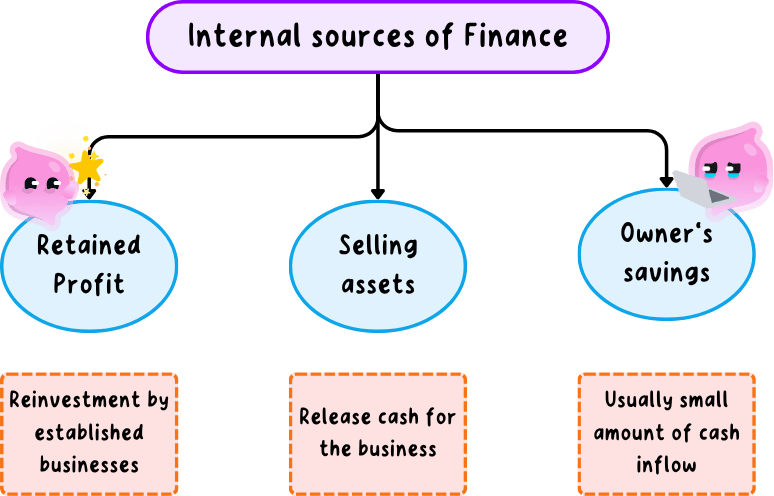
Personal savings: the owner's own money invested in the business as a source of finance, shown as “owner's savings” in the CIE diagram below.
- Advantage: the money can often be used immediately, carries no interest charge and does not reduce the owner's control of the business.
- Disadvantage: the amount is limited by what the owner has saved and the owner risks losing personal money if the business performs badly.
An owner who invests £10,000 of personal savings pays no interest, but that £10,000 of personal wealth is at risk if the business fails.
Retained profit reinvests money the business has already earned
Retained profit: profit kept in the business for future use rather than distributed to the owners.
- Advantage: it has no interest charge and does not bring a new lender or investor into the business, so existing owners keep control.
- Disadvantage: it is available only when the business has made enough profit to retain, and keeping more profit in the business leaves less available for owners to take out.
Do not describe retained profit as free money: it has no interest charge, but using it means the owners give up the opportunity to take or use that profit elsewhere.
The business stage affects which internal source is available
- Personal savings can be used at start-up because they do not depend on the business having traded before.
- Retained profit suits an established profitable business, but a start-up has no past business profit to retain and a loss-making firm may have none available.
- The diagram also shows selling assets, the third Edexcel internal source of finance, which is developed in the next article.
- Check whether the business is new or established before recommending retained profit.
- For personal savings, balance the lack of interest against the owner's limited funds and personal financial risk.
- For retained profit, balance retained control against the fact that profits must already exist and less can be distributed to owners.
- What are personal savings as a source of finance?
- Give one advantage and one disadvantage of using personal savings.
- What is retained profit?
- Why can a start-up not use retained profit from the business?
- Why might owners prefer retained profit to bringing in an outside investor?
3.1.2b Selling assets
Selling assets releases cash from resources the business no longer needs
Selling assets: raising finance by selling assets owned by the business that are no longer needed for its operations.
- A business might sell an unused vehicle, old machinery, spare equipment, land or a building it no longer needs, turning an existing resource into cash without borrowing from an outside lender.
- It is an internal source of finance because the money is raised from an asset the business already owns rather than from a new lender or investor.
Selling assets avoids borrowing but can reduce future capacity
- Advantages: the business raises cash without paying interest or giving up ownership, and selling an unused asset can also remove maintenance, storage or insurance costs.
- Disadvantages: the source can be used only when suitable assets exist, the sale may take time or achieve a low price, and the asset cannot be used again after it has been sold.
A delivery business that has switched to a smaller fleet could sell a spare van, raising cash while also removing the cost of insuring and maintaining a vehicle it no longer needs.
The asset must be genuinely spare or non-essential
- Selling an asset is most suitable when the business can continue operating effectively without it, such as when equipment is surplus after a change in production or a vehicle is no longer required.
- A start-up usually has few spare assets to sell, while an established business is more likely to have older or surplus resources that can be converted into cash.
Do not assume that selling any valuable asset is good finance: selling machinery, premises or vehicles that the business still needs can reduce its ability to operate and earn revenue.
The value of the source depends on the sale price and the lost use
- A quick sale can improve cash immediately, but accepting a low price reduces how much finance is raised and may make the source less attractive than waiting for a better buyer.
- The business should compare the cash received with what it gives up, including any future productive use of the asset or the cost of replacing it later.
- Check that the business already owns an asset it can realistically spare.
- Explain the benefit of raising cash without interest or new ownership.
- Balance that benefit against the sale price, the time needed to find a buyer and the loss of future use of the asset.
- What does selling assets mean as a source of finance?
- Why is selling assets an internal source of finance?
- Give one advantage and one disadvantage of selling assets.
- Why might a rushed sale raise less finance than expected?
- Why is selling assets usually less useful to a brand-new business?
3.1.3a Overdrafts, loans and share capital
External finance can provide larger sums but creates repayment or ownership trade-offs
- External finance comes from outside the business and includes overdrafts, trade payables, loan capital and share capital, including stock market flotation for public limited companies.
- The main trade-off is that borrowed finance keeps ownership unchanged but must be repaid, while share capital does not have to be repaid but gives investors ownership and a claim on future profits.
Overdrafts and trade payables help with short-term cash needs
Overdraft: an agreement allowing a business bank account to go below zero up to an agreed limit.
- Advantage: it is flexible for a temporary cash shortage because the business can use only the amount it needs and interest is normally charged on the amount overdrawn.
- Disadvantage: interest can be relatively high and the facility may be reduced or withdrawn, so it is unsuitable for funding a large long-term asset.
Trade payables: amounts owed to suppliers for goods or services bought on credit and paid for later.
- Advantage: buying on credit delays the cash outflow, so the business may be able to sell inventories and receive customer payments before the supplier has to be paid.
- Disadvantage: suppliers may restrict credit for new or unreliable customers, early-payment discounts may be lost, and late payment can damage the supplier relationship.
A retailer facing a short gap before customers pay may use an overdraft for the cash shortage or buy new inventories on supplier credit so payment is delayed.
Loan capital spreads repayment over time but creates a fixed financial commitment
Loan capital: money borrowed for an agreed period and repaid with interest, usually through regular repayments.
- Advantage: a business can raise a substantial amount without giving the lender ownership, and a longer repayment period can suit assets that generate benefits over several years.
- Disadvantage: interest and repayments still have to be paid when trading is weak, and a lender may require security before agreeing to the loan.
Share capital raises permanent finance but reduces existing owners' control
Share capital: money raised by a limited company from selling shares to investors, who become part-owners of the company.
- Advantage: the money does not have to be repaid and there is no interest charge, which can reduce repayment pressure during a large expansion.
- Disadvantage: existing owners give up part of the company and may lose some control, while future profits may be shared with shareholders through dividends.
Stock market flotation: the process of a public limited company offering its shares to the public on a stock market for the first time.
- Advantage: flotation can give a public limited company access to a much wider pool of investors and therefore very large amounts of share capital.
- Disadvantage: flotation is costly to arrange and wider share ownership can reduce the original owners' control of the company.
Do not recommend share capital to a sole trader or partnership: share capital is available only to limited companies, and stock market flotation applies to public limited companies.
The best external source depends on the timescale and the trade-off the owners accept
- A temporary cash gap can suit an overdraft or supplier credit, while a long-term asset may suit loan capital because repayments are spread over time.
- Share capital can suit a company that wants finance without repayment pressure, but the owners must accept that investors receive ownership rights and may receive part of future profits.
- Match the source to the length and purpose of the finance need.
- For borrowing, consider interest, repayment pressure and any security required.
- For share capital, check that the legal form allows it and explain the effect on ownership and control.
- What is an overdraft, and when is it most suitable?
- How do trade payables help a business's cash flow?
- Give one advantage and one disadvantage of loan capital.
- Give one advantage and one disadvantage of share capital.
- What is a stock market flotation, and why can it reduce the original owners' control?
3.1.3b Venture capital and crowdfunding
Venture capital and crowdfunding raise finance in different ways
- Both sources can help a business raise finance outside traditional bank borrowing, but venture capital depends on a specialist investor while crowdfunding depends on attracting many backers.
- The right choice depends on the business's growth potential, the amount required and whether the owners are willing to give investors part-ownership or make the business idea public.
Venture capital can bring substantial finance and expertise in return for ownership
Venture capital: investment provided to a business with high growth potential by specialist investors in return for a share of ownership.
- Advantages: venture capital can provide substantial finance without scheduled loan repayments, and investors may bring business experience, contacts and advice as well as money.
- Disadvantages: the existing owners give up part of the business and some control, and investors may put pressure on managers to grow quickly or make decisions that increase the value of their investment.
A technology start-up with a product that could grow rapidly may accept venture capital because it needs a large amount of finance and values the investor's experience, even though the founders keep a smaller share of the company.
Crowdfunding raises smaller contributions from many people
Crowdfunding: raising finance by collecting contributions from a large number of people, usually through an online platform.
- A crowdfunding campaign presents the idea to potential backers and sets a funding target; depending on the arrangement, backers may receive a reward, early access to a product or a small ownership stake.
- Advantages: the business can reach many potential funders without relying on one lender, and a successful campaign can also show that there is interest in the product before full-scale production begins.
- Disadvantages: the campaign may fail to raise enough money, promotion takes time and effort, and explaining the idea publicly can reveal it to competitors before launch.
Do not assume crowdfunding always means giving away shares: some campaigns offer rewards or products instead, so check what backers receive in the business situation given.
The two sources suit different financing problems
- Venture capital is more suitable when a business has strong growth potential, needs substantial finance and can benefit from an experienced investor, provided the owners accept sharing ownership and control.
- Crowdfunding can suit a business with an idea that is easy to explain to the public and can attract many supporters, especially when the campaign can also build early awareness of the product.
- For venture capital, link the finance to high growth potential and explain the cost in ownership and control.
- For crowdfunding, consider whether the idea can attract many backers and what the campaign offers them in return.
- Compare the business's need with the main risk of the source rather than listing advantages without context.
- What is venture capital?
- Give one advantage and one disadvantage of venture capital.
- What is crowdfunding?
- Give one advantage and one disadvantage of crowdfunding.
- Why might a high-growth start-up prefer venture capital to crowdfunding?