Why owners want the business to grow
- Higher profit: selling 20,000 units instead of 5,000 at the same profit per unit multiplies total profit, which is the return the owners take out of the business.
- Fixed costs such as rent and the manager's salary are then spread over more units, so the cost of making each unit falls and the profit per unit can rise as well.
- Larger market share: a firm selling a bigger share of its market has more influence over price, because customers have fewer alternatives to switch to.
- It also gives power over suppliers, since a supplier that depends on one large customer for half its orders cannot refuse a demand for lower prices.
- Survival and security: a larger firm is harder for a rival to take over and better able to absorb a bad year, and spreading into other products or countries means one weak market no longer threatens the whole business.
- Easier access to finance: banks lend more, and at lower interest, to firms with assets to offer as security, so growth makes the next expansion cheaper to fund.
- Better staff and better equipment: a larger firm can pay for specialists such as a marketing manager and afford machinery a small firm could never justify, which raises productivity.
- Brand recognition and status: more outlets and more advertising make the name familiar, and directors' pay usually rises with the size of the firm they manage.
Definition
Internal (organic) growth: Expansion of a business using its own resources, for example by opening more outlets, launching new products or selling in new markets, without joining with another business.
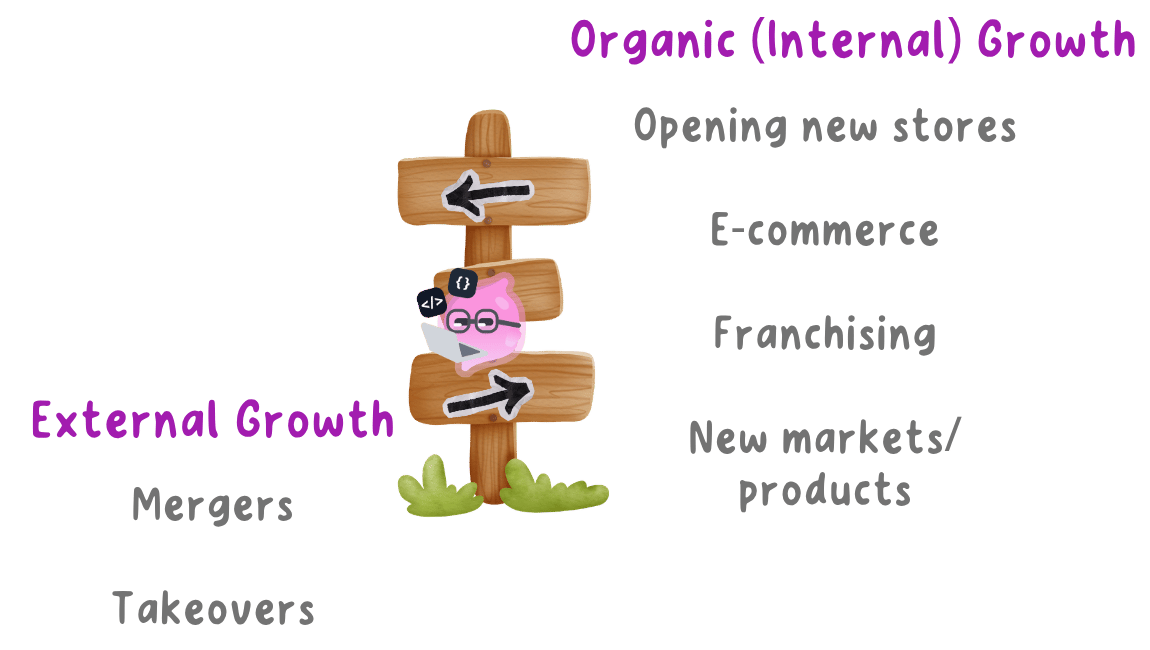
Internal growth: expanding using the firm's own resources
- Opening more outlets: a chain that opens 20 new shops a year reaches customers in towns it did not serve before, and several national bakery and coffee chains grew from a single shop to more than 2,000 outlets this way.
- Selling new products: adding hot food and coffee to a bakery range brings existing customers back at different times of day, raising sales per shop without any new site.
- Entering new markets: exporting, or selling to a different age group, increases the number of possible customers for a product that already works.
- Selling online: a website turns a local shop into a national seller for the cost of delivery and a small team, which is far cheaper than building branches.
- Franchising: letting other people open outlets under the brand and pay a fee, so the network grows using the franchisees' capital rather than the owner's.
- Internal growth is usually funded from retained profit or a loan, so it costs far less than buying a whole company.
- It happens step by step, so managers keep control of quality, the existing culture is not disturbed, and no shares have to be given to another firm's shareholders.
- Its weakness is speed, since building 30 shops one at a time can take a decade while a rival buys 30 shops in a single deal.
- It is also limited by the size of the market, so a firm already selling to most of the customers in its area cannot grow much further this way.
Definition
External growth: Expansion of a business by joining with another business, either through a merger, where two firms agree to combine, or a takeover, where one firm buys control of another.
External growth: joining with another business
- Merger: two businesses agree to join and become one, usually keeping managers from both sides.
- Takeover, or acquisition: one business buys more than half the shares of another and controls it, which can happen even if the target's directors object.
- The attraction is speed, because the firm gains the other company's customers, staff, premises and brand on the day the deal completes.
- Buying a competitor also removes it from the market rather than adding capacity to it, so prices are less likely to be pushed down.
- The cost is high, since the buyer pays for assets it may not need, and paying with new shares dilutes the original owners' control because the sellers become shareholders with votes of their own.
- Deals can also be blocked by the competition authorities if the combined firm would control too much of the market.
Example
- A supermarket group bought a wholesaler, gaining a supplier to convenience shops and caterers rather than another set of its own stores.
- Two rival supermarket groups later agreed to merge, but the competition regulator blocked the deal on the grounds that shoppers would face higher prices and less choice.
- Both cases show that external growth depends on approval as well as on money.
What decides which route a firm takes
- Finance decides much of it, since a sole trader with £50,000 of retained profit can open one more branch but cannot buy a company.
- Control differs, so a family firm may prefer slow internal growth to a merger that would hand outsiders a say in decisions.
- Risk differs sharply, because internal growth can be slowed or stopped if sales disappoint, while a takeover is paid for in full before anyone knows whether it works.
- Most large firms use both routes, opening their own outlets year by year while buying a competitor when the right one comes up for sale.
Exam technique
- Opening more branches is internal growth, so do not describe it as a merger just because the business got bigger.
- A merger is agreed by both sides while a takeover is a purchase of control, so do not use the two words as if they mean the same thing.
- Growing bigger is not the same as making more profit, so say which of the two the figures in front of you actually show.
Self review
- Give four reasons an owner may want the business to grow.
- Name three methods of internal growth.
- What is the difference between a merger and a takeover?
- Give one advantage and one drawback of external growth.
- Why might a family firm prefer to grow internally?