Quality: consistently meeting customer expectations
Definition
Quality: A good or service that consistently meets the expectations of the customers it is aimed at.
- Quality is judged by the customer, so a good or service has quality when it does what the buyer was led to expect for the price they paid.
- Consistency is the heart of the idea, because one good meal followed by a poor one tells the customer that the business cannot be relied on.
- A cafe that serves a hot, fresh sandwich on nine visits and a stale one on the tenth has a quality problem rather than a run of bad luck.
- Fit for purpose means the product does the job it was bought for, works safely and lasts as long as the seller promised.
- Quality covers everything the customer experiences, including the packaging, the delivery time, the accuracy of the order and the way a complaint is handled.
- Services are judged on quality just as goods are, so a bus that runs to timetable, a haircut that matches what was asked for and an insurance claim settled within three days are all quality outcomes.
Example
- Greggs sells a sausage roll for a little over £1 and is a quality producer when that roll is hot, correctly filled and the same in every one of its shops.
- A £60,000 car is poor quality if the electrics fail within a year, because it has failed against the expectations its price created.
Quality is not the same as luxury or a high price
- The most common error in this topic is treating quality as a word for expensive, luxury or top of the range.
- An £8 supermarket kettle and a £150 designer kettle can both be quality products, because each is judged against what its own buyer was promised.
- The £8 kettle boils water reliably for two years, which is exactly what its buyer wanted, so it has met its promise in full.
- Aldi sells at low prices and still wins product awards, which shows that low price and high quality sit together comfortably.
Common Mistake
- Do not define quality as luxury, expensive or top of the range, because that is not the meaning Cambridge is looking for.
- The definition to write is that the good or service consistently meets the expectations of the customers it is aimed at.
- Judge every product against its own market, so a budget hotel is not poor quality simply because it has no swimming pool.
Why quality matters: the effect on revenue
- Repeat custom: a customer whose expectations were met has no reason to try a rival, so sales are steadier and the business spends less on replacing lost customers.
- Customer loyalty: buyers who trust one product return for others in the same range, which raises the average amount each customer spends over a year.
- Brand reputation: satisfied customers recommend the business and leave positive reviews, which brings in new buyers without any increase in the marketing budget.
- The ability to charge a higher price: a business known for reliability can price above its rivals for a similar product, and because costs have not changed, the extra price is extra profit per unit.
- Apple charges several hundred pounds more than rival phone makers, largely because buyers expect the product to work and to be supported for years.
- Winning contracts: large retailers and public sector buyers only buy from suppliers who can show consistent quality, so quality is what gets a small firm onto an approved supplier list.
Why quality matters: the effect on costs
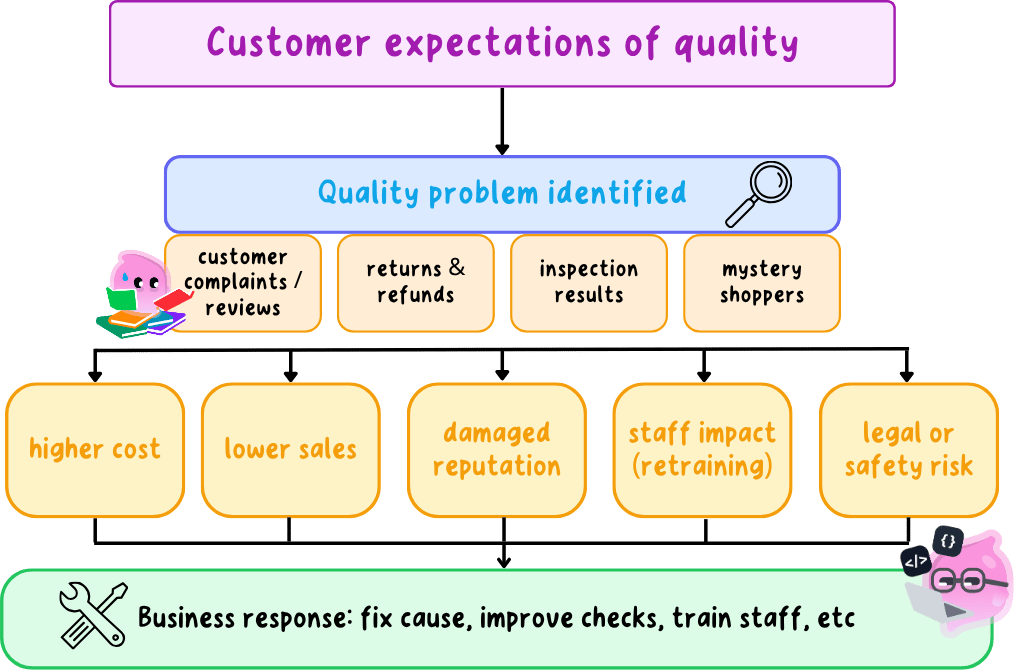
- Fewer returns and refunds: each returned item costs the refund, the return delivery and the staff time to process it, and the sale itself is lost.
- Fewer complaints: dealing with complaints uses management hours that could be spent running the business, and compensation or replacement goods come straight out of profit.
- Less waste: an item scrapped at the end of the line has already used its materials, its machine time and its wages, so the full unit cost is lost with no revenue against it.
Example
- Suppose a firm makes 10,000 units a month at a variable cost of £4 each and scraps 5 per cent of them.
- Cutting the fault rate to 2 per cent would leave £1,200 a month in the business, which goes straight to profit because no extra sales are needed to earn it.
- Legal costs: selling faulty or dangerous goods breaks consumer protection law, so poor quality can bring refunds ordered by a court, compensation claims and fines on top of the lost sale.
Example
Toyota built its reputation on cars that rarely go wrong, which cut warranty repair costs and allowed dealers to sell on reliability rather than on discounts.
Why quality matters to every business, not only factories
- Service businesses have no physical item to inspect, so their quality is judged on reliability, waiting time, accuracy and how staff treat the customer.
- The NHS measures quality through waiting times, infection rates and patient survey scores rather than through faulty units.
- Small businesses rely on a small pool of local customers, so a handful of bad reviews takes away a far larger share of their sales than it would from a national chain.
- Firms that sell to other businesses are judged most harshly of all, because one faulty component can stop their customer's production line and trigger a claim for the losses.
- Public sector organisations do not aim at profit, but poor quality still raises complaints and costs taxpayers money to put right.
Self review
- Define quality in one sentence.
- Why can a £1 loaf and a £4 sourdough both be quality products?
- Give two ways in which good quality raises a business's revenue.
- Explain how one faulty item scrapped at the end of production wastes money.
- How is quality judged in a service business such as a bus company?