The business cycle: trade does not grow in a straight line
Business cycle: The repeating pattern of rises and falls in a country's total output and spending over a period of years.
- No economy grows at the same rate every year, so a business faces periods when customers spend freely and periods when they cut back hard.
- Business confidence: how willing owners and managers feel about risking money on new machinery, new branches or extra staff, which is what turns a change in demand into a change in spending by the firm itself.
- A single business cannot stop the cycle, so the skill is recognising which stage the economy is in and adjusting output, hiring and spending to match it.
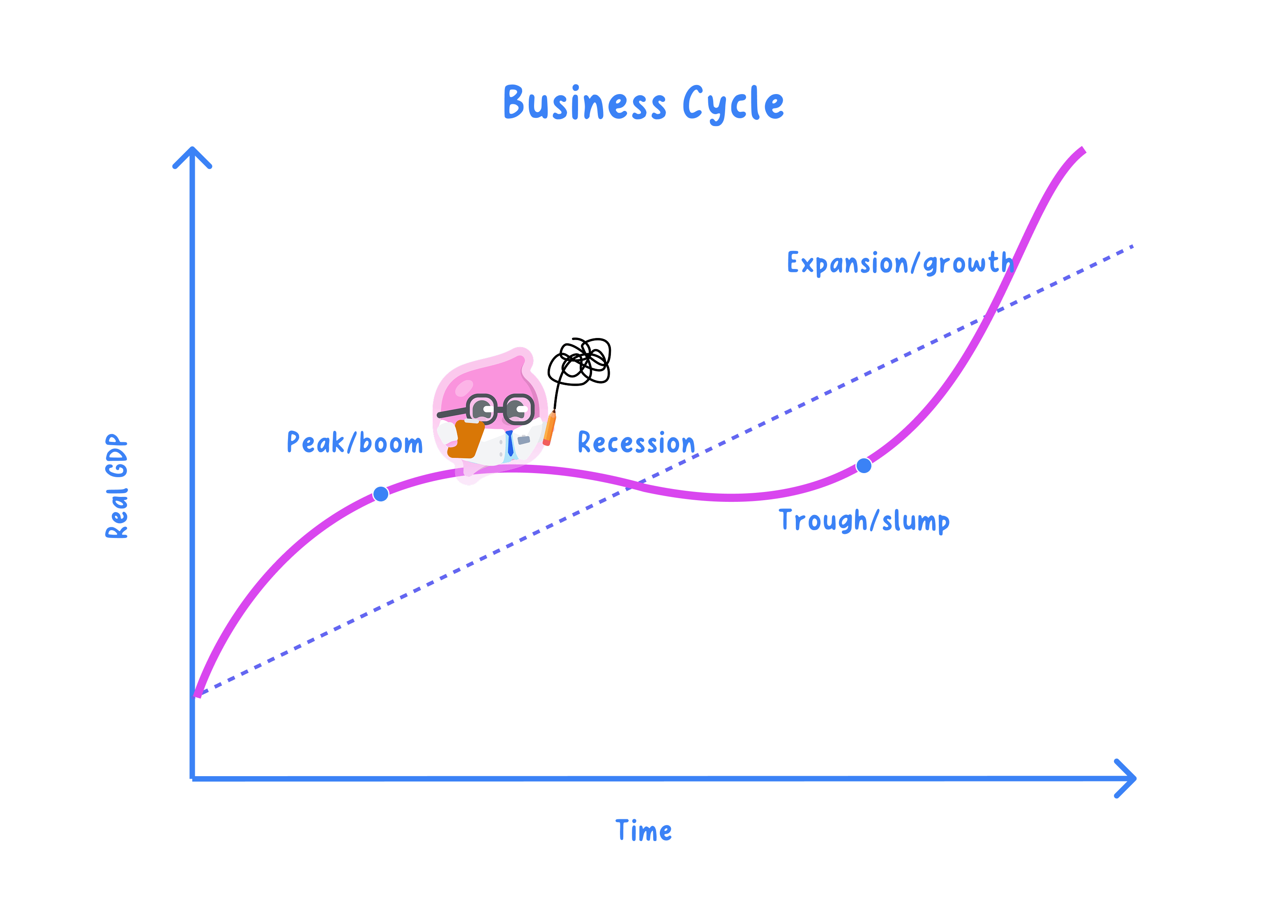
The four stages: growth, boom, recession and slump
Growth: The stage of the cycle in which output, spending and employment are rising again after a downturn.
Boom: The peak of the cycle, when demand and employment are at their highest and firms are working close to full capacity.
Recession: A period in which total output falls, orders are cancelled and unemployment begins to rise.
Slump: The bottom of the cycle, when demand is at its lowest, unemployment is high and many businesses are making losses or closing.
- Growth: demand is rising month by month, unemployment is falling and confidence is returning after a downturn.
- Sales volumes recover, so a firm can sell without discounting as heavily and its profit margin widens.
- The business rebuilds its inventories, restarts recruitment and reopens the investment projects it shelved.
- Boom: demand is at its highest, unemployment is low and confidence is strong enough for firms to borrow heavily.
- Capacity is stretched, so waiting lists lengthen and a business can raise prices without losing many customers.
- Costs climb at the same time, because skilled workers are scarce and suppliers of materials know they can charge more.
- Firms expand capacity and take on loans, and that debt is the risk they carry into the next stage.
- Recession: demand is falling, orders are cancelled, unemployment starts to rise and confidence drains away.
- Luxuries and expensive one-off purchases such as new cars, kitchens and holidays are postponed first.
- The business cuts overtime, delays investment, runs inventories down and may make workers redundant.
- Cash matters more than profit at this point, because a firm still holding orders but no cash to pay wages will fail.
- Slump: demand is at its lowest, unemployment is high and many firms are already making losses.
- Weaker competitors close, which leaves the survivors with a larger share of a smaller market.
- A business now cuts fixed costs, closes loss-making branches and protects its bank balance rather than chasing growth.
In the downturn that followed 2008, sales of new cars and fitted kitchens fell sharply while the discounters Aldi and Lidl grew their share of UK grocery.
Employment levels: demand on one side, labour costs on the other
Unemployment: People who are able and willing to work and are looking for a job but cannot find one.
- Rising unemployment removes wages from households, so demand falls fastest for luxuries, branded goods and treats such as eating out.
- Demand for necessities such as bread and washing powder changes far less, which is why Tesco holds up better in a downturn than a chain of jewellers.
- Rising unemployment also makes recruitment easier and cheaper, because more applicants chase each vacancy, so posts are filled quickly and pay rises can be held back.
- Falling unemployment reverses both effects, because customers have more income to spend but the business must pay more, or offer better conditions, to attract and keep staff.
- Higher wages raise the cost per unit, so a firm that cannot raise its selling price earns less profit on each sale even though it is selling more.
- Do not write that a recession is bad for every business.
- Discounters, repair services and own-label producers often gain customers who are trading down.
Inflation: costs rise before the firm can reprice
Inflation: A sustained rise in the general level of prices, so each pound buys less than it did before.
- Inflation raises the price of raw materials, energy, rent and transport, so the cost of making each unit rises.
- If the business can pass the increase on, it raises its selling price and protects the margin, but it risks losing price-sensitive customers to a cheaper rival.
- If it cannot pass the increase on, because competitors are holding their prices or a supermarket buyer refuses to accept a higher wholesale price, the profit margin is squeezed.
- Employees ask for pay rises that keep up with prices, so the wage bill rises as well and a refusal risks losing trained staff.
- Planning becomes harder, because a quotation given to a customer today can turn into a loss-making job by the time the work is delivered.
- A cafe makes a sandwich for £1.20 and sells it for £3.00, so it earns £1.80 on each one.
- Ingredient inflation lifts the cost to £1.50 while the price stays at £3.00, so the profit per sandwich falls to £1.50.
Gross domestic product: the size of the market a business sells into
Gross domestic product (GDP): The total value of all goods and services produced in a country in one year.
- Rising GDP means the country is producing and earning more, so total spending grows and most businesses see orders rise without doing anything differently.
- Growing GDP is also the signal firms use to invest, because banks lend more readily and owners expect the extra capacity to be used.
- A sustained fall in GDP is what a recession is, so the same figure tells a business which stage of the cycle it is trading in.
- Businesses selling income-sensitive products such as restaurant meals, air travel and furniture feel GDP changes most sharply, in both directions.
- A discount retailer can gain sales when GDP falls, so the effect of a change in GDP depends on what the business sells.
- Do not use recession and slump as two words for the same thing, because a recession is output falling while a slump is the bottom of the cycle with firms already closing.
- Inflation is not automatically bad for a firm, so say whether this firm can pass its higher costs on to customers before you state the effect on profit.
- Rising unemployment has two effects on a business, and answers that mention only falling demand miss the cheaper recruitment effect entirely.
- Name the four stages of the business cycle in order.
- What happens to business confidence during a recession?
- Give one way rising unemployment can help a business.
- Why can inflation squeeze a firm's profit margin?
- What does GDP measure, and which kinds of business are most affected when it falls?