Taxes, spending and interest rates: three levers that reach every business
- A change in tax, in government spending or in interest rates reaches a business down one of two routes: it changes what the firm pays out, or it changes what its customers can afford.
- Working out which route applies is the whole task, because a tax on profits hits the firm's own accounts while a tax on spending hits the shelf price the customer sees.
Direct taxes: less profit left inside the business
Definition
Direct tax: A tax taken from the income, profit or wealth of a person or a business, such as income tax and corporation tax.
- Corporation tax is charged on a company's profit, so a rise leaves less retained profit for the owners and less internal finance for expansion.
- Income tax is taken from employees' wages, so a rise cuts household disposable income and demand falls, fastest for non-essentials such as meals out and holidays.
- Higher income tax also makes recruitment dearer, because staff judge a job on take-home pay and may ask for a larger gross wage.
- Cuts in direct tax run the other way, leaving more retained profit inside the firm and more spending power with its customers.
Common Mistake
- A direct tax reduces money the business or the worker has already earned, while an indirect tax is charged when something is bought.
- Mixing the two breaks the chain, because it puts a change in VAT into a firm's profit figure instead of into its customers' willingness to buy.
Indirect taxes: a higher price on the shelf
Definition
Indirect tax: A tax added to the price of goods and services when they are bought, such as value added tax (VAT) and duties on fuel.
- An indirect tax is added to the selling price, so the customer meets it at the till rather than the firm meeting it in its profit statement.
- A rise in VAT therefore raises the shelf price and cuts the quantity demanded, which matters most for goods customers can easily do without or buy abroad.
- The business faces a choice: pass the whole rise on and risk losing sales, or absorb part of it, hold the price and accept a thinner margin on every unit.
- Duties on fuel, alcohol and tobacco work the same way, so a rise in fuel duty lands on a haulage firm or a taxi operator as a straight increase in running costs.
Example
- A company making £200,000\text{£}200{,}000£200,000 profit pays £38,000\text{£}38{,}000£38,000 in corporation tax at 19%, rising to £50,000\text{£}50{,}000£50,000 if the rate moves to 25%.
- That is £12,000\text{£}12{,}000£12,000 less to reinvest, which could be the deposit on a delivery van the firm now has to borrow for instead.
- A product priced at £200\text{£}200£200 before tax reaches the shelf at £200×1.20=£240\text{£}200 \times 1.20 = \text{£}240£200×1.20=£240 with VAT at 20%, and the customer meets that extra £40\text{£}40£40.
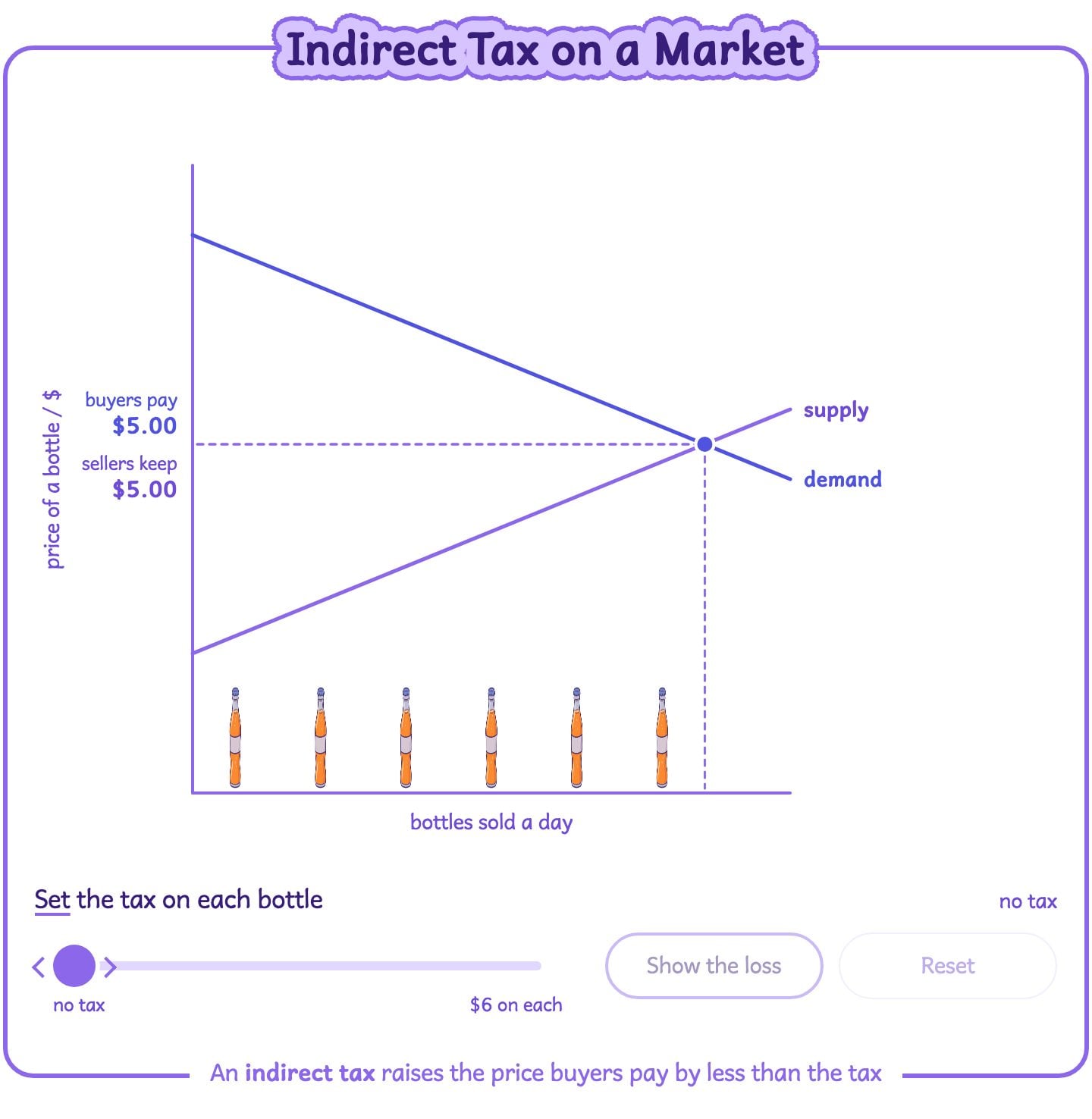
Raise the indirect tax and see the price buyers pay rise by less than the tax.
Government spending: a source of demand and of contracts
Definition
Government spending: Money a government spends on services such as health, education, defence, roads and benefits.
- Government spending is direct demand for some businesses, because building a school, a hospital or a motorway is paid work for construction firms and their suppliers.
- The NHS buys from thousands of suppliers, from bandages to catering, so a firm winning one of those contracts gains guaranteed orders and a reliable payer.
- Spending on wages for public sector workers and on benefits puts income into households, which then reaches shops, cafes and every other ordinary business.
- Spending on roads, broadband and training also cuts a firm's own costs later, because better transport and better-trained workers make it cheaper to operate.
- A cut in government spending removes these effects at once: contracts are cancelled and household incomes fall, so a firm can lose public orders and private customers together.
Interest rates: the firm's borrowing and the customer's credit
Definition
Interest rate: The price of borrowing money, and the reward for saving it, usually given as a percentage per year.
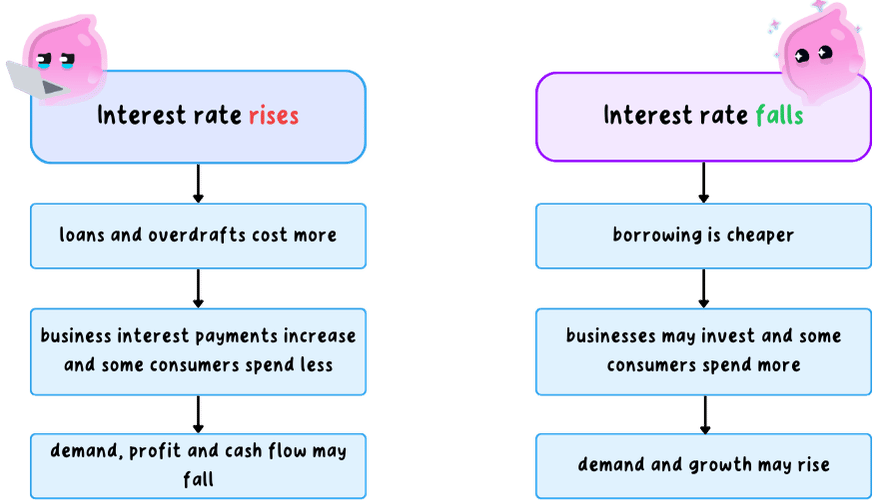
- A rate rise increases the cost of the firm's own loans and overdrafts, so interest payments rise and profit falls even if sales are unchanged.
- On a £100,000\text{£}100{,}000£100,000 loan a move from 6% to 9% raises the annual interest from £6,000\text{£}6{,}000£6,000 to £9,000\text{£}9{,}000£9,000, money that no longer buys inventories or pays wages.
- Expansion financed by borrowing becomes harder to justify, so machinery, vehicles and new premises are postponed and the firms that supply them lose orders too.
- On the customer side, higher mortgage and credit card repayments cut disposable income, so purchases usually bought on credit, such as cars, sofas and kitchens, are cancelled first.
- A supermarket selling everyday food feels this far less than a car dealer, so the same rate rise is a mild irritation to one firm and a crisis for another.
- A business holding cash rather than debt gains from a rate rise, because its savings earn more interest.
- A rate cut reverses each link: borrowing is cheaper, shelved investment goes ahead and credit-financed demand recovers.
Analogy
- A rate rise is like a shop whose rent goes up in the same week its customers' wages are cut.
- The firm's own repayments climb at the exact moment its customers stop buying on credit, so the squeeze arrives from both ends at once.
How businesses respond to these changes
- Pricing is the first lever: pass a tax or cost rise on where customers are loyal, absorb it where a cheaper rival is one click away.
- Costs are the second: firms cut overtime, renegotiate with suppliers, run smaller inventories and delay replacing equipment to protect profit.
- Finance is the third: a firm facing rising rates can repay debt early, switch a variable-rate loan to a fixed rate, or fund expansion from retained profit instead of borrowing.
- The product range is the fourth: when incomes are squeezed a retailer pushes its value line, as Tesco does with Tesco Everyday Value, to keep customers who would otherwise go to Aldi.
- Where government spending is rising, a business can chase the opportunity by bidding for public contracts or moving into the sector being funded.
- Every one of these responses takes time and costs money, so a firm that reads the change late is left cutting prices from a weaker position.
Exam technique
- Say which tax you mean, because a rise in corporation tax and a rise in VAT reach the business through completely different routes.
- Interest rates and inflation are not the same thing, so do not write that a rate rise makes goods in the shops more expensive.
- Check how the firm in the case is financed before judging a rate rise, since a debt-free business with savings in the bank is better off.
Self review
- Give one direct tax and one indirect tax, and say who pays each.
- Why does a rise in corporation tax slow a firm's expansion?
- Give two ways government spending creates demand for businesses.
- Name the two separate effects of an interest rate rise on a furniture retailer.
- State three ways a business could respond to rising interest rates.