Ownership: who owns the business and what that carries
- Ownership means holding a legal claim on a business, which brings the right to a share of its profits and the duty to bear its losses.
- In a sole trader the owner is one person, in a partnership the owners are the partners, and in a company the owners are the shareholders.
- An owner is paid only out of what is left after every cost, while an employee is paid a wage whether the firm profits or not.
- Ownership is not the same as control, because a plc shareholder owns part of the company but has no say in daily decisions, which are taken by directors.
- Ownership can be transferred, and how easily it can be transferred is one of the main differences between the forms of business.
Example
- Tesco plc is owned by hundreds of thousands of shareholders, from large pension funds to savers holding a few hundred pounds of shares.
- None of them decides what a store stocks or what staff are paid, because those decisions belong to the directors and managers they appoint.
Definition
Risk: The chance that a business decision leads to financial loss or to the failure of the business.
Risk: what an owner stands to lose, and why they accept it
- Business failure is the largest risk, because if the firm closes the owner loses the capital put in and, in an unincorporated business, may still owe money afterwards.
- Financial loss covers everything short of closure, from a product launch that has to be written off to a customer who never pays a £3,000 invoice.
- Loss of security is a personal risk, because starting a business usually means giving up a regular wage, paid holiday and a pension for an income that may be nothing in a bad month.
- Owners accept these risks for the rewards: profit that is uncapped in a way a wage is not, independence over what to sell and when to work, and a business whose value can be sold later.
- Risk rises with the amount of capital committed, with how new the idea is, and with how much of the money is borrowed rather than the owner's own.
Example
- A cafe owner spends £15,000 fitting out a second unit near an office block.
- If the offices stay busy the extra sales could add £12,000 of profit a year, which is the reward.
- If the employer moves out, the £15,000 is lost and the lease still has to be paid, which is the risk.
Definition
Unlimited liability: A legal position in which the owner is personally responsible for all the debts of the business, so personal possessions can be sold to pay them.
Unlimited liability: the owner's own money is on the line
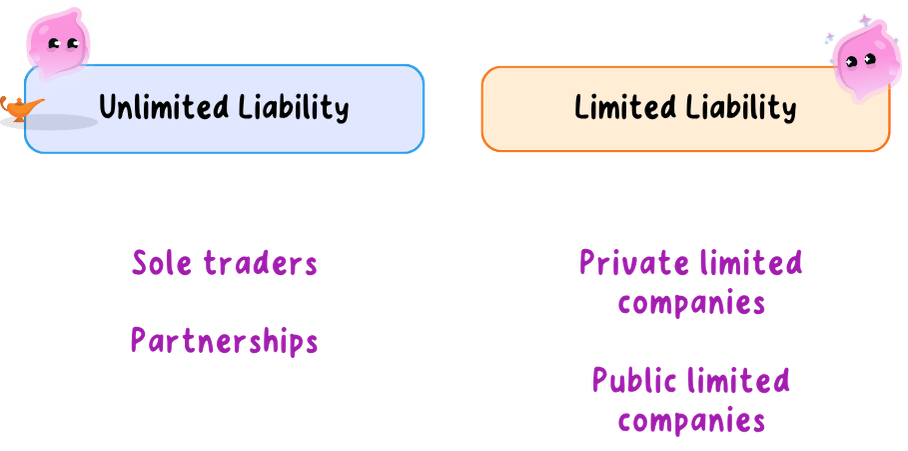
- Unlimited liability follows directly from being unincorporated, because if the business has no separate legal identity then its debts can only be the owner's debts.
- There is no cap, so a sole trader who invested £5,000 but whose business collapses owing £45,000 must find the whole £45,000, and savings, a car or in the worst case the family home can be sold to settle it.
- In an ordinary partnership each partner can be pursued for the firm's whole debt rather than an agreed share, so one partner's reckless order can cost the others everything they own.
Analogy
- A share is like a ticket to a show, because the most it can ever cost you is the price printed on it.
- An unincorporated owner holds no ticket, so the bill keeps growing until every debt of the business has been paid.
Definition
Limited liability: A legal position in which the most a shareholder can lose is the amount they paid for their shares, so personal possessions cannot be taken to pay the company's debts.
Limited liability: the loss stops at the amount invested
- The mechanism is the company's separate legal identity, because the debts belong to the company and a shareholder who has paid in full for their shares owes it nothing more.
- The maximum loss is known in advance, so someone who buys £2,000 of shares loses at most £2,000 however large the company's debts become.
- What is limited is the owner's personal loss, not the company's, because the company itself can lose millions and be forced to close.
- Shareholders still lose their whole investment when a company fails, because the shares become worthless, so limited liability is not a guarantee against loss.
- Because the downside can be worked out in advance, ordinary savers will buy shares in companies they will never visit, which is how a plc raises millions from strangers.
Exam technique
- Unlimited liability is not capped at the amount the owner originally invested, which is the point students most often get wrong.
- Do not write that limited liability means the business can only lose a limited amount, because it is the owner's personal loss that is capped and not the company's.
- Quote the maximum figure whenever the question gives you one, so answer with the £2,000 paid for the shares rather than with the phrase only what they invested.
Self review
- State the maximum a shareholder who paid £5,000 for shares can lose if the company collapses owing £2m.
- Explain why unlimited liability follows from being unincorporated.
- Give two rewards that persuade an owner to accept business risk.
- Why can a partner be made to pay a debt another partner ran up?
- Why is ownership not the same as control in a public limited company?