Why ratios: turning £ figures into a comparable measure
- A ratio sets one figure from the accounts against another, so the answer is a relationship rather than an amount of money, which lets businesses of very different sizes be compared on equal terms.
- Cambridge examines exactly five ratios: the gross profit margin, the profit margin and return on capital employed measure profitability, while the current ratio and the acid test ratio measure liquidity.
The figures used throughout: Meridian Sports Ltd
- Every calculation on this page uses the same sports shop, and the two columns are the years ended 31 March 2025 and 31 March 2026.
| Meridian Sports Ltd, £ | 2025 | 2026 |
|---|---|---|
| Revenue | 400,000 | 500,000 |
| Cost of sales | 232,000 | 300,000 |
| Gross profit | 168,000 | 200,000 |
| Expenses | 108,000 | 130,000 |
| Profit | 60,000 | 70,000 |
| Current assets | 96,000 | 100,000 |
| Inventories | 40,000 | 60,000 |
| Current liabilities | 40,000 | 50,000 |
| Capital employed | 250,000 | 350,000 |
Gross profit margin: what survives the cost of the goods
Gross profit margin: Gross profit as a percentage of revenue, showing how much of each £1 of sales is left after paying for the goods sold.
- Meridian keeps 40p of every £1 taken at the till once it has paid for the trainers, racquets and kit it sold.
- Last year the figure was 42%, so each £1 of sales now leaves 2p less to cover wages, rent and everything else.
- Only two figures go into this ratio, so a fall can only mean the goods cost more to buy or they were sold for less.
Profit margin: what survives every cost
Profit margin: Profit as a percentage of revenue, showing how much of each £1 of sales is left once every cost has been paid.
- Meridian keeps 14p of every £1 of sales once wages, rent, energy, insurance and every other expense have been paid.
- Last year it was 15%, so profitability slipped slightly even though £ profit rose from £60,000 to £70,000.
- The gap between the two margins is the share of every £1 that expenses take, and it narrowed from 27p to 26p, so the fall in the profit margin comes from the gross profit margin rather than from expenses.
Return on capital employed: how hard the invested money works
Return on capital employed (ROCE): Profit as a percentage of capital employed, showing how much profit is earned from each £1 of long-term finance invested in the business.
Capital employed: The total value of the long-term finance invested in a business, made up of the owners' capital plus any long-term borrowing, and used to buy the assets the business trades with.
- Every £1 of long-term finance tied up in Meridian generated 20p of profit during the year.
- Last year the figure was 24%, so the money now invested is working less hard than the money invested before.
- Capital employed rose by £100,000 while profit rose by only £10,000, a return of 10% on the new money, and that dragged the overall figure down.
Current ratio: short-term assets against short-term debts
Current ratio: Current assets divided by current liabilities, showing how many times a business could cover its short-term debts with its short-term assets.
- The answer is normally written as 2:1, which means Meridian holds £2 of current assets for every £1 it has to pay within the year.
- Last year the ratio was 2.4:1, so the cushion has thinned, and a result below 1 would mean short-term debts exceeded short-term assets.
Acid test ratio: liquidity without selling any inventories
Acid test ratio: Current assets minus inventories, divided by current liabilities, showing whether a business could pay its short-term debts without selling any stock.
- The answer is written as 0.8:1, so Meridian holds 80p of quickly available assets for every £1 owed within the year and could not pay those debts without selling inventories.
- Last year the ratio was 1.4:1, and the deterioration is sharp: quick assets fell from £56,000 to £40,000 while short-term debts rose from £40,000 to £50,000.
A rail of unsold replica shirts is worth £60,000 on paper but cannot settle a supplier invoice falling due this week, which is why inventories are stripped out and only money, or what is about to become money, is counted.
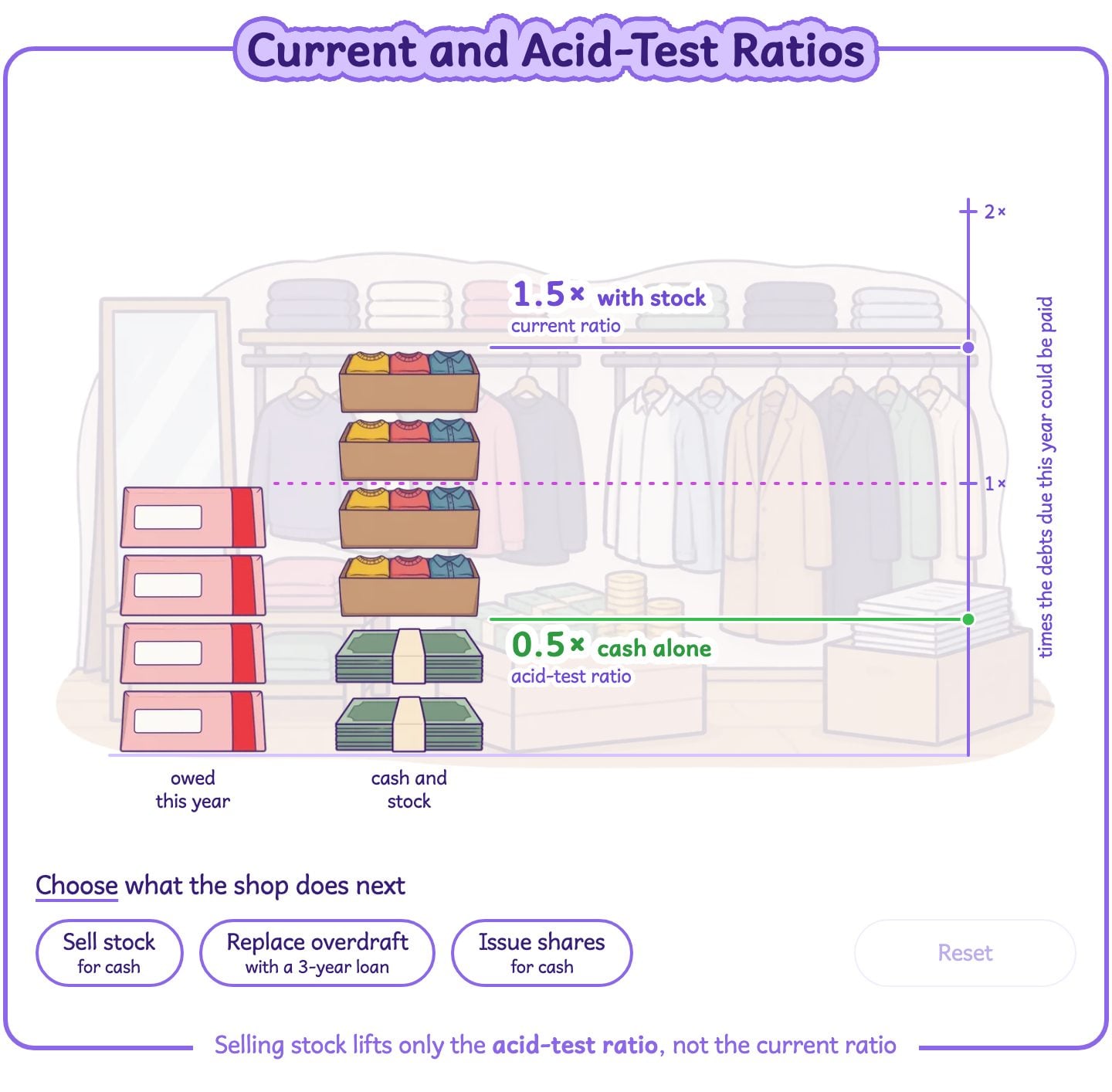
Sell inventories and notice only the acid test ratio changes, while the current ratio does not.
A ratio only means something next to another figure
- A ratio is judged against three things: the same business in earlier years, a rival selling similar goods in the same market, and the return the money could earn somewhere else.
- The trend matters most, because two or three years of figures show whether performance is improving or slipping while a single year shows neither.
- Compare ROCE with the interest a bank would pay, because that is the return the owners could earn with no work and no risk.
Do not call a ratio good or bad on its own, because 40% is a strong gross profit margin for a supermarket and a weak one for a jeweller.
What Meridian's five ratios say together
| Ratio | 2025 | 2026 |
|---|---|---|
| Gross profit margin | 42% | 40% |
| Profit margin | 15% | 14% |
| ROCE | 24% | 20% |
| Current ratio | 2.4:1 | 2:1 |
| Acid test ratio | 1.4:1 | 0.8:1 |
- Revenue grew by 25%, from £400,000 to £500,000, yet every one of the five ratios moved the wrong way, so the business has grown without becoming stronger.
- The two margins say the extra sales were won on worse terms, most likely through discounting or through higher buying prices.
- The two liquidity ratios say the growth was funded partly by extra inventories and extra short-term credit, leaving the shop unable to cover immediate debts without selling trainers.
- The commonest slip is dividing by the wrong figure, so hold on to the rule that the two margins divide by revenue while ROCE divides by capital employed.
- Write the subtraction of inventories out in full in the acid test, because leaving it out simply reproduces the current ratio and answers a different question.
- Write the formula for return on capital employed.
- A shop has current assets of £100,000, inventories of £60,000 and current liabilities of £50,000: calculate its acid test ratio.
- Why can the gross profit margin only change when buying prices or selling prices change?
- What does a wide gap between a business's current ratio and its acid test ratio tell you?
- Why is a single year's ratio almost impossible to judge?