The main methods of primary research
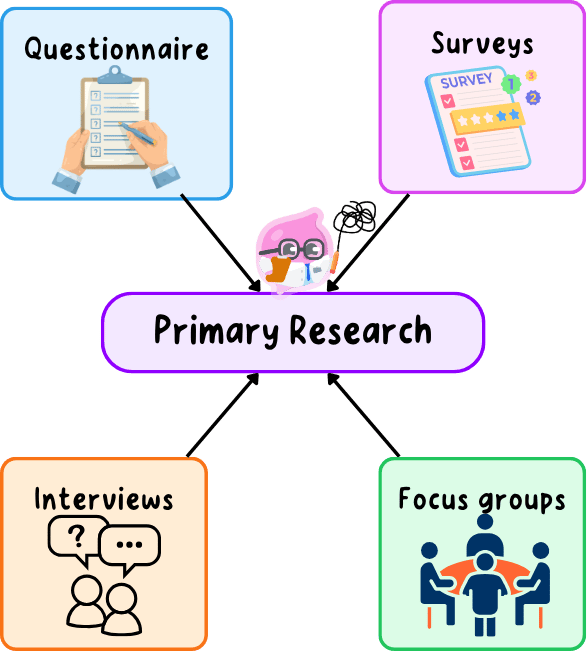
- Questionnaires, surveys, interviews and focus groups are the main methods of primary research, and observation and test marketing belong with them, because in every one the business collects the information itself for its own decision.
Postal questionnaires and online surveys: numbers from many people
Definition
Questionnaire: A set list of written questions put to a sample of people so that their answers can be counted and compared.
- Both routes put the same fixed questions to a large number of people, so the replies can be counted, turned into percentages and compared between groups.
- Postal questionnaire: forms are sent to addresses with a reply envelope, so a whole town can be reached from the office, but printing and postage for 2,000 letters costs several hundred pounds before a single answer arrives.
- Response rates are low and replies take weeks, so a firm that posts 500 forms may get 60 back and still be deciding after the moment has passed.
- Online survey: sent by email or posted on social media, it is the cheapest option per person and the software counts the answers within days.
- Only people who use the internet and choose to reply are heard, so older or less connected customers are under-represented and the results are skewed.
- Wording decides the answer, because a question such as do you agree our prices are fair pushes people towards yes and the business hears what it hoped to hear.
- Both are best used for measuring how many customers think or do something, such as how many would pay £4.50 for a lunch deal, rather than for finding out why.
Example
- A gym gives a five-question form to 400 members and finds 62% want later opening at weekends.
- That figure is enough to justify paying staff for extra weekend hours, which a handful of comments could not have done.
Interviews and focus groups: reasons from a few people
Definition
Focus group: A small group of customers brought together and led through a discussion about a product, a brand or an idea so the business can hear their reasons and reactions.
- Interview: a face-to-face or telephone conversation in which a researcher works through prepared questions and adds more as the conversation develops.
- The interviewer can keep asking why until the real reason for a choice comes out, and can explain a question that has confused the respondent, so the answers are more accurate than a tick box.
- Paying an interviewer for an hour to speak to one customer is expensive per answer, and 20 interviews cannot show what a market of 50,000 people thinks.
- Focus group: a moderator guides six to ten people through the questions and can show them samples, packaging or advertisements and record how they react.
- One person's comment prompts another, so objections the business never thought to ask about come to the surface, and testing two packaging designs on a group costs a few hundred pounds against thousands spent printing the wrong one.
- A confident participant can silence the rest, so the group agrees with an opinion most of them do not hold, and participants and a moderator usually have to be paid.
- Both methods give opinions rather than measurements, so a business should not set production levels from what eight people said.
Common Mistake
- Do not treat what customers say in a survey or a focus group as what they will actually do.
- Far more people say they would pay extra for greener packaging than hand the money over at the till.
- That gap is why firms check stated answers against what customers are seen to do, or against a trial in a few shops.
Observation and test marketing: what customers actually do
- Observation: watching and counting what customers actually do, such as footfall past three possible sites, which catches real behaviour but never explains why the people who walked past did so.
- Test marketing: selling the product in a limited area or a few outlets first, so the price, the recipe or the packaging can be corrected before a full launch.
- The trial delays the launch and shows rivals the idea while there is still time for them to copy it.
Example
- Greggs puts a new item on sale in a small number of selected shops before deciding whether to stock it everywhere.
- Real sales at a real price show whether customers will buy it, which no questionnaire can confirm.
- A weak trial can be dropped for the cost of a few shops rather than the cost of supplying more than 2,000 of them.
The need for sampling: asking a few to stand for the many
- Asking every possible customer would take months and cost more than the decision is worth, so the business questions a sample, a smaller group chosen to stand for the whole market.
- A sample of 500 shoppers can be surveyed in a week, while surveying a town of 60,000 could not be done at all with the staff and money a small firm has.
- The findings are then treated as if they applied to everyone, so how many people are asked and how closely they resemble the whole market decide whether the research can be trusted.
Exam technique
- Pair each method with the kind of information it produces: questionnaires and online surveys give numbers, interviews and focus groups give reasons, observation and test marketing give behaviour.
- When you are asked for primary methods, do not offer government statistics or internet searches, because those are somebody else's data.
Self review
- Give one benefit and one drawback of a postal questionnaire.
- Why can an online survey give a skewed picture of the market?
- What can an interview find out that a tick-box questionnaire cannot?
- Why should a business not set production levels from a focus group?
- Why does a business use a sample instead of asking every customer?