4.1.1a Understanding customers and gaps
Research replaces guesswork before the money is spent
Market research: the process of gathering and analysing information about customers, competitors and the market to support business decisions.
- A business may spend heavily on designing, making, stocking and promoting a product before it earns anything back, so finding out what customers want first reduces the risk of committing money to the wrong idea.
- Research can also give lenders or investors evidence that demand exists, although it cannot guarantee that customers will buy when the product launches.
Research identifies who the customers are and what they value
- Research can identify customer characteristics such as age, income, location and lifestyle, helping the business focus on the people most likely to buy rather than treating everyone as one market.
- It can then investigate the features, quality, buying habits and price range those customers prefer. This information can shape what the business offers and how it positions the product.
A café researching a new menu may discover that regular customers want more vegan options and will pay slightly more for them, giving the owner evidence for both the product range and the price.
A gap in the market is an unmet customer need
Gap in the market: a customer need or group of customers that existing businesses are not serving well.
- Research can reveal repeated complaints about existing products, groups of customers that rivals overlook, or locations where a service is not available. Filling such a gap can give a business less direct competition and a clearer reason for customers to choose it.
- A gap is only attractive if enough customers want the solution and are willing to pay enough for it. A need may be genuinely unmet because serving it would cost more than customers are prepared to pay.
- Suppose local commuters repeatedly complain that no café near a station opens before 7 am.
- That may reveal a gap, but the owner still needs to estimate whether enough early customers would buy to cover the extra staffing and opening costs.
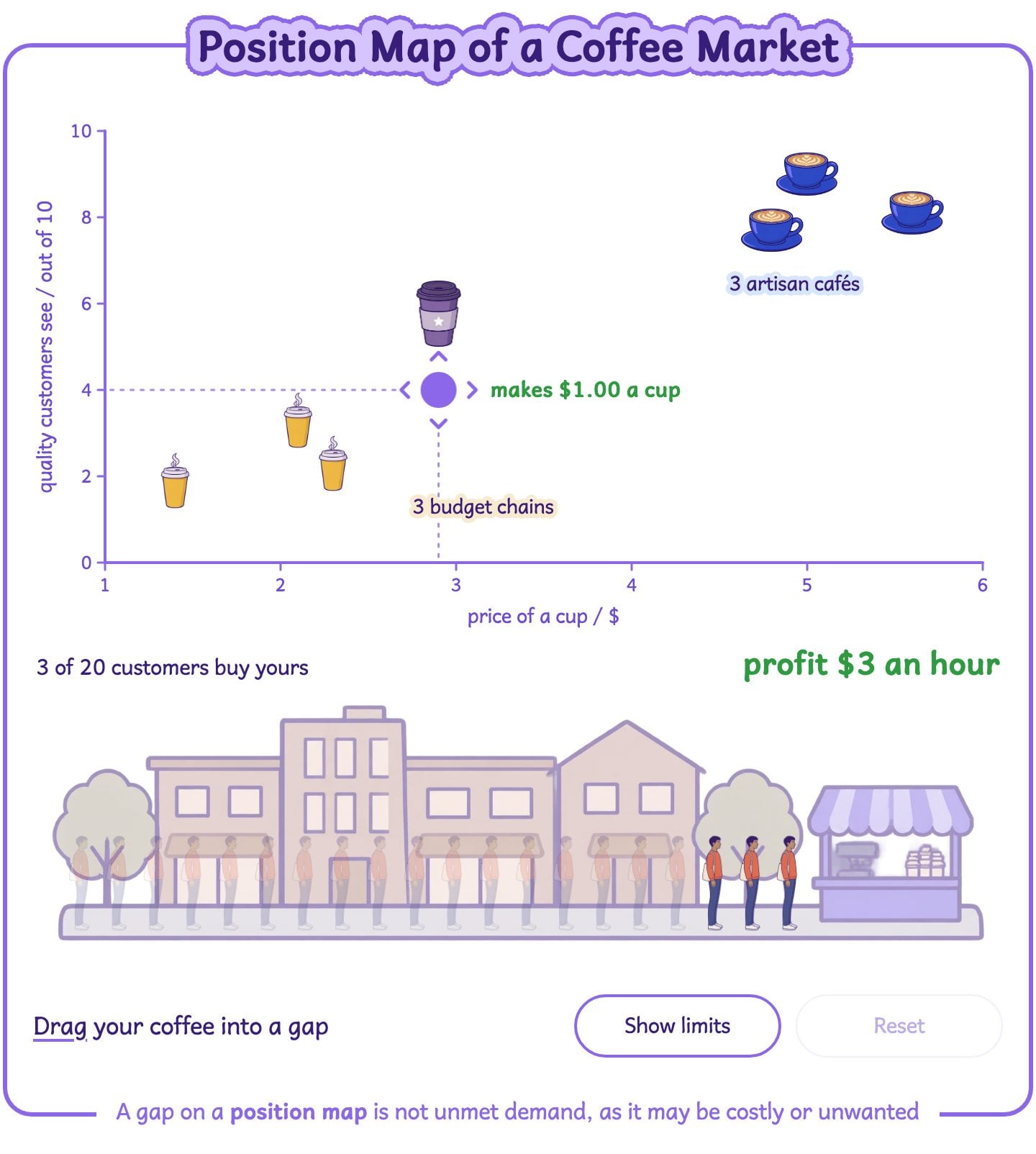
Look at the position map and notice that a gap does not always mean real, profitable demand.
Customer research feeds directly into the marketing mix
- What customers value affects the product; what they are willing to pay influences price; where they shop influences place; and the media they use influences promotion.
- The research therefore becomes useful only when the business turns the finding into a decision, rather than collecting information without changing what it does.
- Identify the customer need or gap shown by the information.
- Link the finding to a specific business decision, such as product design, price, place or promotion.
- For a market gap, explain why enough demand and willingness to pay still have to be checked.
- What is market research?
- Give three things research can reveal about customers.
- What is a gap in the market?
- Why might an apparent gap still not be commercially worthwhile?
- How can market research influence the marketing mix?
4.1.1b Reducing risk and informing decisions
Research reduces the risk of committing money to the wrong decision
- Launching or changing a product can require spending on design, inventories, premises and promotion before the business knows how customers will respond.
- Market research reduces this risk by testing assumptions before the largest costs are committed. If demand looks weak, the business can change, delay or abandon the plan while it is still relatively cheap to do so.
- A small café considering a second site could first measure local footfall and ask nearby customers about demand.
- Weak findings might prevent the owner signing an expensive lease, while strong findings provide evidence for proceeding.
Research informs decisions across the business
- Research can influence product features, price, distribution and promotion by showing what customers value, what they are willing to pay, where they buy and which media they use.
- It can also inform larger decisions such as entering a new market, expanding a branch network or withdrawing a product whose demand is weakening.
- Demand estimates can guide production and inventory decisions, helping a business avoid both shortages of popular products and excess inventory that ties up cash.
Research reduces uncertainty rather than eliminating it. The reliability of research findings is developed later in this section.
The value comes from linking evidence to a decision
- A useful conclusion does more than say that research is helpful: it identifies what the evidence suggests the business should do and how that action reduces a specific risk.
- Managers still have to judge the cost of acting, the strength of the evidence and other business constraints, so research informs the decision rather than making it automatically.
- State the business decision the research is informing.
- Use the research finding to explain what action becomes more or less sensible.
- Explain the particular cost or risk the evidence helps the business avoid.
- How can market research reduce the risk of a product launch?
- Give two marketing decisions that research can inform.
- How can demand estimates affect production or inventory decisions?
- Why does research reduce risk rather than remove it?
- Why must managers still use judgement after receiving research findings?
4.1.2a Primary research methods
Primary research collects fresh information for the business's own question
Primary research: new information collected first-hand by or for a business for a specific research purpose.
- Because the information is collected for the exact decision being made, it can be current and highly relevant. The trade-off is that collecting it takes time and usually costs more than using existing information.
- Edexcel requires five methods: surveys, questionnaires, focus groups, observation and test marketing. The best method depends on whether the business needs numbers, detailed reasons or evidence of actual behaviour.
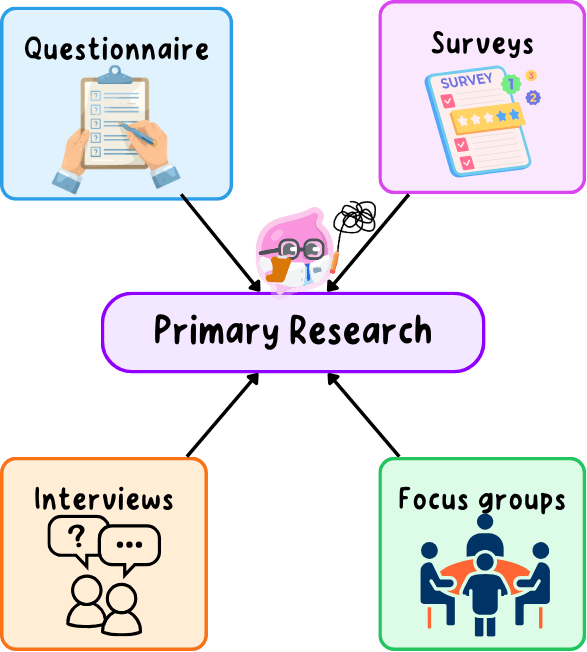
Surveys and questionnaires can collect comparable answers from many people
- Survey: asking a sample of people questions, for example face to face, by phone or online. A questionnaire is a fixed written set of questions, usually completed on paper or online.
- Advantages: both can reach relatively large samples and ask directly about the business's decision. Standard questions also make answers easier to count and compare.
- Disadvantages: response rates can be low, respondents may not answer honestly, and badly worded or leading questions can produce misleading results. Face-to-face surveys can also be slow and expensive.
A gym could send members a short questionnaire asking which evening classes they would attend, then use the results to decide which classes justify paying an instructor.
Focus groups trade sample size for depth
- Focus group: a small group of people discussing a product, idea or marketing decision with a researcher who can explore their reasons in detail.
- Advantages: discussion can reveal why customers react as they do and uncover ideas the business did not think to ask about. Disadvantages: the group is small, dominant participants can influence others, and the findings may not represent the wider market.
Observation and test marketing show what customers actually do
- Observation: watching and recording customer behaviour. It provides evidence of real actions, such as which display attracts shoppers, but it usually cannot explain why the behaviour occurred.
- Test marketing: selling a product in a limited area or a small number of outlets before a full launch. Real sales provide a stronger test of demand and allow problems to be corrected before a large rollout.
- Disadvantages: test marketing delays a full launch, the test area may not represent the wider market, and competitors can see the idea before the business expands it.
- Do not assume that what customers say they would buy is the same as what they will actually buy.
- Observation and test marketing can help check stated opinions against real behaviour.
The research question should determine the method
- A business wanting a broad measure of demand may favour a survey or questionnaire, while one trying to understand reactions in depth may favour a focus group. If it needs evidence of behaviour, observation or test marketing is stronger.
- Choose the method from the information the business needs, not from a memorised favourite.
- Give a relevant advantage, then link it to the business's decision.
- Balance it with a limitation such as cost, time, sample quality or whether stated answers reflect real behaviour.
- What is primary research?
- What is the difference between a survey and a questionnaire?
- Give one advantage and one disadvantage of a focus group.
- What can observation show that a questionnaire may not?
- Why might a business test market a product before a full launch?
4.1.2b Secondary research methods
Secondary research uses information that already exists
Secondary research: information that already exists and was originally collected for another purpose.
- Because the information has already been collected, secondary research is usually faster and cheaper than primary research. The limitation is that it may be old, too general or not designed for the business's exact question.
- Businesses often start with secondary research to understand the market cheaply, then use primary research only for the important questions that existing information cannot answer.
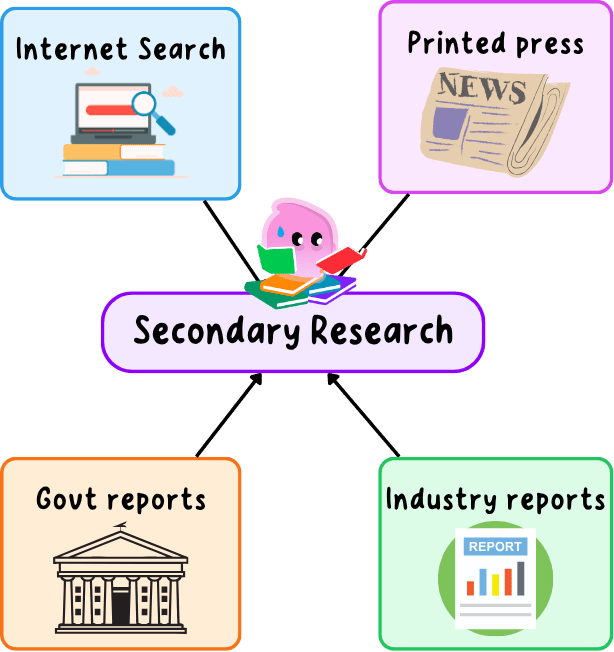
The internet is fast and wide-ranging but quality varies
- Websites, online articles, customer reviews and competitors' pages can reveal prices, product features, complaints and market trends very quickly and often at little or no cost.
- The drawback is reliability: some sources are biased, inaccurate or out of date, and the same public information is available to competitors, so it rarely provides an advantage by itself.
Market reports provide professional detail at a price
- Market reports are detailed studies produced by specialist research organisations. They can provide professionally collected information on market size, trends, competitors and customer segments without the business gathering it all itself.
- The disadvantage is that good reports can be expensive and still describe the market in general rather than answering a very specific question about one business's product.
A new drinks business could use an industry report to estimate the size and growth of the UK soft-drinks market before deciding which customer group needs further primary research.
Government reports provide broad official data
- Government sources can provide population, income, employment and spending information. This data is usually free and produced using large-scale official collection, making it useful for understanding the wider market.
- The information can be broad or several years old, so it may not describe a fast-changing product market or the exact customers a business wants to target.
Do not assume secondary research is reliable simply because it already exists. Check who produced it, when it was collected and whether it is relevant to the decision.
The best source depends on the decision and the budget
- A small business may begin with free internet and government data, while a larger business making a high-cost decision may be willing to buy a specialist market report for greater depth.
- Match the secondary source to the information the business needs.
- Balance speed and cost against relevance, age and reliability.
- Explain when primary research would still be needed to answer a more specific question.
- What is secondary research?
- Give one advantage and one disadvantage of using internet sources.
- Why might a business pay for a market report?
- Why can government data be useful but still too broad?
- Why do businesses often use secondary research before primary research?
4.1.3a Qualitative and quantitative data
Quantitative data measures the pattern; qualitative data explains the reason
Quantitative data: numerical information that can be counted, measured or compared.
Qualitative data: descriptive information about opinions, attitudes and reasons.
- Quantitative data answers questions such as how many, how often and how much, while qualitative data explains why customers think or behave as they do.
- The two forms are strongest when used together: numbers show whether a pattern is important, and detailed comments help the business understand what is causing it.
Quantitative data is easy to compare but can hide the reason
- Advantages: numerical results can be converted into percentages, charts and trends, making it easier to compare large groups or track changes over time.
- Disadvantages: a number may show what happened without explaining why, and a badly designed question or unrepresentative sample can still produce a precise-looking but misleading result.
Qualitative data gives depth but is harder to generalise
- Advantages: open comments and discussion can reveal motives, feelings, complaints and ideas that fixed questions may miss, helping a business understand what should change.
- Disadvantages: qualitative research often comes from smaller groups, takes longer to interpret and can be influenced by a few strong opinions, so the findings may not represent the whole market.
- A survey finds that 70% of customers would not buy a new drink: quantitative data showing the size of the problem.
- A focus group then explains that customers find the drink too sweet: qualitative data identifying what the business may need to change.
Social media can provide both types of research data
- Poll results, views, likes and shares provide quantitative data, while comments, reviews and direct messages provide qualitative reactions and reasons.
- Advantages: feedback can be gathered quickly and cheaply from many real users. Disadvantages: people who follow or comment on a brand may not represent all customers, and online reactions can be exaggerated or difficult to verify.
Do not classify data by the research method alone: the same survey can produce quantitative answers from tick boxes and qualitative answers from an open comment box.
The best evidence combines scale with explanation
- A business can use quantitative data to judge how widespread a customer need or problem is, then qualitative data to understand the cause and design a response.
- Identify whether the evidence is numerical or descriptive before using it.
- Use quantitative data to show the size or pattern and qualitative data to explain the reason.
- When social media data is used, consider whether the users represent the wider customer base.
- What is quantitative data?
- What is qualitative data?
- Give one strength and one weakness of each type of data.
- Give one quantitative and one qualitative example from social media.
- Why is using both types of data often stronger than using only one?
4.1.3b Reliability of research data
Research is useful only if the evidence is reliable enough to support a decision
Reliable data: information that is sufficiently accurate, relevant and trustworthy to use when making a decision.
- A business may make pricing, product or investment decisions from its research, so unreliable evidence can create false confidence and lead to costly mistakes.
Sample quality, bias and the source affect reliability
- Sample size and choice: a sample is the group actually researched. A larger, well-chosen sample is usually more representative than a very small group, but size alone does not help if the wrong people are being asked.
- Bias: results become one-sided when the sample, question wording or research process pushes the findings in a particular direction. Asking only loyal customers or using a leading question can therefore misrepresent the wider market.
- Source and age: data from a credible source that was collected recently is generally more useful than old information or figures from an unknown source, especially in a fast-changing market.
- A business asks only members of its loyalty scheme whether they like a new product and receives overwhelmingly positive answers.
- The respondents already favour the brand, so the sample may exaggerate demand among the wider market.
Businesses can improve reliability without making research perfect
- Choose a sample that reflects the target market, use enough respondents for the decision being made and avoid wording questions in a way that encourages a preferred answer.
- Check who produced secondary data, when it was collected and whether another credible source points in the same direction. Comparing sources can reveal figures that need further investigation.
- Even well-designed research remains evidence rather than certainty, because customer behaviour and market conditions can change after the research is completed.
Do not assume that a bigger sample automatically means reliable research: a large biased sample can still give a misleading result.
Reliability should be judged in the context of the decision
- A low-cost, reversible decision may not justify expensive research, whereas a national launch or major investment needs stronger evidence because the cost of being wrong is much higher.
- Check who was researched and whether the sample represents the target market.
- Look for bias in the questions, sample or source and check how current the data is.
- Link the reliability problem to how it could cause the business to make the wrong decision.
- What makes market research data reliable?
- Why does sample choice matter as well as sample size?
- Give one example of bias in market research.
- Why can old data be unreliable in a fast-changing market?
- Why might a high-cost decision require more reliable research than a low-cost decision?