The marketing mix as one decision, not four
Definition
Marketing mix: The combination of product, price, place and promotion a business uses to sell to its target market.
- The four elements are product (design, quality, packaging, brand), price (cost-plus, competitive, penetration, skimming or promotional), place (wholesalers, retailers, own shops or a website) and promotion (advertising, sales promotion and social media).
- Customers see the packaging, the price label and the shop at the same moment, so all four elements have to push the same customer towards the same purchase.
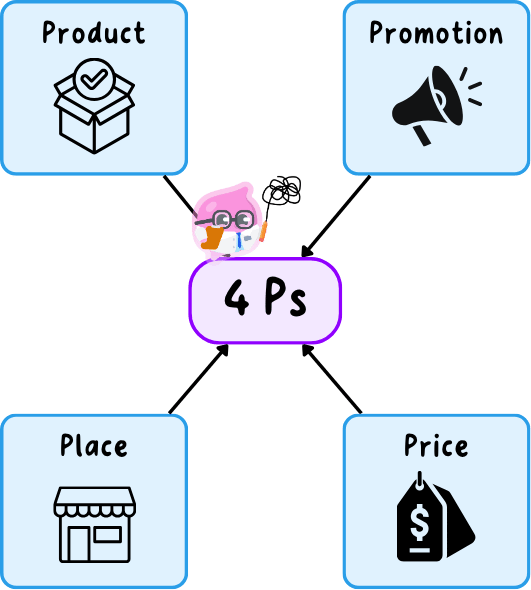
- The support is practical as well as visual, since promotion that lifts demand is wasted unless place has put the product within reach of the people who saw the advert.
- The elements also constrain each other financially, because selling through supermarkets means giving the retailer a margin, which either raises the price to the customer or cuts the profit the producer keeps.
- The weakest element sets the impression, so a £6 luxury chocolate bar wrapped in thin plastic and stacked in a discount supermarket is judged overpriced and left until it is marked down.
Analogy
- A shop with a designer window display, a broken door handle and prices written on torn cardboard tells the customer three different stories at once.
- Shoppers believe the cheapest signal, not the most expensive one.
Which element matters most depends on the circumstances
- Price dominates where products are close substitutes and incomes are tight, so sugar and petrol are decided almost entirely on price and the seller must cut its own costs rather than advertise more.
- Product dominates where the purchase is expensive, risky or long-lasting, because somebody choosing a washing machine reads about reliability first, and cutting quality to fund a price cut loses the sale.
- Place dominates for impulse and convenience buying, since a cold drink bought on the way to a train is chosen from whatever is within reach in the next two minutes.
- Promotion dominates where rival products are physically similar and the real difference is image, which is why soft drinks, trainers and fragrances are sold on brand rather than on ingredients.
- What shifts the weighting is the customer's income, whether the purchase is planned or impulsive, how easy the product is to compare, and how many rivals sell something close to it.
Example
- Aldi runs more than 900 UK stores on a mix in which every element serves one aim, a low price.
- Its range is narrow and mostly own-label, which raises the order size per line and cuts the price it pays suppliers.
- Its promotion compares prices against named rivals rather than building a glamorous image, so shoppers believe the claim because nothing they see contradicts it.
A worked recommendation: chilled soup for office workers
Definition
Marketing strategy: The plan a business follows to reach a chosen target market and meet a marketing objective, set out as decisions on all four elements of the mix.
- Bara Foods is a new business with £40,000 of capital launching chilled soups in one city, aimed at office workers spending £3 to £6 on lunch, with survival and repeat custom as the year-one objective.
- Product: three flavours in a 400g microwavable pot with clear calorie and allergen labelling.
- A ten-flavour launch was rejected because chilled soup lasts about a week, so every slow-selling flavour becomes waste the business has already paid for.
- Price: £2.60 a pot, set competitively against branded soups at £2.80 to £3.20 in the same chiller.
- Skimming at £4.50 was rejected because the soup has no patent or unique ingredient, so nothing stops the customer taking the £3 branded pot beside it.
- Place: delicatessens, convenience stores and two food-to-go counters in the office district, which puts the pots where the customer already walks at one o'clock.
- A supermarket listing was rejected because the chain would demand volumes the kitchen cannot produce and pay after around 60 days while ingredients must be paid for weekly.
- Promotion: free tastings outside office blocks between twelve and two, plus a stamp card giving the sixth pot free.
- Television was rejected because one campaign would cost many times the whole £40,000 and reach millions of people who cannot buy the product where they live.
Key Idea
- An element is only justified when it has been defended twice, once against the target customer and once against the money available.
- Naming the alternative that was rejected, and the reason, is what turns a description of a mix into a justification of it.
How the mix changes with the product and the market
- A new product leans on informative promotion and on getting distribution at all, with penetration pricing to buy trial or skimming where it is first of its kind, and a narrow range while demand is still a guess.
- An established product leans on availability and reminder advertising, moves to competitive pricing because customers know what it should cost, and is stretched with new flavours, sizes or versions.
- A niche mix is specialised and often made to order, priced high because output is small and unit costs stay high, sold through selective outlets and promoted where the niche already gathers.
- A mass-market mix is standardised for long production runs, priced competitively with a thin margin so profit comes from volume, and distributed as widely as possible.
Judging whether a marketing mix is the right one
- There is no single best mix, so the judgement has to be argued from the firm's own circumstances rather than from a rule.
- Finance: a firm short of cash puts money where it converts into sales fastest, usually place and low-cost promotion, because a large advertising spend can empty the bank account months before the extra sales arrive.
- Objective: a firm chasing market share accepts a lower price and the widest distribution it can get, while one protecting its margin holds its price and drops outlets that demand discounts.
- Competition: where rivals are large and buy their supplies more cheaply, matching them on price is a fight a small firm loses, so the sensible mix competes on quality and service instead.
- The strongest judgements say what would change the answer, such as noting that this mix holds only while ingredient costs stay stable, since a sharp rise would force the price up and shift promotion from quality towards value.
Self review
- Name the four elements of the marketing mix and one decision each covers.
- Explain why a £6 luxury chocolate bar fails when it is sold from a discount supermarket shelf.
- Give one situation in which place rather than price decides the sale.
- State two ways the mix for a new product differs from the mix for an established one.