What you are asked to do with a statement of financial position
- Your job is to make deductions from a completed statement: what the business owns, how it is financing its activities, and whether it can pay what falls due soon.
- You may also be asked to calculate from it, for example working capital or the liquidity ratios, using figures already printed on the page.
Cambridge always gives you a completed statement, because constructing a statement of financial position will not be assessed.
The statement in full: Meridian Sports Ltd
- Meridian Sports Ltd is a private limited company running one sports shop, and the statement below is the kind you would be given to read rather than one you would be asked to draw up.
- The statement always balances, because everything the business owns had to be paid for by somebody: total assets = total liabilities + capital and reserves.
| As at 31 March 2026 | £ | |
|---|---|---|
| Assets | ||
| Non-current | ||
| Premises | 240,000 | |
| Fittings and equipment | 40,000 | |
| Delivery vehicle | 20,000 | |
| Total non-current | 300,000 | |
| Current | ||
| Inventories | 60,000 | |
| Trade receivables | 25,000 | |
| Cash at bank | 15,000 | |
| Total current | 100,000 | |
| Total assets | 400,000 | |
| Liabilities | ||
| Non-current | ||
| Bank loan due 2031 | 100,000 | |
| Total non-current | 100,000 | |
| Current | ||
| Trade payables | 35,000 | |
| Bank overdraft | 15,000 | |
| Total current | 50,000 | |
| Total liabilities | 150,000 | |
| Capital and reserves | ||
| Share capital | 150,000 | |
| Retained profit | 100,000 | |
| Total capital and reserves | 250,000 | |
| Total funding | 400,000 |
What assets the business owns
- Total assets come to £400,000: £300,000 of non-current assets and £100,000 of current assets, so three quarters of what Meridian owns is tied up in things it uses rather than sells.
- Premises alone account for £240,000, so the largest asset on the statement cannot be sold without closing the business down.
- Inventories of £60,000 make up 60% of the current assets, so most of the money expected to become cash this year is still sitting on the shelves.
- Only £15,000 is actual cash, so almost everything the company owns is either bricks or inventories rather than spendable money.
How the business is financing its activities
Retained profit: The profit left in the business after tax has been paid and the owners have taken their share, kept to be used as finance.
- The £400,000 of assets is paid for by £150,000 of liabilities and £250,000 of capital and reserves, which is the balance the statement shows.
- Owner finance supplies £250,000 of the long-term funding and the £100,000 bank loan supplies the rest, so the shop is funded mainly by its owners.
- Inside the £250,000, share capital of £150,000 is the money the shareholders paid in and £100,000 is profit the company earned and chose to keep.
- A further £50,000 of short-term funding sits in current liabilities: £35,000 owed to suppliers and a £15,000 overdraft.
Suppliers who allow 30 days to pay are lending the business £35,000 free of interest, which is why trade credit is such a common source of short-term finance.
Working capital: current assets minus current liabilities
Working capital: The money a business has available to pay its day-to-day running costs such as wages, suppliers, rent and energy bills.
- Working capital is what pays for inventories, wages and bills in the gap between buying goods and taking the money from customers.
- Both figures you need are printed on the statement as the current asset and current liability totals, so take them straight from those two lines.
- Meridian expects £50,000 more to come in over the next twelve months than it has to pay out over the same period, so day-to-day trading can be funded.
Can it meet its short-term debts?
- £50,000 falls due within twelve months, made up of £35,000 of trade payables and the £15,000 overdraft.
- £15,000+£25,000=£40,000£15{,}000 + £25{,}000 = £40{,}000£15,000+£25,000=£40,000 of cash and trade receivables is available without selling a single item of inventory.
- £50,000−£40,000=£10,000£50{,}000 - £40{,}000 = £10{,}000£50,000−£40,000=£10,000, so Meridian would still be £10,000 short if every supplier and the bank asked to be paid at once.
- The gap can only be closed by selling inventories, which means the company depends on trade continuing at its normal pace.
A supermarket such as Aldi can run with far less cover, because customers pay at the till on the day, while a sports shop selling replica kit turns its inventories over far more slowly.
Selling inventories to raise finance
- The £60,000 of trainers, racquets and replica kit is the largest sum Meridian could raise quickly without touching its premises.
- Selling inventories fast almost always means discounting them, so £60,000 of inventories might raise only £45,000 in a clearance sale.
- Every pound of discount comes straight out of gross profit, so raising cash this way makes the year's profit worse at the same time as it helps the bank balance.
- Empty shelves cost future sales too, because a customer who cannot find their size walks to a rival such as JD Sports and may not come back.
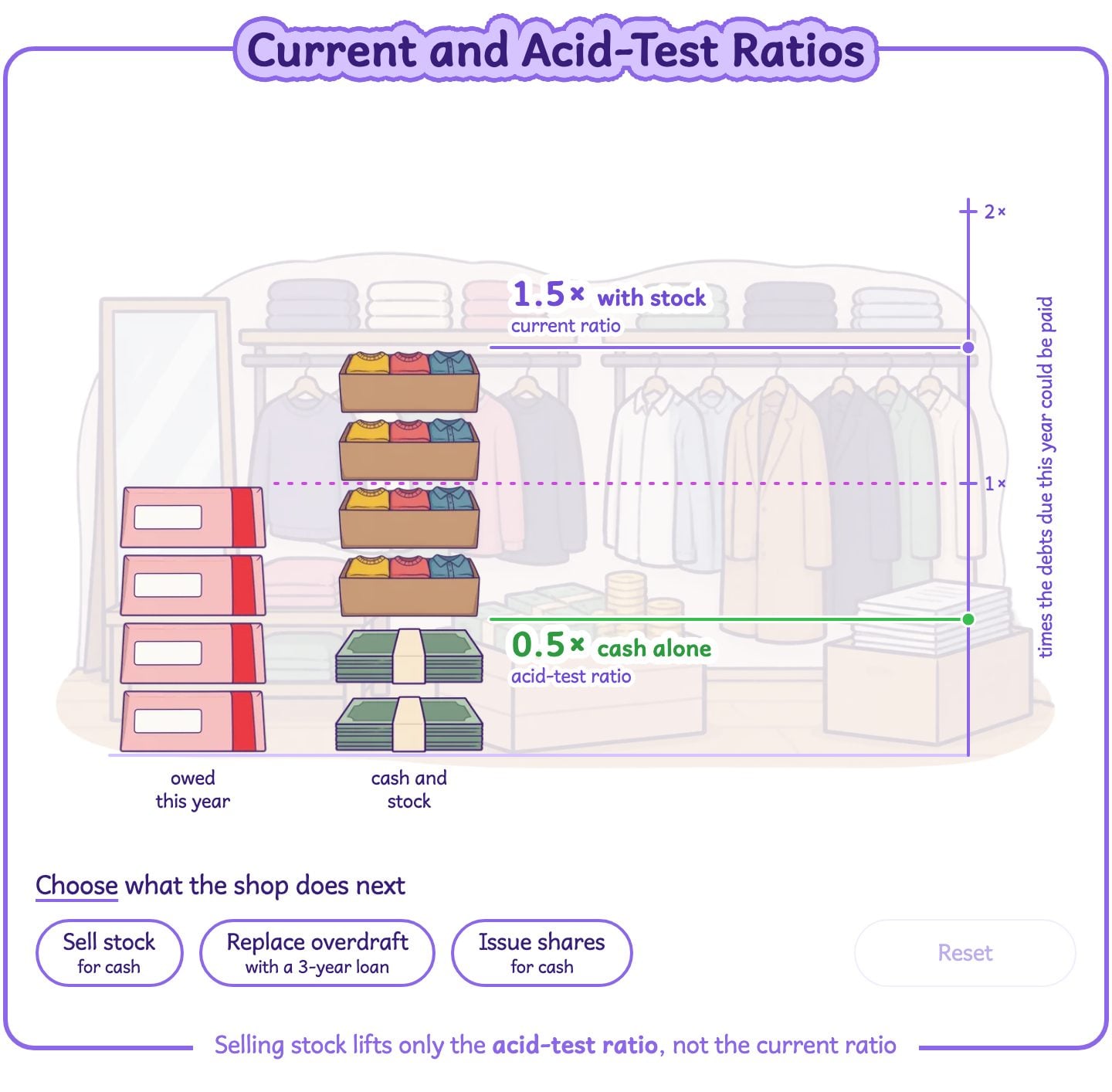
Sell inventories and watch the acid test ratio rise while the current ratio stays the same.
What the statement cannot tell you
- It reports a single date, so a company can arrange its affairs to look strong on 31 March and be deep into its overdraft a fortnight later.
- It shows no revenue and no profit, so it cannot say whether the year's trading was successful.
- Asset values are the amounts recorded in the books, and premises bought years ago may be worth far more or far less if they were actually sold today.
- The commonest error is treating this statement as a record of the year's profit, so check the heading: a date means position, a period means performance.
- Quote the printed figures, such as £50,000 of current liabilities, rather than writing about assets and liabilities in general terms.
- Why is a statement of financial position described as a snapshot?
- Using Meridian's figures, calculate its working capital.
- Which two amounts make up Meridian's £250,000 of capital and reserves?
- Why can Meridian not settle its current liabilities from cash and trade receivables alone?
- Give two drawbacks of selling inventories quickly to raise cash.