Inside or outside: the first division of finance
- The division matters because internal money is already the firm's own, so nobody has to be persuaded, no interest is charged and no share of the business is given away.
- Internal finance is limited by how much the firm has made and owns, so a business that has only just started or has been losing money has almost nothing to draw on.
- External finance can supply far larger sums, but the money comes with a price: interest to pay, security to give, or ownership to share.
Internal sources: using what the business already has
Definition
Internal source of finance: Money raised from inside the business itself, from its profits, its assets or its owner.
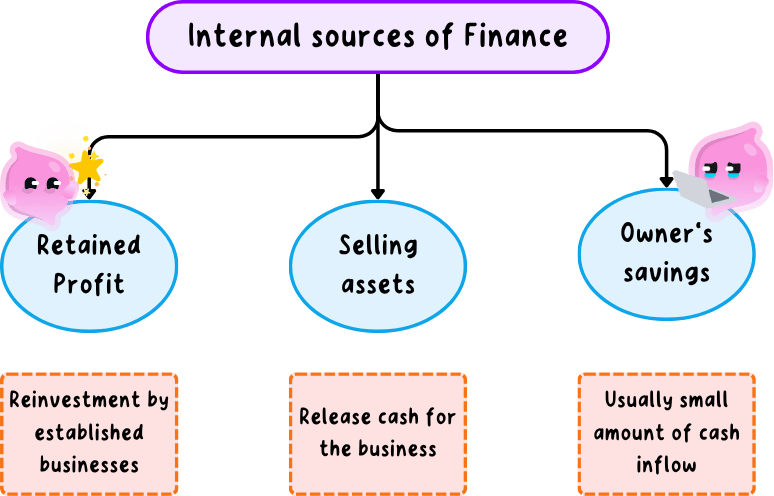
- There are four of them: profit the business has kept, assets it no longer needs, inventories it can run down, and the owner's own money.
Definition
Retained profit: The profit left in the business after tax has been paid and the owners have taken their share, kept to be used as finance.
- Retained profit costs nothing in interest and leaves the owners in full control, which makes it the cheapest finance a business can use.
- The catch is that money kept in the business is money not paid out to the owners, and a firm that has never made a profit has none to retain.
Common Mistake
- Retained profit is not free money, because every pound kept in the business is a pound the owners could have taken or invested somewhere else.
- Shareholders who see their dividend cut two years running may sell their shares, which pushes the share price down.
- Say it has no interest charge rather than no cost, because the cost is the use the money could have been put to instead.
Other internal sources: assets, inventories and the owner's savings
- Sale of unwanted assets: selling machines, vehicles or land the firm no longer uses turns idle items into cash without taking on any debt.
- It raises money only once, a buyer can take months to find, and a rushed sale usually fetches less than the asset is worth.
- Running down inventories: selling existing inventories without fully replacing them releases the cash that was sitting on the shelves, and it can be done within weeks.
- Thin inventories mean the firm runs out when demand rises, so customers go to a rival and some do not come back.
- Owner's own savings: personal money put into the business arrives immediately, carries no interest and keeps the owner in complete control.
- The amount is capped by what the owner happens to have, and a sole trader with unlimited liability is putting personal wealth at risk if the business fails.
Example
- A furniture maker needs £30,000 for a new saw and for extra timber to hold as inventories.
- It has £11,000 of retained profit and sells an unused delivery van for £4,000, so £15,000 comes from inside the business.
- The other £15,000 is a five-year bank loan, so only half the money raised carries any interest at all.
External sources: money from lenders, investors, suppliers and government
Definition
External source of finance: Money raised from outside the business, from lenders, investors, suppliers or the government.
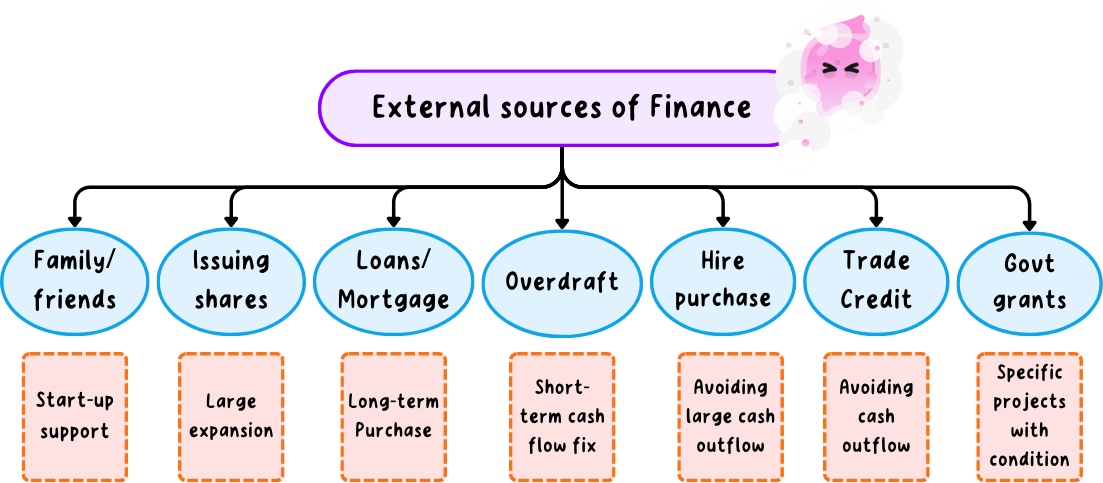
- Bank loan: a fixed sum borrowed and repaid in regular instalments with interest over an agreed number of years, normally secured on an asset.
- Overdraft: an agreed limit that lets the business take more out of its bank account than it has in it, with interest charged only on the amount actually overdrawn.
- Issuing shares: a limited company sells new shares to investors, raising money that is never repaid and carries no interest.
- Debt factoring: the business sells its unpaid customer invoices to a finance company, which pays most of the value at once and then collects from the customers itself.
- Trade credit: a supplier delivers goods now and is paid 30 or 60 days later, so the business can often sell the goods before it has to pay for them.
- Hire purchase: the business uses an asset straight away and pays for it in instalments, becoming its owner once the final instalment is made.
- Leasing: the business rents the asset for as long as it needs it and never owns it, with the leasing company usually responsible for repairs.
- Government grant: a sum given for an approved purpose, such as creating jobs in a particular area, which does not have to be repaid provided the conditions are met.
- Family and friends: money lent or invested by people who know the owner, usually arranged quickly and at little or no interest.
What external finance really costs
- Borrowed money has to be repaid whatever happens to sales, so interest becomes a fixed cost that raises the output the firm must sell each month just to break even.
- Lenders reduce their own risk by taking security over an asset, which means the bank can sell the owner's premises if repayments stop.
- Money raised by selling shares never has to be repaid, but each new share is a permanent claim on future profits and a vote on how the company is run.
- Sole traders and partnerships cannot use it at all, because only limited companies are allowed to issue shares.
- Aldi is family owned rather than listed on a stock exchange, so it pays for new stores out of retained profit and borrowing instead of selling shares to the public.
- Trade credit, hire purchase and leasing all let a firm use something before paying for it, which protects cash but means paying more in total than an outright purchase would cost.
- A delivery firm leasing its vans keeps its cash for wages and fuel, and hands the vans back for newer ones instead of being left with a fleet nobody wants to buy.
- Debt factoring and a government grant sit at opposite ends of the cost range, since the factor keeps a slice of every invoice it buys while the grant is never repaid and costs only the time spent applying and meeting its conditions.
Exam technique
- The word internal means from inside this business, so a loan from the owner's family or from a bank is external however friendly the lender is.
- A business that has only just started trading has no retained profit and no spare assets to sell, so neither internal source is open to it.
- Only limited companies are permitted to issue shares, so a sole trader or a partnership never has that source available.
Self review
- State the difference between an internal and an external source of finance.
- Name the four internal sources and one drawback of each.
- What does a business give up when it uses debt factoring?
- Why can a sole trader not raise finance by issuing shares?
- Give one reason a firm might lease a van rather than buy it.