Effective communication: received, understood and acted on
Effective communication: The passing of information between a sender and a receiver in which the message arrives in time, is understood as the sender intended, and is acted on.
- A message that was sent but not understood has not been communicated, so the test is what the receiver does next rather than what the sender said.
- Every part of a business runs on information from another part, so operations needs the sales forecast to plan output and finance needs cost data to set budgets.
- Timing matters as much as accuracy, because a correct sales figure that reaches the production manager a week late can no longer change the schedule.
- Communication uses management time and so has a cost, which is why the aim is the right information reaching the right people rather than the largest number of messages.
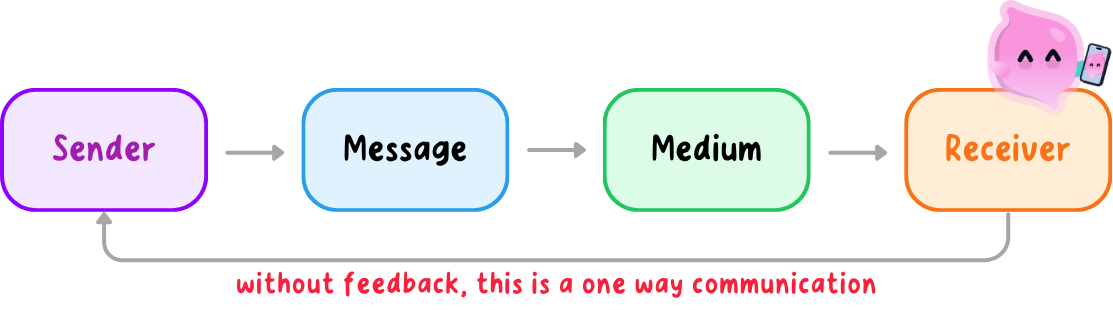
The communication model: sender, message, medium, receiver, feedback
Communication medium: The channel chosen to carry a message from sender to receiver, such as a face-to-face conversation, a phone call, a printed notice or an email.
Feedback: The receiver's reply to the sender, which shows whether the message arrived and was understood correctly.
- Sender: the person who holds the information and decides someone else needs it, such as an operations manager who knows machine 3 is off for repair on Tuesday.
- Message: the information itself, which must be complete enough to act on, so naming the day lets a supervisor rearrange shifts while warning of possible disruption does not.
- Medium: the channel chosen, and a poor choice wastes a good message, since a notice on a board reaches nobody who is on holiday or on nights.
- Receiver: whoever must act, so a safety warning sent to supervisors but not to the workers on the machine protects nobody.
- Feedback: the reply that closes the loop, without which the sender never learns the message failed until the work has been done wrongly.
- Greggs runs more than 2,000 shops, so a new breakfast deal has to reach every shop team before the advertising starts.
- Head office is the sender, the price and start date are the message, the company system each shop checks at opening is the medium, shop teams are the receivers, and managers confirming the tills are updated is the feedback.
Internal and external communication: who the message is for
Internal communication: Messages passed between people who work inside the same business, such as managers, departments and employees.
External communication: Messages passed between the business and people or organisations outside it, such as customers, suppliers, banks, shareholders and the government.
- Internal communication stays inside the business, such as a manager briefing a shift or a department sending production figures to finance.
- External communication goes to people outside it, such as an order to a supplier or a reply to a customer.
- External messages carry more risk because the receiver has no loyalty to the business, so a vague order brings the wrong goods and a careless reply sends the customer to a competitor.
One-way and two-way communication: whether the receiver can reply
One-way communication: Communication in which the message travels from sender to receiver and no feedback is expected or given.
Two-way communication: Communication in which the receiver replies to the sender, so the message can be questioned, checked and confirmed.
- One-way communication is fast and cheap per person, so it suits simple facts that many people need at the same moment, such as a change to opening hours.
- Its weakness is that the sender has no proof the message landed and no chance to correct a misunderstanding before it turns into a costly mistake.
- Two-way communication lets the receiver ask questions and say back what they have understood, so the sender finds out at once whether the message landed instead of discovering it when the work is delivered.
- It is slower and costs more management time, so the working rule is that the more a message affects people personally, the more feedback the business needs to build in.
- Do not treat two-way communication as automatically the better choice, because inviting discussion on a fixed change such as new opening hours only burns management time.
- The question is whether the receiver needs to check understanding or raise concerns, not whether the method sounds friendlier.
Why effective communication matters to the business
- Better decisions: a manager choosing an output level, a supplier or a price is only as good as the information that reaches them, so accurate figures arriving in time turn a guess into a judgement.
- The job is done right the first time. An instruction that carries the quantity, the date and the name of the person responsible leaves nothing to guess, so the wages and materials that would have gone into doing the work twice stay in the business.
- Departments stay coordinated. Operations can only meet a delivery date that sales has passed on, and finance can only budget from cost figures it has been sent, so the plan holds together only while information crosses those boundaries.
- Staff stay, and stay motivated. Employees who are told what is happening, and who can put a question and get an answer, do not have to work from rumour, so absence and labour turnover fall and less is spent replacing leavers.
- Customers and suppliers get one answer. A buyer quoted the same price by everyone they speak to, who then receives exactly what the order specified, comes back, and keeping a customer costs far less than winning a new one.
- Change meets less resistance. A new rota or a new till system is accepted far more readily when the reason has been explained and staff have been able to raise objections first, so the change takes effect sooner.
- An importance question is not answered by defining communication, so say what the business actually gains, such as a delivery date that is met or an order that does not have to be remade.
- Check who receives the message before labelling it internal or external, because the sender being inside the business tells you nothing.
- Feedback means evidence that the message was understood, not simply that the receiver was polite about it.
- Name the five parts of the communication model in order.
- What is the difference between internal and external communication?
- Give one situation in which one-way communication is the better choice, and say why.
- Explain two ways effective communication lowers a business's costs.
- Why does sending more messages not mean better communication?