Exchange rates: the price of one currency in another
Definition
Exchange rate: The price of one country's currency in terms of another, which decides how much foreign wages, materials and revenue are worth in pounds.
- A rate is always quoted as a pair of currencies, such as the pound against the euro, because a currency can only be priced in terms of another one.
- Rates move constantly, driven by how much of each currency people want for trade, travel, saving and investment.
- Two things follow for a business: the price its goods carry in a foreign market, and the pound cost of everything it buys from abroad.
- No business controls the rate, so exchange rate movements are part of the external environment a firm has to plan around.
Analogy
- Treat a currency like any other product with a price that rises and falls.
- When the pound becomes dearer, foreigners buy fewer British goods, and when it becomes cheaper British goods go on sale to the rest of the world without the seller changing a single price tag.
Depreciation and appreciation: which way has it moved
- Depreciation is usually described in the news as a weaker or falling pound, and appreciation as a stronger or rising pound.
- The single test to apply is what one pound now buys: after a depreciation it buys less foreign currency than before, and after an appreciation it buys more.
- Every movement looks the opposite way round from the other country's side, so if the pound has fallen against the euro then the euro has risen against the pound.
- A currency can depreciate against one currency while appreciating against another, so the effect on a business depends on which countries it actually deals with.
Key Idea
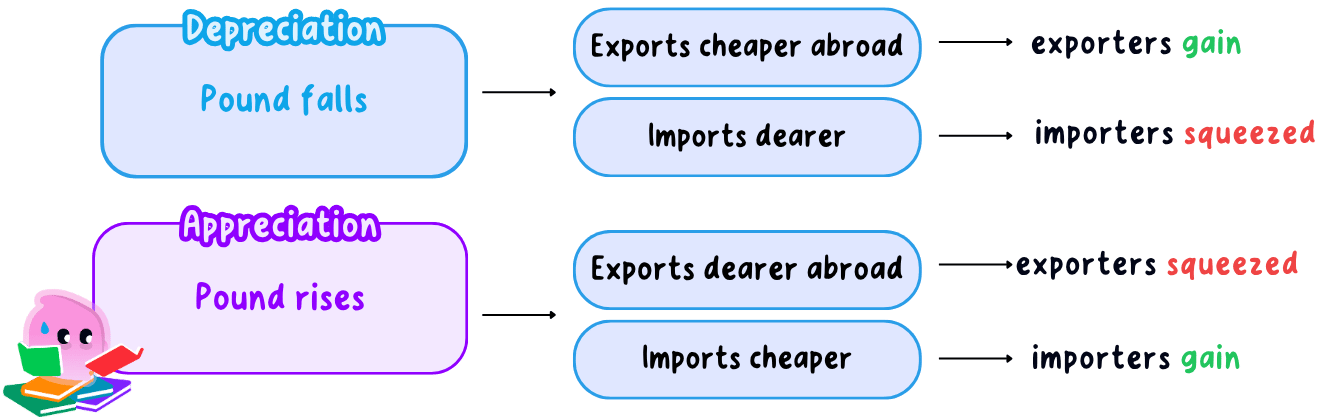
- SPICED keeps the direction straight: Strong Pound, Imports Cheaper, Exports Dearer.
- A weak pound is simply the mirror of it: British goods look cheaper to foreign buyers and foreign goods look dearer to us.
Depreciation: cheaper exports, dearer imports
Definition
Depreciation of an exchange rate: A fall in the value of a currency against another, so each unit of it now buys less foreign currency than before.
- Exports become cheaper abroad. A foreign customer paying in their own currency now has to give up less of it to buy the same British product.
- The exporter becomes more price competitive against producers already inside that market, so sales volume usually rises.
- A digger built at JCB's Staffordshire works becomes cheaper for a customer paying in dollars, without JCB touching its own price list.
- The alternative is to leave the foreign price where it was and take more pounds back on every sale, which lifts the profit margin rather than the volume.
- Imports become dearer. The overseas supplier still wants the same amount of its own currency, but paying that bill now takes more pounds.
- Higher input costs squeeze the profit margin unless the importer raises its own selling price to match, which risks losing customers.
- Primark, which buys much of its clothing from suppliers in Asia, sees the pound cost of every order rise even though nothing about the clothes has changed.
- A firm that imports materials and exports finished goods feels both effects together, so the net result depends on how much of each it does.
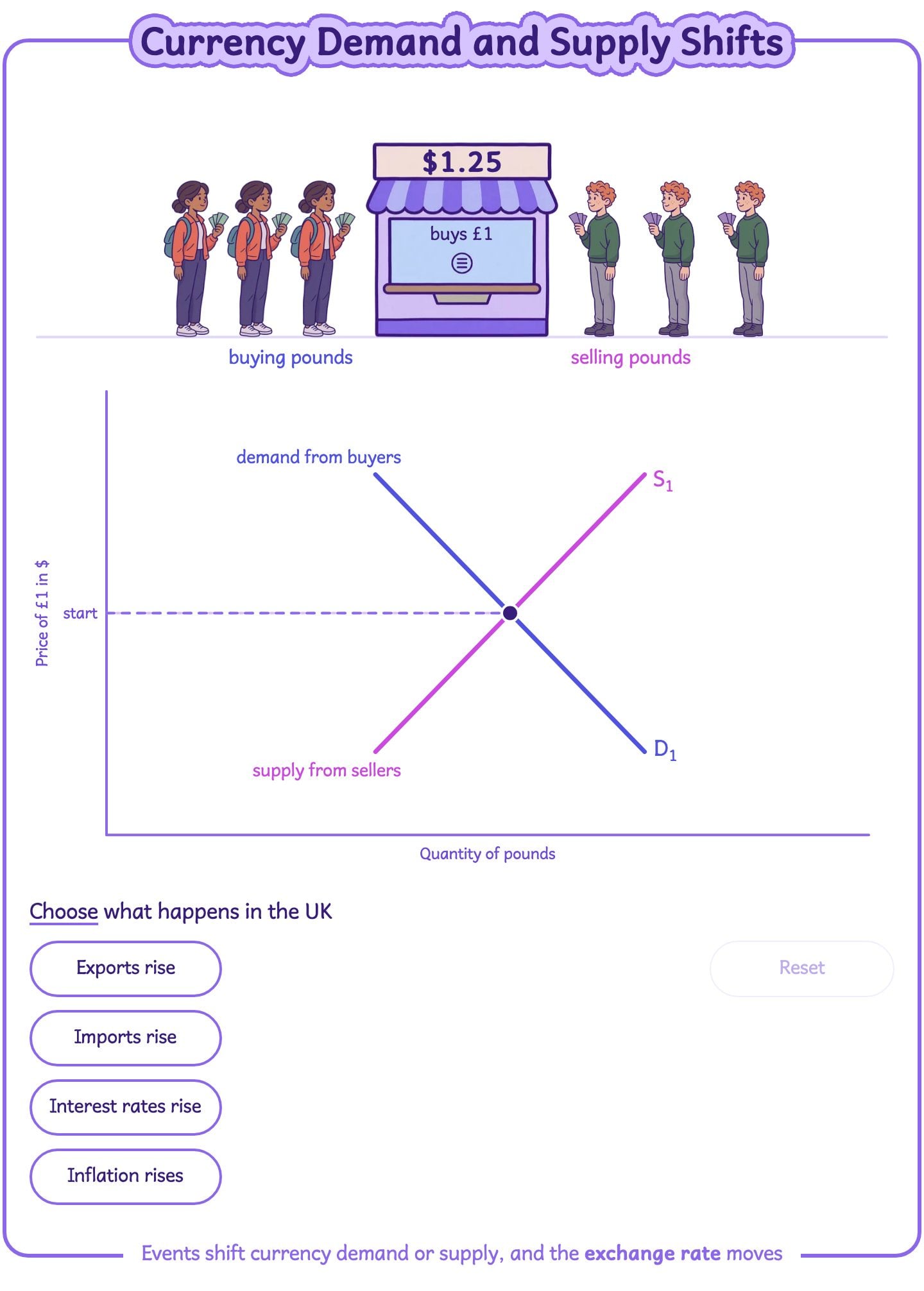
Shift currency demand or supply and watch the exchange rate fall, making exports cheaper and imports dearer.
Appreciation: dearer exports, cheaper imports
Definition
Appreciation of an exchange rate: A rise in the value of a currency against another, so each unit of it now buys more foreign currency than before.
- Exports become dearer abroad. The foreign buyer must now give up more of their own currency for exactly the same British product.
- The exporter is less price competitive, so orders fall as customers switch to local producers or to suppliers from a third country.
- The exporter can instead cut its pound price to hold the foreign price steady, which protects sales volume but reduces profit on every unit.
- Imports become cheaper. The same invoice from an overseas supplier is settled with fewer pounds than before.
- Lower input costs widen the profit margin, or free the business to cut its selling price and take market share.
- Domestic producers competing with imports face the opposite problem, since the imported rival on the shelf beside them has just become cheaper.
- Which effect dominates for a particular firm depends on the share of its costs paid in foreign currency and the share of its revenue earned overseas.
- Uncertainty is itself a cost, because a firm quoting a price today for delivery in six months cannot know what the rate will be when the payment finally arrives.
Note
- The syllabus states that exchange rate calculations will not be assessed, so you will never be asked to convert one currency into another here.
- What is assessed is the direction of the movement and what it does to a firm's prices, competitiveness and profitability.
Exam technique
- Do not write that a depreciation makes exports cheaper for the exporter, because the price falls for the foreign buyer while the exporter still takes the same pounds.
- Saying the exchange rate changed tells the reader nothing, so name the currency and the direction, such as the pound has depreciated against the dollar.
- The most common mistake is treating a strong pound as good news for every British business, when it helps importers and hurts exporters at the same time.
Self review
- What does it mean for an exchange rate to depreciate?
- If the pound appreciates, what happens to the price a foreign customer pays for a UK export?
- Why do an importer's costs rise when the pound depreciates?
- Give the two choices open to an exporter after the pound has depreciated.
- Why is a firm quoting a price today for delivery in six months exposed to a later movement in the rate?