1.5.1 Globalisation
Globalisation creates opportunities and threats for businesses
Globalisation: the increasing connections between countries as businesses trade, invest and operate across national borders.
- Improved communication, transport and international trade have made it easier for businesses to reach customers, suppliers and production locations in other countries.
A small UK toy producer may gain access to customers abroad through online marketplaces, but the same global links also allow overseas toy producers to compete for its customers in the UK.
Opportunities from globalisation
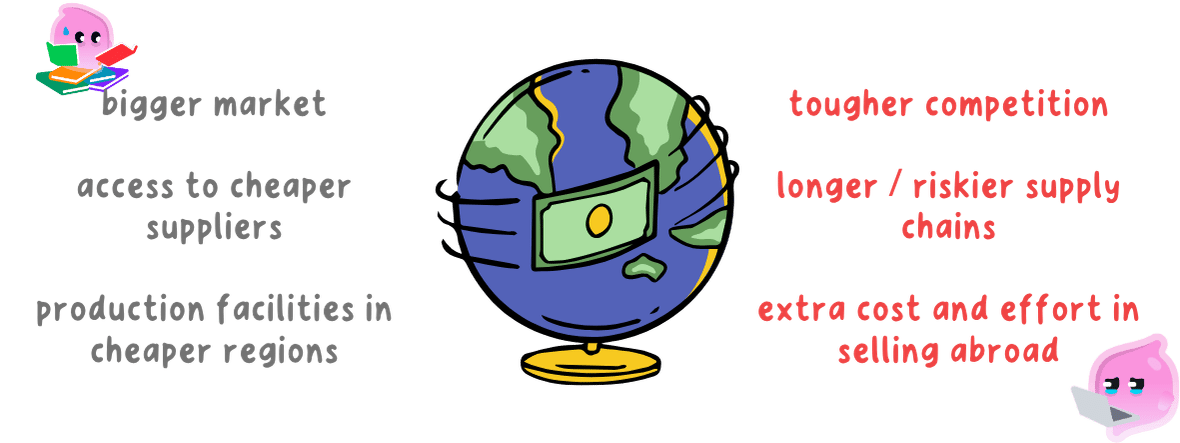
- Access to larger markets: businesses can sell to customers in more countries, increasing the potential size of the market and creating opportunities for higher sales.
- A digital business can make the same product available to customers in many countries without opening a physical store in each one.
- Access to lower-cost suppliers or production: businesses may source materials or locate production in countries where costs are lower, helping them reduce unit costs or remain price-competitive.
- A clothing business may source fabric or manufacture garments abroad if doing so lowers its costs while maintaining the required quality.
- Access to a wider range of resources and knowledge: businesses can work with suppliers, employees and partners in different countries, giving access to skills, materials or ideas that may not be as readily available at home.
Threats from globalisation
- Greater competition: domestic businesses can face competitors from other countries, putting pressure on prices, quality, customer service and market share.
- A local manufacturer may lose customers if imported products offer a similar quality at a lower price.
- Longer and riskier supply chains: relying on overseas suppliers can increase the distance, time and complexity involved in obtaining materials and expose the firm to disruption in other countries.
- Extra cost and complexity when selling abroad: businesses entering foreign markets may have to adapt products, promotion or distribution and deal with unfamiliar laws, languages and customer preferences.
The effect depends on the business
- A competitive business may be able to use globalisation to reach more customers and reduce costs. A less efficient business may be more exposed to international competitors that can offer lower prices or better products.
- The same feature can create both an opportunity and a threat. Easier international trade allows a business to enter foreign markets, but also makes it easier for foreign firms to enter its home market.
For this topic, avoid treating globalisation as automatically positive or negative. Use the business in front of you to decide whether larger markets and lower costs outweigh stronger competition and international risk.
- What is globalisation?
- Give two opportunities globalisation can create for a business.
- How can globalisation increase competition for a domestic business?
- Why can an international supply chain be riskier than a local one?
- Why might globalisation help one business but threaten another?
1.5.2a Benefits of becoming a multinational
Becoming a multinational can give a business access to larger markets and lower costs
Multinational: a business that owns or controls business operations in more than one country, such as factories, offices or stores. Merely exporting to customers abroad does not by itself make a business multinational.
- A business may become multinational when locating activities abroad gives it advantages that are difficult to achieve from its home country alone.
A car producer may manufacture inside several major markets so it can serve local customers directly, reduce some transport costs and avoid tariffs that would apply to imported cars.
Benefits to the business
- Access to larger markets: operating in more countries gives the business access to more potential customers, creating opportunities to increase sales and revenue beyond what the home market alone can provide.
- A business with a successful product can continue growing by entering countries where there is still a large untapped customer base.
- Lower production costs: production may be located where labour, land, energy or other inputs are cheaper, reducing the cost of making each unit.
- If lower labour costs reduce the cost per unit, the business may gain a larger profit margin or be able to lower its selling price.
- Economies of scale: serving several countries can increase total output, allowing some average costs to fall as the business operates on a larger scale.
- Access to raw materials: locating operations near important natural resources or suppliers can improve access to inputs and reduce the distance some materials need to travel.
- Reduced trade barriers: producing within a country or trade bloc may avoid tariffs that would otherwise be charged on imports, helping the firm's products remain price-competitive.
- Spreading market risk: sales are spread across different countries, so weak demand in one market may be partly offset by stronger demand elsewhere.
This article is about benefits to the business itself; jobs, tax revenue and other effects on the host country belong to the separate host-country article.
Why the benefits vary between businesses
- The value of each benefit depends on the firm. A manufacturer using large quantities of imported raw materials may gain strongly from locating near those inputs, while a digital service business may gain more from access to new customers than from production-cost savings.
- The size of the potential foreign market also matters. Entering another country creates little benefit if demand is weak, but can transform growth if the product has a strong market there.
- What is a multinational?
- Give three benefits to a business of becoming a multinational.
- How can locating production abroad reduce costs?
- How can becoming multinational help a business reduce trade barriers?
- Why can operating in several countries spread market risk?
1.5.2b Impact on host country/economy
A multinational can bring both benefits and drawbacks to its host country or economy
Host country: a country where a multinational has business operations such as factories, offices or stores.
- The impact on the host country depends on what the multinational does there, how many people it employs, how much it buys locally and whether the wider economic benefits outweigh the costs.
A global retailer opening stores in a country may create jobs and increase customer choice, but local retailers can lose sales if they cannot compete with its prices or scale.
Benefits to the host country or economy
- Employment and incomes: the multinational can employ local workers, reducing unemployment and providing incomes that are then spent in other local businesses.
- A new factory may create direct jobs inside the plant and additional demand for transport, maintenance, catering and other local services.
- Skills and technology: training, management methods and production technology introduced by the multinational can increase the skills and experience available in the host economy.
- Tax revenue: taxes paid by the business and its employees can provide government revenue that can be used for public services and infrastructure.
- Investment and economic activity: building factories, offices or stores brings investment into the country, increases output and can create orders for local suppliers.
- Exports can increase: if the multinational produces goods in the host country and sells them abroad, the host economy gains additional export activity.
Possible drawbacks to the host country or economy
- Pressure on local businesses: a large multinational may have lower costs, a recognised brand or greater buying power, making it difficult for smaller domestic firms to compete.
- If local businesses lose enough customers, some may reduce employment or close, offsetting part of the employment benefit created by the multinational.
- Profits may leave the host economy: some profit may be returned to owners or the head office in another country instead of being retained and spent in the host economy.
- Working conditions or environmental damage can be concerns: multinational activity may create costs if working practices are poor, natural resources are heavily used or production causes pollution and waste.
- The host area can become dependent on the multinational: if a major employer later closes or moves production elsewhere, the area can lose many jobs, supplier contracts and incomes at the same time.
The overall effect depends on the balance
- A multinational is more likely to create a strong net benefit when it creates secure jobs, trains workers, buys from domestic suppliers and invests for the long term.
- The benefits may be smaller when the jobs are insecure, few inputs are bought locally, profits are mainly sent abroad or the multinational causes significant damage to domestic firms or the environment.
Keep the viewpoint straight. Jobs, skills, tax revenue and effects on local firms are host-country effects; larger markets and lower production costs are benefits to the multinational itself.
- Give three benefits a multinational can bring to a host country or economy.
- How can a multinational harm local businesses?
- Why can profits leaving the host country be a drawback?
- Give one possible social or environmental drawback.
- What factors would make the overall impact on a host country more positive?
1.5.3 Exchange rate calculation
Exchange rates convert the value of one currency into another
Exchange rate: the price of one currency in terms of another currency, for example £1 = $1.25.
- Start by reading which currency is written as the single unit in the quotation, because that tells you what the rate means.
- Do not memorise a multiply-or-divide rule without reading the quotation first.
- If the exchange rate is written the other way round, the operation changes.
Pounds to dollars: multiply when £1 is the single unit
- If £1=$1.25\pounds1 = {\char36}1.25£1=$1.25, multiply a pound amount by 1.251.251.25 to find the dollar value.
- Convert £200\pounds200£200 into dollars when £1=$1.25\pounds1 = {\char36}1.25£1=$1.25.
Dollars to pounds: divide by the dollars-per-pound rate
- Using the same quotation, divide a dollar amount by 1.251.251.25 to convert it into pounds.
- Convert $500{\char36}500$500 into pounds when £1=$1.25\pounds1 = {\char36}1.25£1=$1.25.
Businesses use the same conversion for export prices and import costs
- A UK exporter prices a machine at £8,000\pounds8{,}000£8,000 when £1=$1.25\pounds1 = {\char36}1.25£1=$1.25, so the US customer sees a price of $10,000{\char36}10{,}000$10,000.
- A UK importer buys $4,000{\char36}4{,}000$4,000 of components at the same rate, so the cost is £3,200\pounds3{,}200£3,200.
A sense check can catch a conversion in the wrong direction
- At £1=$1.25\pounds1 = {\char36}1.25£1=$1.25, one pound is worth more than one dollar, so a pound amount should become a larger numerical dollar amount.
- At the same rate, a dollar amount should become a smaller numerical pound amount.
- If the rate is quoted as $1=£0.80{\char36}1 = \pounds0.80$1=£0.80, work from that quotation instead of applying the earlier rule mechanically.
- What is an exchange rate?
- If £1=$1.30\pounds1 = {\char36}1.30£1=$1.30, how many dollars is £100\pounds100£100?
- If £1=$1.30\pounds1 = {\char36}1.30£1=$1.30, how many pounds is $260{\char36}260$260?
- How do you decide whether to multiply or divide by the quoted exchange rate?
- What sense check can you use after a pounds-to-dollars conversion?
1.5.4 Impact of exchange rate changes
Exchange rate changes affect international competitiveness, importers and exporters
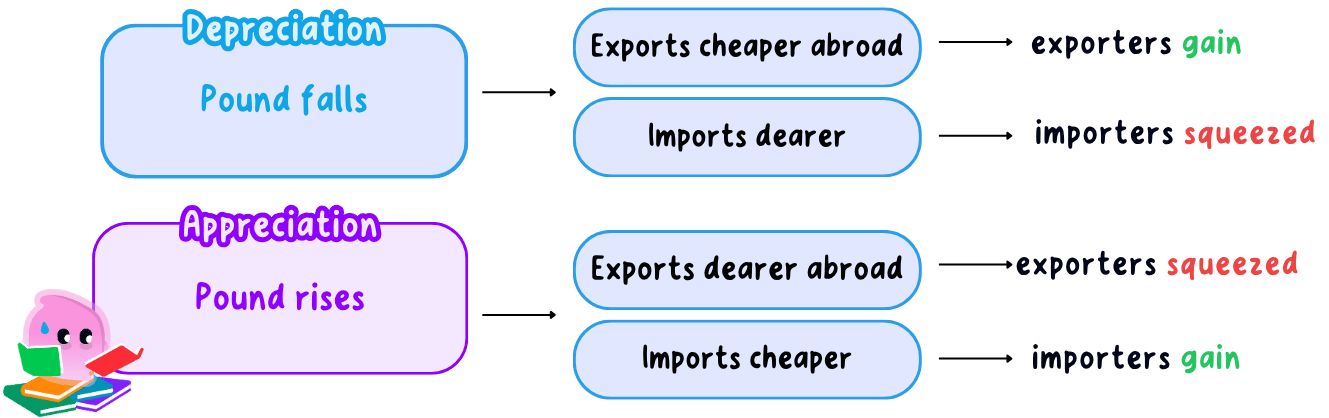
Appreciation: a rise in the value of a currency against another currency.
Depreciation: a fall in the value of a currency against another currency.
- An exchange rate change alters what overseas customers pay for exports and what domestic businesses pay for imports. This can change competitiveness even when the business has not changed its own price.
A weaker home currency
- Exports become more competitive: when the home currency depreciates, a product priced in the home currency becomes cheaper for overseas buyers if the business keeps its home-currency price unchanged.
- A UK exporter may therefore gain more overseas orders because foreign customers see a lower price compared with competing products.
- Import costs rise: imported materials and finished goods become more expensive in the home currency, increasing costs for businesses that rely on overseas suppliers.
- A UK manufacturer importing components may pay more pounds for the same order, which can reduce profit unless it cuts other costs or raises its selling price.
A stronger home currency
- Exports become less competitive: when the home currency appreciates, products priced in that currency become more expensive for overseas customers, which can reduce export demand.
- Import costs fall: overseas goods and materials become cheaper in the home currency, reducing costs for importers.
- An importer may keep the saving as higher profit or lower its own prices in an attempt to increase sales.
The same exchange rate movement can help and harm one business
- Some businesses both import inputs and export finished products. A weaker home currency may make their exports more competitive at the same time as increasing the cost of imported materials.
- The overall effect depends on how much of the firm's costs come from imports and how important overseas sales are to its revenue.
- Demand also matters. An exchange-rate movement can change the overseas price, but the size of the sales response depends on how willing customers are to switch between competing products.
Identify two things before judging the effect: whether the home currency strengthened or weakened, and whether the business mainly imports, exports or does both.
- What is currency depreciation?
- How can a weaker home currency affect an exporter?
- How can a weaker home currency affect an importer?
- How can a stronger home currency affect international competitiveness?
- Why can the same exchange-rate change create both a benefit and a cost for one business?