Calculating break-even output from given data
Definition
Break-even output: The number of units a business must produce and sell for total revenue to cover total costs exactly, found by dividing fixed costs by contribution per unit.
- The formula is break-even output=fixed costs÷contribution per unit\text{break-even output} = \text{fixed costs} \div \text{contribution per unit}break-even output=fixed costs÷contribution per unit.
- It works because the fixed costs are a set number of pounds and each unit sold chips away at them by exactly one contribution.
- A city-centre café sells sandwiches at £3.20, uses £1.20 of bread, filling and packaging in each one, and pays £1,000 a month in rent, rates and insurance.
- Contribution per unit=£3.20−£1.20=£2.00\text{Contribution per unit} = £3.20 - £1.20 = £2.00Contribution per unit=£3.20−£1.20=£2.00.
- Break-even output=£1,000÷£2.00=500\text{Break-even output} = £1{,}000 \div £2.00 = 500Break-even output=£1,000÷£2.00=500 sandwiches a month.
- The same point can be expressed in £ of sales, since 500×£3.20=£1,600500 \times £3.20 = £1{,}600500×£3.20=£1,600 of revenue.
- Total costs at that output come to £1,000+(£1.20×500)=£1,600£1{,}000 + (£1.20 \times 500) = £1{,}600£1,000+(£1.20×500)=£1,600, which confirms that the two sides balance.
- Interpreted, 500 sandwiches a month is roughly 17 a day, a target the manager can check against what the counter actually sells on a normal lunchtime.
- On its own the figure says nothing about whether the café is safe, because a break-even output only means something once it is set against the sales the business expects.
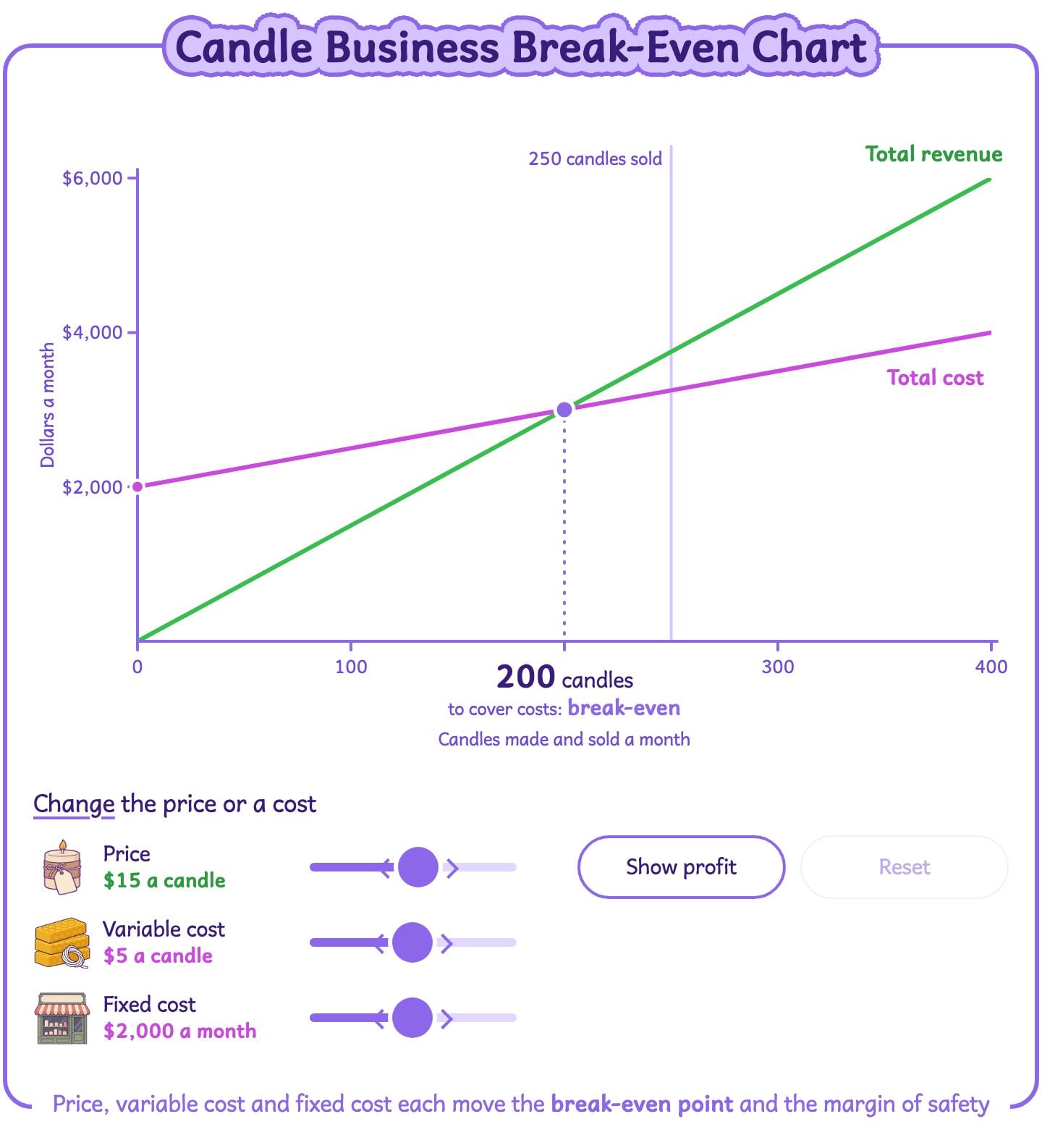
Change price, variable cost or fixed cost and watch break-even output and the margin of safety move.
Margin of safety: the cushion before losses start
Definition
Margin of safety: The amount by which expected sales exceed the break-even output, showing how far sales can fall before the business makes a loss.
- The formula is margin of safety=expected sales−break-even output\text{margin of safety} = \text{expected sales} - \text{break-even output}margin of safety=expected sales−break-even output.
- The café expects to sell 800 sandwiches a month, so 800−500=300800 - 500 = 300800−500=300 sandwiches.
- In money that cushion is 300×£3.20=£960300 \times £3.20 = £960300×£3.20=£960 of sales revenue.
- Interpreted, sales could fall by 300 sandwiches, which is 300÷800=37.5%300 \div 800 = 37.5\%300÷800=37.5% of expected trade, before the café stopped covering its costs.
- Those 300 sandwiches beyond break-even are also where the profit comes from, since 300×£2.00=£600300 \times £2.00 = £600300×£2.00=£600 of contribution is left once the £1,000 of fixed costs has been paid.
- A café in a quieter street expecting only 550 sandwiches would have a margin of just 50, under a tenth of its expected sales, so one wet week or one new rival could tip it into loss.
Common Mistake
- Break-even output is a minimum to clear, not a target to aim at, because a business that hits it exactly has worked a whole month for nothing.
- Both answers are numbers of units unless the question asks for £, in which case multiply by the selling price.
- The margin of safety is not the profit, because profit is the margin multiplied by contribution per unit, never by the selling price.
Reading the two numbers together
- Break-even output states what the business needs to sell, while the margin of safety states how much room it has above that need.
- The same 500 sandwiches a month is a comfortable target beside a busy office block and an impossible one in a quiet village, so the figure has to be judged against the market.
- A wide margin of safety means the business can absorb a wet summer, a new competitor or a lost contract and still cover its costs.
- A narrow margin says the fixed costs are heavy for the trade the business does, and the three ways of widening it are lifting sales, raising contribution per unit and cutting fixed costs.
- Banks read the pair the same way, which is why both appear in the financial section of a business plan before a loan is agreed.
Exam technique
- Dividing fixed costs by the selling price instead of by contribution is the classic wrong answer, so work out the contribution first and label it before dividing.
- Subtract in the right order for the margin of safety, because break-even taken away from expected sales gives the cushion and the other way round gives a meaningless negative.
Self review
- State the formula for break-even output.
- Fixed costs are £900, the price is £5 and the variable cost is £2, so what is the break-even output?
- The same firm expects to sell 400 units, so what is its margin of safety in units and in £ of sales?
- Why does a business with a lower break-even output have a wider margin of safety at the same expected sales?
- Explain what a small margin of safety tells you about a business's position.